Jason was the first person at the table to recognize me.
He leaned toward the television.
“Erica.”
His wife looked up.
“What?”
“That’s Claire.”
My father’s hand stopped halfway to his wineglass.
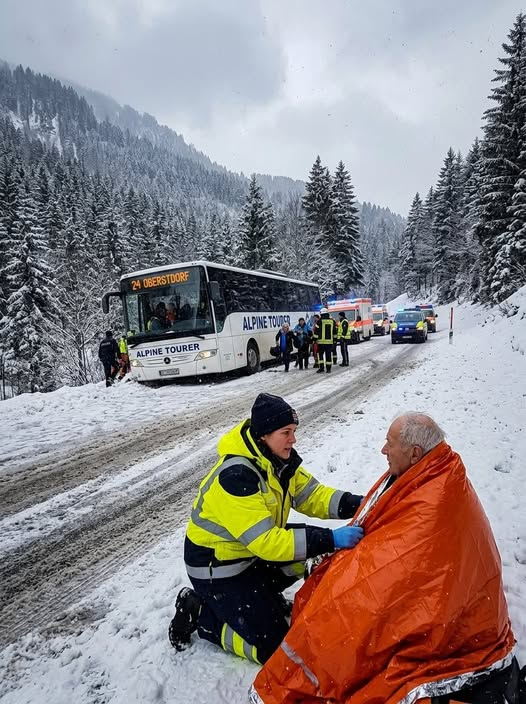
On the screen, snow whipped across the highway while soldiers and state responders moved passengers away from the overturned bus.
Then the anchor’s voice filled the dining room.
“Officials are crediting Major Claire Morgan and her Army team with helping coordinate the evacuation of nearly forty stranded passengers during one of the most dangerous stretches of tonight’s storm.”
My father’s wineglass slipped from his fingers.
It hit the table.
Red wine spread across my mother’s old white tablecloth.
Nobody moved.
The broadcast continued.
A state trooper appeared on camera.
“She kept people calm, kept teams organized, and made sure no one was forgotten.”
Then came the footage of Walt being brought away from the damaged tanker.
The reporter added:
“Several responders emphasized that Major Morgan had originally volunteered for Christmas Eve duty so younger soldiers with children could spend the holiday with their families.”
Jason slowly turned toward my father.
“You told her not to come.”
The room went silent.
Erica looked between them.
“What?”
My father reached for a napkin.
“Jason, not now.”
“No.”
Jason pushed his chair back.
“You told Claire not to come because of me?”
His wife’s parents were staring.
So were the cousins.
My father’s face hardened.
“I was trying to make tonight comfortable.”
“For who?”
“Jason.”
My father lowered his voice.
“You’ve worked hard for your promotion. Tonight was supposed to be about your new marriage, your career—”
Jason laughed.
Not happily.
“I got promoted to regional sales manager.”
My father stared at him.
“So?”
“So Claire is a Major in the United States Army.”
He pointed toward the television.
“She just spent Christmas Eve helping pull people out of a blizzard.”
Then his voice became quieter.
“Why exactly did you think I needed protection from my own sister?”
My father said nothing.
That was the moment something ugly became visible.
There had never been a competition between Jason and me.
At least not one either of us had created.
My father had.
For years, whenever I achieved something, he softened it around Jason.
Whenever Jason achieved something, he made sure I knew how proud everyone was.
I had assumed Jason wanted it that way.
Apparently Jason had assumed the same about me.
Erica looked at her husband.
“Did you know Claire was supposed to be here?”
“No.”
Then Jason turned back to Dad.
“You told me she couldn’t get leave.”
My father’s face changed.
So that was the story he had told.
He had removed me from Christmas and replaced me with a convenient excuse.
My phone rang shortly after midnight.
Dad.
I looked at the screen.
Didn’t answer.
It rang again.
Then Jason.
I answered that one.
“Hey.”
For several seconds, he said nothing.
Then:
“Are you okay?”
I looked around the operations room.
Alvarez was arguing with a vending machine.
Someone had found stale cookies.
Outside, the storm still covered everything in white.
“I’m tired.”
“I saw the news.”
“I figured.”
Another silence.
Then Jason said:
“Dad told you not to come because of me.”
It wasn’t a question.
“Yes.”
He exhaled sharply.
“I didn’t know.”
“I know that now.”
“I would never ask him to do that.”
“I know.”
His voice changed.
“Claire, I’m sorry.”
“You didn’t do anything.”
“I let him make me think you didn’t care.”
That caught me off guard.
“What?”
Jason laughed bitterly.
“Every time you missed something, Dad said the Army mattered more than family.”
My chest tightened.
“He told me you thought my job was a joke.”
“I never said that.”
“I know.”
Now we both did.
I sat down.
For years, my father had translated us to each other.
And apparently he had never used the correct language.
Jason said:
“Erica’s parents asked why you weren’t here.”
“What did Dad say?”
“That you couldn’t get leave.”
I closed my eyes.
Then Jason added:
“I told everyone the truth after the broadcast.”
I opened them again.
“You did what?”
“I said Dad asked you not to come.”
“Jason.”
“What? He did.”
I almost laughed.
He continued:
“Then Aunt Marianne asked why.”
I could imagine my father’s face.
“What did you say?”
“The truth again.”
This time I did laugh.
It came out exhausted and quiet.
Jason said:
“Dad is furious with me.”
“Welcome to the club.”
For the first time in years, my stepbrother and I laughed together.
Before hanging up, he said:
“Next Christmas, if you’re free, you come because I want you there.”
My throat tightened.
“Okay.”
“Not because Dad says so.”
“I understood.”
“Good.”
Then he paused.
“And Claire?”
“Yeah?”
“I’m proud you’re my sister.”
I didn’t know how badly I had needed to hear that until he said it.
My father called six more times that night.
I answered none of them.
The next morning, he sent a text.
Call me when you’re done proving your point.
I stared at it.
Then deleted it.
That sentence told me everything.
Even after seeing the rescue, he still thought my life was somehow directed at him.
My rank was a point.
My service was a point.
My absence from Christmas was a point.
He could not imagine that sometimes I simply existed without performing for his approval.
Three days later, the Army public affairs office notified me that state officials wanted to formally recognize everyone involved in the rescue.
Not me alone.
Everyone.
The soldiers who worked the bus.
The medics.
State patrol.
Firefighters.
Dispatchers.
Dozens of people had made the outcome possible.
That mattered to me.
The story had already begun turning me into the face of the rescue.
I hated that.
So during the small press event, when a reporter asked what I had been thinking that night, I answered:
“I was thinking about the people who needed help and the soldiers beside me doing their jobs.”
Then I named Alvarez.
The medics.
The two young soldiers whose holiday shifts I had covered.
The state responders.
I made sure the story became ours.
My father watched the interview.
I know because he finally left a voicemail.
This time, he didn’t sound angry.
“Claire…”
A long pause.
“I saw the ceremony.”
Another.
“I handled Christmas badly.”
Badly.
Still not the word I would have chosen.
“I thought I was keeping peace between you and Jason.”
He sighed.
“I may have misunderstood some things.”
May have.
I deleted that message too.
Then, one week later, Jason flew to Colorado.
He didn’t come to the base unannounced.
He called first.
We met at a diner halfway between the airport and my apartment.
He walked in carrying a battered plastic container.
“What is that?”
“Christmas pie.”
I stared at him.
“You brought week-old pie across state lines?”
“Erica froze it.”
“That somehow makes it worse.”
He laughed.
For two hours, we talked.
Really talked.
Not about who had accomplished more.
Not about Dad.
About his marriage.
My deployments.
His job.
My plans after the Army.
The way our family had somehow convinced two adults who barely disliked each other that they were lifelong rivals.
At one point Jason said:
“You know what’s messed up?”
“What?”
“I spent years thinking Dad was disappointed in me because I wasn’t you.”
I stared at him.
He continued:
“And apparently you spent years thinking he wished you were more like me.”
I nodded slowly.
Jason laughed without humor.
“He managed to make both kids feel second.”
That sentence stayed with me.
Two months later, my father finally came to Colorado.
He asked for dinner.
I agreed.
Not because everything was forgiven.
Because I wanted to hear what he would say without Christmas guests, cameras or family around him.
He arrived early.
That alone surprised me.
For a while, we talked about nothing.
Then he put down his fork.
“I owe you an apology.”
I waited.
He looked directly at me.
“I should never have asked you not to come home.”
“No.”
“I was proud of Jason’s promotion.”
“You should be.”
“And I thought if you were there, people would compare you.”
I shook my head.
“They probably would have asked about both of us.”
“I know that now.”
“No.”
I leaned forward.
“You need to understand something else.”
He became still.
“Jason never asked you to protect him from me.”
My father looked down.
“I know.”
“And I never asked you to protect me from him.”
“I know.”
“You created a competition and then punished both of us for participating in it.”
His face tightened.
That one landed.
Then I said:
“When I missed holidays because of duty, you told Jason I chose the Army over family.”
His eyes lifted.
“When Jason achieved something, you told me not to make everything about my career.”
He opened his mouth.
I continued:
“You made each of us think the other one resented us.”
“I didn’t mean to.”
“I believe you.”
He looked relieved too quickly.
So I finished:
“But intentions don’t erase consequences.”
The relief disappeared.
For a long time, my father stared at his hands.
Then he said quietly:
“I think I needed Jason to need me.”
I hadn’t expected that.
He continued:
“You left at eighteen.”
“You built a life.”
“Every time you came home, you seemed more certain of yourself.”
His voice became strained.
“And Jason stayed closer.”
I understood.
Not excused.
Understood.
Dad had not been protecting Jason from my success.
He had been protecting himself from the fact that I no longer needed his approval to function.
“I’m still your daughter,” I said.
He nodded.
“But being your daughter doesn’t mean I’ll shrink myself so you feel more necessary.”
His eyes reddened.
“I know.”
This time, I believed he might actually mean it.
Our relationship didn’t heal over one dinner.
That would have been too easy.
But he stopped translating Jason to me.
Stopped comparing.
Stopped turning every achievement into a ranking.
The following Christmas, I had leave.
Jason hosted.
Not Dad.
Erica cooked too much food.
Her parents came.
Dad was there.
When I walked in, Jason shouted from the kitchen:
“Major Morgan! You’re late!”
I checked my watch.
“By three minutes.”
“Military standards are collapsing.”
I threw a napkin at him.
Dad laughed.
No one asked whose career mattered more.
No one needed to.
Later that evening, my father handed me a small envelope.
Inside was the canceled flight confirmation from the previous Christmas.
He had printed it.
On the back, he had written:
I’m sorry I made you feel like there was no seat for you at my table. There always should have been.
I folded it and put it in my pocket.
I didn’t cry.
Almost.
A year earlier, my father told me not to come home because my life might overshadow my stepbrother’s promotion.
So I canceled my flight.
Covered the overnight duty.
And spent Christmas Eve on a frozen highway with people who did not care about my family name, my childhood, or whether I made someone else feel smaller.
They only cared whether I showed up.
And strangely, that was what finally taught me the difference.
Family should never require you to dim yourself so someone else can shine.
Jason had never needed that from me.
The rivalry had never been ours.
And when the national anchor read my name while my father sat at the Christmas table he had asked me to avoid, the thing that slipped from his hand was not only a wineglass.
It was the story he had been telling himself for years—that excluding me was somehow an act of love.
After that night, I stopped accepting love that required my absence.
And for the first time, my father learned that if he wanted his daughter at the table—
he had to make room for all of her.
