“No.”
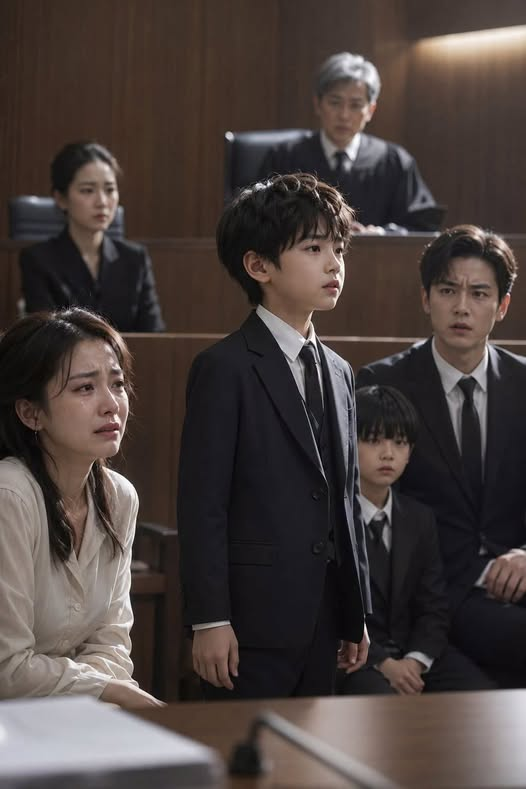
Liam pressed the old phone against his chest.
“This time everyone is going to hear the truth.”
Daniel’s face went white.
His attorney stood immediately.
“Your Honor, we have no idea what is on that device, how it was obtained, or whether a child has been coached—”
“I wasn’t coached!”
Liam’s voice cracked.
That broke me more than anything else.
He was nine.
He should have been worrying about soccer practice.
Not evidence.
Not custody.
Not whether one parent could make the other disappear.
The judge raised her hand.
“That is enough.”
Then she looked at my sons.
Her voice changed completely.
“Liam. Noah. Neither of you needs to prove anything else in this courtroom.”
Liam blinked.
“But the phone—”
“We will preserve it.”
She turned toward the child advocate.
“Please take both boys outside.”
Daniel stood.
“Your Honor—”
“Sit down, Mr. Whitman.”
He did.
No smile now.
No calm expression.
Liam looked at me before leaving.
“Mom?”
I forced myself to smile.
“You’re okay.”
“Are you mad?”
“No.”
“Promise?”
“I promise.”
Then I added the words he needed most.
“You do not have to save me.”
His eyes filled.
The boys left together.
Only then did the judge look at Daniel.
“Now we will find out why your nine-year-old son believed he had to.”
The phone was not played dramatically in court that morning.
It was examined first.
There were several recordings.
Some had been made accidentally after Daniel gave Liam the old device to play games.
Others had been recorded deliberately because Liam had become frightened.
One contained Daniel speaking to his brother in the study.
His voice was perfectly calm.
“Elena will lose control in court.”
His brother asked:
“How do you know?”
“Because she always does when she feels cornered.”
Then Daniel laughed.
“You push someone long enough, eventually they react. People only remember the reaction.”
I closed my eyes.
That sentence described ten years of marriage.
Another recording was worse.
Daniel was speaking directly to Liam.
“If you tell the judge you want your mother, things will become complicated.”
Liam’s tiny voice asked:
“Complicated how?”
“You might have to change schools.”
“And Mom?”
A pause.
Then Daniel said:
“If she keeps fighting me, she may not be part of your life the way she is now.”
No direct threat.
Nothing cinematic.
Worse.
A carefully planted fear.
A nine-year-old had heard:
Choose Dad or lose Mom.
Daniel’s attorney lowered her head when the recording ended.
Daniel said:
“I was explaining reality.”
The judge looked at him.
“No.”
“You were placing adult consequences on a child’s shoulders.”
For the first time, Daniel had nothing to say.
But the phone did not decide the case.
The investigation continued.
And slowly, the beautiful version of Daniel Whitman began to crack.
He had told the court that I routinely neglected meals.
School records showed the twins arrived every morning with packed lunches I had prepared.
Their pediatrician’s notes listed me as the parent who attended nearly every appointment.
The teacher remembered that I was the one who knew Noah developed stomachaches whenever he was anxious.
Daniel had claimed I isolated myself for days.
My therapist testified that after the separation, I had struggled emotionally but had consistently sought treatment and remained responsible for the children.
I did not deny crying.
I did not pretend I had been perfect.
That became important.
Daniel’s case depended on me being ashamed of every imperfect day.
So I stopped being ashamed.
“Yes,” I told the evaluator.
“There were nights I cried after they fell asleep.”
“Yes, once I stayed in my bedroom for most of a Saturday because I was overwhelmed.”
“No, they were not abandoned.”
“My sister came that morning.”
“We ate dinner together.”
“The boys were safe.”
Truth was less elegant than Daniel’s story.
But it held together.
His didn’t.
Then our former housekeeper, Maria, agreed to speak.
Daniel had told the court she left because I was “difficult.”
She had actually resigned after he repeatedly asked her to write down every time I became upset.
Maria produced the messages.
Document Elena’s behavior.
Especially raised voice, crying, missed meals.
Maria had replied:
Should I also record when you are away overnight?
Daniel never answered.
That message mattered.
So did another.
Mr. Whitman, the children ask where you are. What should I tell them?
His response:
Business.
There had been a lot of “business.”
Work dinners.
Trips.
Weekends.
Hours during which I was apparently too unstable to raise his children—
while somehow raising them almost completely alone.
Three months later, we returned for the final hearing.
Liam and Noah were not in the courtroom.
I had asked that they not be.
Their child advocate spoke for them.
Both wanted their primary home with me.
Both also wanted to see Daniel.
That last part seemed to surprise him.
He looked down.
Perhaps he had spent so long thinking custody was something to win that he forgot children could love the parent who frightened them.
The judge’s decision was careful.
I received primary residential custody.
Daniel received regular parenting time, initially with additional family support and clear rules.
No discussing litigation with the boys.
No asking them to report on me.
No threatening changes in school, money, travel or access to either parent based on what they said.
The judge looked directly at Daniel.
“You have repeatedly emphasized what you can provide financially.”
She paused.
“A large house is valuable.”
“So is tuition.”
“So are opportunities.”
“But children also need permission to love both parents without fear.”
Daniel’s face tightened.
She continued:
“Your sons should never again believe affection for their mother is disloyalty to their father.”
I cried quietly.
Not because I had won.
Because someone had finally said aloud what I had been unable to explain.
Outside court, Daniel approached me.
His attorney stayed behind.
“You got them.”
I looked at him.
“They are not property.”
His jaw clenched.
“You know what I mean.”
“I do.”
“That’s the problem.”
He looked toward the doors through which the boys would later leave with the advocate.
Then he whispered:
“Liam recorded me.”
“Yes.”
“My own son.”
I stared at him.
“No, Daniel.”
He looked at me.
“Your son became afraid enough of you that he believed adults would only believe him if he had proof.”
His face changed.
“That is not his betrayal.”
“It is your consequence.”
Then I walked away.
The first year after the ruling was difficult.
Daniel tried to buy normality.
New bicycles.
Expensive electronics.
A holiday he had never discussed with me.
The parenting counselor finally told him:
“Your sons do not need compensation. They need predictability.”
Something changed after that.
Slowly.
He began arriving on time.
He learned Noah’s medication schedule instead of asking his assistant to remember it.
He attended Liam’s school play and sat in the third row without trying to reserve the best seats.
Most importantly, he stopped asking:
“What did Mom say?”
Instead he asked:
“How was your week?”
Small difference.
Enormous effect.
One evening, Liam returned from Daniel’s house unusually quiet.
I worried.
“What happened?”
He shrugged.
“Dad apologized.”
My chest tightened.
“For what?”
“For making me think I had to choose.”
I sat beside him.
“What did you say?”
“Nothing.”
Then Liam looked at me.
“Mom, am I allowed to forgive him?”
The question nearly destroyed me.
I pulled him close.
“Of course.”
“You won’t be sad?”
“No.”
“You’re sure?”
I kissed his forehead.
“Loving your father is not betraying me.”
His shoulders finally relaxed.
That was the day I felt we had actually won something.
Not court.
Freedom.
I rebuilt too.
Before the twins, I had worked in marketing.
I started again at thirty-seven.
My first position was junior enough to bruise my pride.
I took it anyway.
I learned new software.
Sat in meetings with people ten years younger than me.
Made mistakes.
Got promoted.
Our apartment remained small for two years.
The twins shared a bedroom and complained constantly.
Then one day Liam said:
“Mom, I kind of like it.”
Noah threw a sock at him.
Normal.
Beautifully normal.
By the time they were thirteen, I was managing client accounts and could afford a three-bedroom apartment.
No mansion.
No marble staircase.
But both boys had keys.
Both knew where home was.
When Liam was fourteen, we found the old phone while moving boxes.
He held it up.
“Whoa.”
I recognized it instantly.
His smile disappeared.
“Do you remember?”
“Yes.”
He sat on the floor.
“I thought this saved you.”
I sat beside him.
“It helped people understand what was happening.”
“That means it did.”
“Not alone.”
He frowned.
I continued:
“Your teacher spoke.”
“Maria spoke.”
“Doctors spoke.”
“I spoke.”
“Noah spoke.”
“Your dad’s own records mattered.”
“The court looked at everything.”
Then I took his hand.
“You were never responsible for rescuing me.”
He looked down.
“But I wanted to.”
“I know.”
“That’s why I’m sorry you ever felt you had to.”
His eyes filled.
Then he asked:
“Can we throw it away?”
I smiled.
“Yes.”
We did.
No ceremony.
No dramatic destruction.
Just an old phone into an electronics recycling box.
A piece of evidence becoming garbage.
Exactly where it belonged.
Years later, Daniel and I sat several seats apart at the twins’ graduation.
Noah crossed the stage first.
Then Liam.
Daniel stood and applauded so loudly that Liam visibly cringed.
I laughed.
Daniel caught my eye.
“For someone who exposed me in court, he embarrasses easily.”
I looked at him.
“Do not call it that.”
Daniel’s smile disappeared.
“You’re right.”
That surprised me.
He looked toward Liam.
Then said quietly:
“For years I told myself he destroyed me.”
“And now?”
Daniel watched our son celebrating with his brother.
“Now I think he was nine years old and scared.”
I said nothing.
He continued:
“I should have been the person making him feel safe.”
“Instead I made him gather proof.”
His eyes reddened.
“That’s mine to live with.”
For once, Daniel was not asking me to make him feel better.
So I simply nodded.
Then Noah shouted:
“Mom! Dad! Picture!”
We both stood.
Not husband and wife.
Not enemies.
Parents.
The twins stood between us.
And neither child had to choose a side.
People later loved telling the story dramatically.
They said my nine-year-old son “destroyed his father in court” with an old phone.
That was never how I saw it.
Liam did not destroy Daniel.
Daniel damaged himself each time he used fear to control the people closest to him.
My son simply brought one small piece of the truth into a room where Daniel believed money, composure and a gray suit would speak louder.
And the judge did something more important than choosing which parent was richer.
She gave two frightened children permission to stop fighting their parents’ war.
Liam never had to save me again.
Daniel eventually learned to be a father without demanding loyalty as payment.
I learned that being emotionally wounded did not make me an unfit mother.
And my sons learned the lesson I wanted most for them:
They were allowed to love both parents.
But they were never responsible for protecting either one from the consequences of adult choices.
