The door closed.
For several seconds, nobody moved.
Then Noah tugged on my sweater.
“Mom?”
I looked down.
His dark eyes were wide.
“Who was that man?”
My throat tightened.
Five years earlier, I had told a nurse:
My son has no father.
At the time, it had been grief speaking.
Biology had never disappeared.
Only Ethan had.
I crouched in front of Noah.
“Someone I knew before you were born.”
“Why was the grandma crying?”
“Because grown-ups sometimes make mistakes and understand them very late.”
Noah considered that.
Then nodded with the seriousness only a five-year-old could have.
“Can I finish my cartoon?”
“Yes.”
He ran back toward the sofa.
Behind the door, Ethan’s mother was still crying.
“Olivia, please.”
I did not open it.
“Mrs. Cole, contact my lawyer tomorrow.”
“Ethan has nowhere else to go.”
“That stopped being my responsibility five years ago.”
Then Ethan finally spoke.
His voice was rough.
“Noah is mine.”
I rested my forehead against the door.
Biologically?
Yes.
But I remembered the divorce papers.
The keys.
The twenty thousand yuan I returned.
The hospital room where my phone remained silent.
So I answered:
“You had five years to ask whether your child survived.”
Silence.
“You didn’t.”
Then I walked away from the door.
Natalie arrived twenty minutes later.
She had remained my closest friend through everything.
She was the one who had driven me to the hospital.
The one who sat beside Noah’s incubator when I was too exhausted to stand.
The one who helped me find work after maternity leave.
Now she entered carrying two cartons of noodles and took one look at my face.
“He came.”
“Yes.”
“And?”
“His mother said only I can save him.”
Natalie put down the food.
“From what?”
“I didn’t ask.”
“Good.”
I looked toward Noah.
He was building a tower from plastic blocks.
“He saw him.”
Natalie’s expression softened.
“I figured.”
“He knew.”
“Of course he knew.”
Noah had Ethan’s eyes.
That was the only inheritance from the Cole family I had never been able to return.
The next morning, Natalie called Ethan’s lawyer.
By noon, we had the explanation.
Ethan’s company was under financial investigation.
Not because it had simply failed.
Because several large transfers had been made through a subsidiary controlled by the woman he had left me for.
Her name was Serena Vale.
Apparently, Ethan married her less than a year after our divorce became final.
For several years, everything looked perfect.
Then the company began losing money.
Serena disappeared three months earlier.
So did a significant amount of corporate cash.
Before leaving, she gave investigators a statement claiming Ethan had approved the questionable transactions himself.
Ethan denied it.
Some of the disputed payments went back to the period before our divorce.
And one of them involved money I knew very well.
Two hundred and eighty thousand yuan.
The money from my mother’s jewelry.
I stared at the figure on Natalie’s screen.
Five years disappeared.
I remembered sitting at a pawn office holding my mother’s bracelet.
Ethan’s company had been days away from missing payroll.
He had been too proud to ask his mother.
So I sold almost everything valuable my mother left me.
I transferred the money directly into the company’s emergency account.
Ethan promised:
“I’ll return every cent.”
He never did.
Later, after Serena joined the company, the accounting description was changed.
What had originally been recorded as a temporary shareholder-family loan was later categorized differently during a restructuring.
Now investigators were trying to determine which transactions had been legitimate and which had been concealed.
Natalie looked at me.
“Do you still have the original bank records?”
“Yes.”
She blinked.
“You do?”
“I kept everything after the divorce.”
That had become a habit.
When a man once sat across from you and calmly explained that one hundred thousand of joint savings belonged mainly to him because he had “earned more,” you learned to appreciate receipts.
Natalie leaned back.
“That’s why his mother said you can save him.”
“No.”
I closed the file.
“I can tell the truth.”
“That’s different.”
Exactly.
Ethan came alone the next afternoon.
This time he did not knock repeatedly.
He waited outside until I opened the door.
His eyes immediately searched behind me.
“Noah?”
“At kindergarten.”
His face tightened.
“Can we talk?”
“Ten minutes.”
We sat at the dining table.
Ethan looked around.
My house was not enormous.
No marble.
No imported furniture.
But it was mine.
I had bought it three years earlier after being promoted to operations supervisor at a medical-supplies distributor.
No secret fortune.
No miracle inheritance.
Just work.
Savings.
And a mortgage I paid every month.
Ethan placed a folder on the table.
“Serena says I authorized everything.”
“Did you?”
“Some transactions.”
“Not all.”
“Then investigators can determine that.”
His jaw tightened.
“They found the old transfer from you.”
“I know.”
“They need proof of where the money came from and what it was intended for.”
“I have it.”
His eyes lifted quickly.
For the first time, I saw hope.
I hated how familiar that expression felt.
He whispered:
“Olivia…”
“I will provide copies directly to the investigators.”
Relief flooded his face.
“Thank you.”
“I’m not finished.”
He stopped.
“I will not change dates.”
“I will not hide anything.”
“I will not describe transactions differently because it helps you.”
“I will provide exactly what I have.”
His voice became quiet.
“That’s enough.”
“Good.”
Then he looked toward the hallway.
“What about Noah?”
“No.”
His eyes darkened.
“What do you mean, no?”
“I mean you are not leaving here today with access to a five-year-old who has never met you.”
“I’m his father.”
“Biologically.”
“Olivia.”
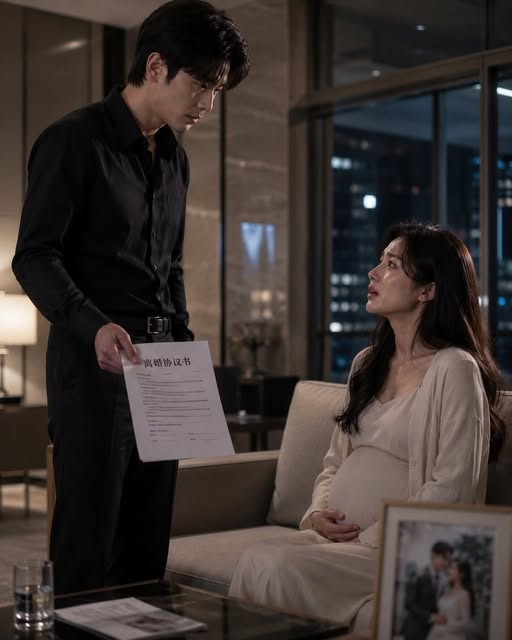
“You demanded a divorce ten days before I was supposed to give birth.”
“I know.”
“You knew the pregnancy was medically difficult.”
His face went pale.
“I know.”
“You never called.”
He lowered his eyes.
“I thought you hated me.”
I almost laughed.
“That prevented you from asking whether your child was alive?”
He had no answer.
I continued:
“Three days after Noah was born, your transfer arrived.”
“Twenty thousand yuan.”
“I sent it back.”
His fingers slowly curled.
“I thought that meant you wanted nothing from me.”
“It meant I wanted nothing from you.”
I leaned forward.
“It did not erase your responsibility to ask about your son.”
His eyes reddened.
“I was ashamed.”
“You were comfortable.”
He flinched.
“Those are not the same thing.”
Silence.
Then he whispered:
“Is he healthy?”
I looked at him.
That was the first question he had ever asked about Noah.
Five years late.
But finally the right one.
“Yes.”
Ethan closed his eyes.
“He had problems after birth?”
“He needed extra care at first.”
His face broke.
I kept the details simple.
“He recovered.”
“Is he…”
He stopped.
“Is he happy?”
“Yes.”
That answer made him cry.
Quietly.
I did not comfort him.
But I did not enjoy it either.
After several moments, he asked:
“Can I meet him?”
“Not because you showed up crying.”
He nodded.
“Then tell me what I have to do.”
“For once, I’m not going to.”
He stared at me.
“Speak to a family lawyer.”
“Accept whatever child-focused process is recommended.”
“Show consistency.”
“And understand that Noah does not exist to make you feel forgiven.”
Ethan swallowed.
“I understand.”
“We’ll see.”
The records I provided helped clarify part of the investigation.
They did not magically erase every question around Ethan’s company.
Some decisions had genuinely been careless.
He had given Serena far too much control without sufficient oversight.
He had signed documents he admitted he had barely read.
But the evidence also showed that several transactions Serena attributed to him had not been what she claimed.
The truth was less dramatic than his mother’s words.
I did not “save” Ethan.
Documents helped investigators separate one set of facts from another.
That was all.
His company survived.
Smaller.
He sold one property.
Closed an unprofitable division.
Lost the house he had once insisted belonged entirely to him.
I heard about that from Natalie.
I felt nothing.
That surprised me.
Five years earlier, I would have considered it justice.
Now it was simply real estate.
The larger question was Noah.
For months, Ethan followed the process without arguing.
The first meeting happened in a child-friendly office with a professional present.
Beforehand, I told Noah the truth in words he could understand.
“The man you saw is your biological father.”
Noah frowned.
“Why didn’t he live with us?”
“Because your father and I separated before you were born.”
“Did he not want me?”
My heart hurt.
I chose my words carefully.
“He made choices that meant he wasn’t there.”
“That was an adult mistake.”
“It wasn’t because of anything about you.”
Noah thought for a moment.
“Do I have to call him Dad?”
“No.”
That seemed to be the answer he cared about most.
When Ethan entered the room, he looked more nervous than I had ever seen him.
Noah looked at him.
Ethan looked at Noah.
Then Noah asked:
“Do you like dinosaurs?”
Ethan blinked.
“Yes.”
“Which one?”
Ethan clearly did not know enough about dinosaurs to survive the interview.
That was the beginning.
Not of a restored family.
Of a relationship Ethan had to build from zero.
He missed no scheduled visit.
He learned Noah hated carrots but loved broccoli for reasons nobody understood.
He learned which dinosaur was currently acceptable and which one was “boring now.”
He learned not to arrive with expensive toys every time.
Once, Noah handed back a huge remote-control car and said:
“Mom says presents aren’t the same as showing up.”
I nearly died of embarrassment.
Ethan looked at me.
I lifted both hands.
“I did not tell him to say that.”
Noah added:
“She says it about Grandma.”
Ethan laughed.
It was the first time I heard him laugh around our son.
Over the years, he became better.
Not my husband.
Noah’s father.
There was a difference.
Serena never returned to Ethan.
Their marriage ended.
He once tried to explain that relationship to me.
I stopped him.
“I don’t need to know.”
“But I want you to understand—”
“No.”
He looked confused.
I smiled faintly.
“For years I wanted to know what she had that I didn’t.”
“I don’t anymore.”
That hurt him more than anger would have.
Three years after he appeared at my door, Ethan asked me to dinner after dropping Noah home.
I knew immediately what was coming.
He said:
“I still love you.”
I looked at him.
“No.”
His mouth tightened.
“You don’t even know what I was going to ask.”
“Yes, I do.”
He lowered his eyes.
“I’ve changed.”
“I know.”
“And you forgive me?”
“I stopped carrying anger a long time ago.”
His eyes lifted.
“Then why not us?”
I looked through the window.
Noah was in the living room building another impossible structure.
“Because becoming a decent father does not recreate the husband you destroyed.”
Ethan’s face went still.
I continued:
“I’m glad you changed.”
“I’m glad Noah has you now.”
“But I do not owe you remarriage as a reward.”
He nodded slowly.
Tears appeared in his eyes.
“I thought if I fixed everything…”
“You can’t fix five years ago.”
“You can only behave differently today.”
He understood.
This time, he did not ask again.
When Noah turned ten, Ethan and I stood on opposite sides of a school auditorium watching him receive an academic award.
My mother-in-law—former mother-in-law, technically—sat beside Ethan.
She no longer knelt in front of me.
She had apologized years earlier for the way she treated me during the divorce.
I accepted it.
We were not family again.
But we had learned civility.
After the ceremony, Noah ran toward us.
“Picture!”
Ethan looked at me uncertainly.
I stepped beside him.
Noah stood between us.
The camera flashed.
One photograph.
Two parents.
No marriage.
No pretending.
And a child who never had to earn either person’s love.
Later, Ethan walked beside me toward the parking lot.
“Do you remember what you said when you closed the door that day?”
“Yes.”
“You said he wasn’t mine.”
I looked at him.
“I was angry.”
“But you were right.”
I stopped.
Ethan smiled sadly.
“He wasn’t mine.”
“Not then.”
“I hadn’t earned any place in his life.”
I studied him.
Five years earlier, that man had asked me to leave the keys to a house while I was carrying his child.
Now he understood that fatherhood could not be claimed like property.
“I’m glad you eventually did,” I said.
He looked at me.
“That means more than you know.”
Then we went to separate cars.
And that was enough.
Ten days before Noah was supposed to be born, Ethan chose a new life and calculated exactly how little of the old one he intended to leave me.
A house for himself.
One hundred thousand for himself.
Twenty thousand for the pregnant wife he no longer wanted.
I walked away believing I had lost everything.
I hadn’t.
Five years later, he arrived at my door with red eyes and a mother begging me to save him.
But I was no longer the woman who measured her future by whether Ethan Cole needed her.
I gave investigators the truth because truth mattered.
I allowed Noah to know his father because Noah’s needs mattered.
And I refused to become Ethan’s wife again because my own life mattered too.
He came back looking for the family he had abandoned.
What he found instead was something he had never expected:
A son he would have to earn.
A woman he could no longer reclaim.
And a door that would open for him only when it was good for the child behind it.
Five years earlier, Ethan had asked me to leave the keys.
When he finally came back, he learned that some doors can reopen without ever becoming your home again.
