Gabriel stared at my phone.
“What exactly did you send?”
I smiled.
For the first time in three years, he sounded afraid of me.
Not angry.
Afraid.
“The original datasets.”
His face stiffened.
“The statistical model.”
Sofia stopped breathing.
“The drafts with dates.”
I continued.
“The emails where you asked me to remove my name from the conference abstract because, according to you, doctoral students should be ‘strategic.’”
Gabriel stepped toward me.
“Elena, stop.”
“And the version of the article you submitted for promotion.”
His face went completely white.
Because he knew what was in it.
My work.
Not inspired by my work.
Not developed jointly.
Mine.
I had built the model over eighteen months.
Gabriel had advised me on methodology, yes.
He had corrected drafts.
Recommended literature.
Done the work a supervisor was supposed to do.
But the central hypothesis, the dataset construction, the analysis pipeline and the conclusions had originated in my dissertation.
Then, three months earlier, he told me:
“This paper is too important to publish under a student’s name first.”
He said he would submit it under both our names.
I later discovered the version sent to the journal listed:
Gabriel Cruz — First Author.
Sofía Shen — Second Author.
My name was in the acknowledgments.
As “research assistance.”
I had confronted him.
He kissed my forehead and said:
“Once you graduate, you’ll understand how academia works.”
Now I finally did.
It worked very differently when records existed.
Gabriel lowered his voice.
“You’re emotional. You don’t understand what you’ve done.”
I almost laughed.
“Again?”
“What?”
“Every time I disagree with you, suddenly I become emotional.”
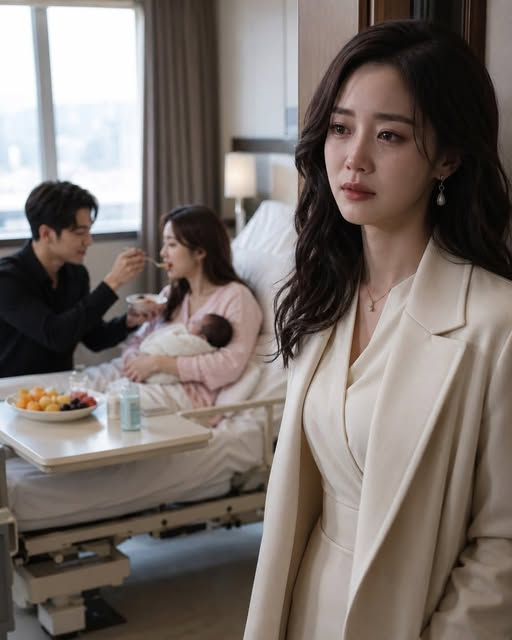
I pointed toward the baby.
“Sofia gave birth.”
“You hid it.”
“You threatened my degree.”
“You used my research.”
“And somehow I am still the unstable one?”
Sofia finally spoke.
“Elena, Gabriel told me you knew about us.”
I looked at her.
“No.”
Her face changed.
“He said the marriage was administrative.”
Gabriel snapped:
“Sofia, don’t.”
I turned slowly toward him.
Administrative.
Three years of sharing a bed.
Three years of cooking together.
Three Christmases.
My grandmother’s funeral.
The night he held me after my first dissertation rejection.
Administrative.
Sofia’s eyes filled.
“He said you married because the university’s housing arrangements made things easier.”
I laughed.
That one was almost creative.
“And you believed that?”
She looked away.
Not completely.
That answer was enough.
I looked at Gabriel.
“Congratulations.”
His jaw tightened.
“For what?”
“You managed to lie to both women in the same room.”
Then I walked toward the door.
He caught my arm.
“Elena.”
I looked down.
He released me.
“Withdraw the complaint.”
“No.”
“You’ll destroy my career.”
“No.”
I shook my head.
“If the evidence destroys your career, then your career was built on something that couldn’t survive being examined.”
His breathing became heavy.
“And your doctorate?”
There it was.
The weapon.
He lowered his voice.
“Do you think another supervisor will take you after this?”
I stared at him.
Then smiled.
“You should have checked your email.”
His expression changed.
“What?”
“The graduate dean already acknowledged receipt.”
I opened the door.
“My supervision has been suspended pending review.”
For the first time, Gabriel Cruz had no authority over my degree.
I left the hospital.
Behind me, I heard the baby begin to cry.
I did not turn around.
She had done nothing to me.
Her parents had.
That distinction mattered.
The university moved faster than Gabriel expected.
Not because I was his wife.
Because the undisclosed marriage created a conflict no institution wanted to discover after publication.
Within forty-eight hours:
Gabriel was removed from my thesis committee.
My dissertation files were preserved by the graduate school.
The journal was asked to pause consideration of the disputed paper.
His promotion review was frozen.
An external academic-integrity panel was appointed.
And I was assigned an interim supervisor from another department.
Professor Helen Ward.
She was sixty-one, terrifyingly direct and completely unimpressed by Gabriel’s reputation.
During our first meeting, she opened my dissertation.
“Did you write this?”
“Yes.”
“Can you defend it?”
“Yes.”
“Then stop looking like someone has permission to take it from you.”
I nearly cried.
Helen pushed a tissue box toward me.
“Cry if necessary.”
Then:
“But after that, explain equation fourteen.”
I laughed through my tears.
That was how my recovery began.
Not with revenge.
With work.
My work.
Under my name.
Gabriel called every day for a week.
Then his lawyer called.
Then his mother.
Then his department chair.
I answered none of them personally.
Everything went through counsel.
The divorce filing was submitted quietly.
I did not ask for his apartment.
I did not try to take his retirement account.
Our finances had largely remained separate because Gabriel insisted secrecy required “clean boundaries.”
Ironically, that made leaving easier.
I asked only for what was legally mine.
Nothing more.
Nothing less.
Sofia contacted me two weeks later.
She asked to meet.
We chose a café.
The baby stayed home with her mother.
Good.
This conversation did not belong beside a child.
Sofia looked exhausted.
“Gabriel says you’re trying to ruin him because of me.”
I stirred my coffee.
“Of course he does.”
She flinched.
“I knew you were legally married.”
I looked up.
At least she had stopped pretending.
“When?”
“About eight months ago.”
“And you stayed with him.”
“Yes.”
“Why?”
Her eyes reddened.
“He told me you were already separated emotionally.”
I waited.
“He said he couldn’t divorce you until you defended your thesis because you would accuse him of sabotaging your degree.”
I almost laughed.
He had turned his own leverage into evidence of his generosity.
Sofia whispered:
“I was stupid.”
“No.”
I shook my head.
“You made a choice.”
Her face tightened.
That was harder to hear.
Good.
Then she said:
“The paper.”
I became still.
“What about it?”
“I knew parts came from your thesis.”
There it was.
“How much?”
“I didn’t know the whole thing.”
“But you knew enough.”
“Yes.”
“Why didn’t you stop the submission?”
She stared at the table.
“Because if it was accepted, it would help my appointment.”
Of course.
Not love.
Not tragedy.
Career.
I almost respected the honesty.
Sofia pushed a flash drive toward me.
“Everything Gabriel sent me is on there.”
Emails.
Drafts.
Tracked changes.
Messages.
I did not touch it.
“Give it directly to the integrity panel.”
“I already did.”
I looked at her.
“Then why bring this?”
“So you know I’m not protecting him anymore.”
I leaned back.
“Sofia, I don’t need you on my side.”
Her eyes filled.
“I know.”
“Take care of your daughter.”
She nodded.
“And make sure whatever happens between you and Gabriel never becomes her burden.”
That was the only advice I gave her.
We never became friends.
We did not need to.
The review took four months.
The conclusion was not dramatic.
It was worse for Gabriel.
Because it was precise.
The panel found that:
My dissertation contained the earliest documented version of the core model.
My datasets predated Gabriel’s article draft.
Several sections of the paper reproduced my analytical structure without appropriate authorship credit.
Gabriel had failed to disclose that he was married to the doctoral student whose work he supervised.
And messages showed he had linked my academic progress to my willingness to avoid “personal complications.”
The university did not erase his entire career.
He had published legitimate work before me.
He had taught good students.
He had earned some of his reputation.
But the promotion was denied.
He lost supervisory privileges for doctoral candidates.
The disputed paper was withdrawn.
And his conduct was formally sanctioned.
That mattered to me.
Because truth did not need to turn someone into a cartoon villain.
It only needed to stop protecting them from what they had actually done.
Sofia was also reviewed.
Her role was judged differently.
She had not supervised me.
But she had knowingly accepted authorship on work she knew was partly mine.
She lost the paper and faced internal consequences.
She eventually left the university the following year.
Gabriel remained.
Smaller.
No longer untouchable.
My dissertation defense happened seven months after the hospital.
Professor Helen sat on my left.
Three external examiners sat across from me.
Gabriel was nowhere in the room.
For nearly two hours, they questioned everything.
My assumptions.
My methods.
My limitations.
My conclusions.
Nobody asked whose wife I was.
When the committee called me back inside, the chair smiled.
“Congratulations, Dr. Elena Suárez.”
I stopped breathing.
Doctor.
My name.
No Gabriel attached.
No secret marriage.
No stolen first authorship.
Just mine.
I cried.
Helen pretended not to notice.
Then handed me a tissue.
“You still owe me revisions on chapter six.”
I laughed.
Naturally.
The divorce became final two months later.
Gabriel asked to meet once.
I agreed.
We sat in his office.
The same office where, for three years, I had called him Professor Cruz while other students were present.
He looked older.
“There’s a photograph on my desk.”
I glanced toward it.
His daughter.
Six months old.
Smiling.
“She has your eyes,” I said.
His expression softened.
“Yes.”
For a moment, he was simply a father.
Then he looked at me.
“I made mistakes.”
I said nothing.
“I should have told the university.”
“Yes.”
“I should have credited you.”
“Yes.”
“I should have told you about Sofia.”
“Yes.”
His mouth tightened.
“Is that all you’re going to say?”
“What do you want?”
“I want you to admit there were good years.”
I looked at him.
“There were.”
He seemed relieved.
I continued:
“That is why betrayal hurts.”
The relief vanished.
He lowered his head.
“I did love you.”
“I believe you.”
His eyes lifted.
“But you loved me best when nobody else could see it.”
He said nothing.
I continued:
“You wanted a wife at home.”
“A student at work.”
“And a future with Sofia somewhere in between.”
“You kept all three lives because admitting the truth would force you to choose.”
His voice cracked.
“I chose badly.”
“No.”
I shook my head.
“You chose repeatedly.”
That was different.
Then he asked:
“Could we ever try again?”
“No.”
No pause.
No cruelty.
Just no.
He nodded slowly.
“What about forgiveness?”
“Maybe someday.”
“And Sofia?”
“That’s your life.”
He looked toward his daughter’s photograph.
“We’re trying to co-parent.”
“Then do that well.”
The baby did not need parents performing a romance that no longer existed.
She needed adults.
I stood.
At the door, Gabriel called my name.
“Elena.”
I turned.
“I’m sorry.”
For once, he did not add an explanation.
I nodded.
Then left.
Three years later, I returned to the same university.
Not as Gabriel’s student.
As an invited speaker.
My research had grown into a larger project with collaborators from three institutions.
At the entrance, a doctoral student stopped me.
“Dr. Suárez?”
“Yes?”
“I read your article.”
Which article?
For a second, old fear returned.
Then she smiled.
“The one on the Suárez model.”
My throat tightened.
The Suárez model.
My model.
My name.
“Thank you.”
After the lecture, I walked past Gabriel in the hallway.
He had attended from the back row.
We exchanged a polite nod.
Nothing more.
That was enough.
Years earlier, I had spent three years desperately wishing the university would discover I was Professor Gabriel Cruz’s wife.
I thought the truth would protect me.
I thought people would respect me if they knew who I belonged to.
I had been wrong.
The truth that saved me was not:
Elena is Gabriel’s wife.
It was:
This research belongs to Elena.
The marriage ended.
His daughter grew up outside my resentment.
Sofia became someone I no longer thought about.
And Gabriel eventually learned that controlling a student’s future and loving a wife were incompatible roles, no matter how elegantly he hid the conflict.
The day I entered that hospital, I gave his daughter a medal engraved with the words legal wife.
At the time, I thought that title was the strongest proof I had.
Years later, I understood how little it mattered.
I did not need to be acknowledged as Mrs. Cruz.
I needed to stop disappearing behind him.
And when the academic world finally learned my name, it was not because Gabriel admitted I was his wife.
It was because he could no longer pretend my work was his.
