I walked out of the clinic with the examination report folded inside my bag.
I did not cry.
Not yet.
I sat on a stone bench beneath an old acacia tree and called Giang Hai.
Once.
Twice.
Five times.
He finally answered.
His voice was impatient.
“What?”
I stared at the words on the medical record.
“Did we divorce on June twelfth?”
Silence.
Only two seconds.
But two seconds were enough.
Then he said:
“Who told you?”
I laughed.
So softly that even I barely recognized the sound.
Not:
What are you talking about?
Not:
There must be a mistake.
Who told you?
I closed my eyes.
“So it’s true.”
“Mai Le, listen to me.”
“Did we divorce?”
“Yes.”
One word.
Seven years disappeared.
I held the phone tighter.
“You told me those were military family-registration documents.”
“They were documents that needed your signature.”
“Divorce documents.”
He sighed.
As if I were the unreasonable one.
“You would never have agreed if I explained everything.”
My fingertips went numb.
“So you deceived me.”
“I handled it in the way that caused the least trouble.”
I almost laughed again.
The least trouble.
For him.
Always for him.
Then I asked:
“Why?”
Another silence.
“There’s someone else.”
Of course.
“How long?”
“Mai Le—”
“How long?”
“Almost a year.”
I looked toward the clinic entrance.
Women came and went holding their husbands’ arms.
Some were laughing.
Some were arguing.
Ordinary marriages.
Mine had apparently ended six months ago without anyone telling me.
“Are you marrying her?”
He did not answer.
That was an answer.
I whispered:
“When?”
“This week.”
My heart finally stopped hurting.
Not because I was healed.
Because there was simply no room left for another wound.
I hung up.
I returned home at noon.
My mother-in-law was asleep.
Mrs. Jiang had suffered a severe stroke two years earlier.
She could barely move one side of her body and needed help with almost everything.
Giang Hai visited when leave allowed.
Sometimes once a month.
Sometimes not even that.
The rest belonged to me.
Physical therapy appointments.
Medication.
Bathing.
Meals.
Turning her at night.
Hospital bills.
Nursing-home contracts when I became too exhausted to manage alone.
I had always told myself:
She is his mother.
Therefore she is my mother too.
That afternoon I stood beside her bed and realized something cruel.
Giang Hai had stopped considering me his wife six months earlier.
But he had allowed me to continue living as his daughter-in-law.
He took away the marriage.
He kept the labor.
Mrs. Jiang opened her eyes.
“Mai Le?”
Her speech was slow.
I sat beside her.
“Mom.”
She smiled faintly.
“When is Hai coming back?”
I looked at her for a long time.
“Soon.”
That was not a lie.
Not this time.
The nursing facility administrator was shocked when I canceled the long-term care agreement.
“Mrs. Jiang’s fees are already paid through the end of the quarter.”
“By whom?”
The woman checked.
“You.”
Of course.
I had used the household allowance and my own savings whenever Giang Hai’s transfers arrived late.
I asked for a full statement.
Every payment.
Every medical invoice.
Every rehabilitation charge.
Every receipt with my signature.
Then I contacted a patient-transfer service.
I did not abandon a sick woman on a roadside.
I arranged a proper ambulance.
A nurse.
Medication.
Her records.
And enough supplies for several days.
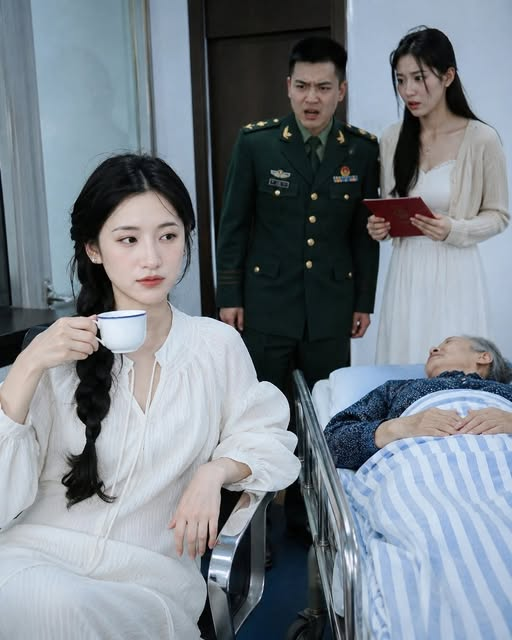
The next morning, we drove directly to the reception area outside Giang Hai’s barracks.
Mrs. Jiang looked confused.
“Why are we here?”
I squeezed her hand.
“Your son needs to arrange your care from now on.”
She looked at me.
Then, perhaps because she knew me too well, tears filled her eyes.
“Did Hai do something?”
I could not lie anymore.
“Yes.”
She closed her eyes.
At ten forty-three, Giang Hai arrived.
And beside him was a woman wearing a red coat.
Young.
Pretty.
Nervous.
In her hand was a newly issued marriage certificate.
So the timing had been perfect.
He had divorced one wife in secret.
Allowed that wife to nurse his mother for another six months.
Then married another woman.
He stopped when he saw me.
His face went white.
“What are you doing here?”
I lifted my teacup.
“Waiting for you.”
His gaze fell on the stretcher.
Then hardened.
“Why did you bring my mother here?”
I reached into my bag.
First, I placed a copy of the divorce record on the table.
Then the nursing-home cancellation.
Then the folder containing two years of expenses.
Finally, I smiled.
“You remarried.”
“So congratulations.”
“From today, your biological mother’s care returns to you.”
His new wife stared at him.
“What does she mean?”
Giang Hai ignored her.
“Mai Le, stop this.”
“Stop what?”
“You know my schedule.”
“Yes.”
“That’s why we used a nursing facility.”
I nodded.
“And the contract was under my name.”
His face changed.
“You can’t cancel it without discussing it with me.”
I looked at the divorce paper.
“Apparently important family decisions don’t require discussion.”
The new wife slowly turned toward him.
“Didn’t you tell me the divorce was mutual?”
Silence.
Her face lost color.
I looked at her.
“Did he?”
She whispered:
“He said you had separated long ago.”
I almost felt sorry for her.
Almost.
Then she looked at Mrs. Jiang.
“And she has been caring for your mother?”
I answered:
“For two years.”
Giang Hai snapped:
“That is enough.”
I nodded.
“Yes.”
“It is.”
He tried to pull me aside.
I refused.
“If you have something to say, say it here.”
His jaw tightened.
“Do you understand how this looks?”
That sentence nearly made me laugh.
“How it looks?”
“You brought my mother here on the day—”
“On the day you married someone else?”
His new wife flinched.
I continued:
“I didn’t choose the date.”
“You did.”
A duty officer entered after hearing raised voices.
Then another.
Giang Hai immediately lowered his voice.
“Mai Le, go home. I will deal with this tonight.”
I looked at him.
“Which home?”
He froze.
“You divorced me six months ago.”
“I no longer live in your house.”
His new wife whispered:
“You said she already moved out.”
Giang Hai turned sharply.
“Lan, not now.”
So her name was Lan.
Interesting.
She looked at him.
“No. Now.”
For the first time, someone else was asking him the questions I no longer cared to ask.
I stood.
“Mrs. Jiang’s medication schedule is in this folder.”
“Her rehabilitation center number is inside.”
“The ambulance nurse can explain her current condition.”
“And here are all unpaid and upcoming expenses.”
I placed the folder in front of Giang Hai.
He did not touch it.
“You’re leaving my mother?”
I stared at him.
“No.”
“I’m returning responsibility for your mother to her son.”
His face reddened.
“She considers you her daughter.”
That hurt.
Because Mrs. Jiang had treated me better than he had.
I looked at her.
She was crying silently.
I went to the stretcher and held her hand.
“Mom.”
Her fingers closed weakly around mine.
“I’m sorry.”
She shook her head.
“No.”
Then, slowly:
“Hai… wrong.”
Giang Hai looked away.
That was the only reason I almost broke.
Not him.
Her.
I leaned down and kissed her forehead.
“I’ll visit when you want me to.”
“But I cannot continue living as a wife in a marriage your son already erased.”
Her tears fell.
She understood.
The unit did not immediately “punish” Giang Hai because I appeared at the gate.
Real life was not that theatrical.
But questions began.
The marital-status records did not match the family allowance records.
My name had continued appearing on some dependency paperwork after the divorce.
I had still received household support connected to his family registration.
Mrs. Jiang’s care arrangements had also continued under the assumption that I was his spouse.
Then there was the larger issue:
How exactly had the divorce been processed?
I obtained copies.
My signature was there.
So was a statement saying I had read and voluntarily accepted the terms.
That statement was false.
I had signed where Giang Hai told me to sign while caring for his mother.
My attorney reviewed the documents.
“You did sign.”
“I know.”
“But deception matters.”
She tapped the page.
“And if he made false representations in official family records afterward, that can create separate problems.”
I nodded.
“I don’t want revenge.”
“Good.”
She closed the file.
“Then we ask for correction, financial accounting, and formal review.”
That was enough.
Lan came to see me one week later.
I almost refused.
Then curiosity won.
She sat across from me in a small café.
Her marriage certificate was no longer in sight.
“Did you know about me?” she asked.
“No.”
“He told me you two had been living separately for more than a year.”
“We slept in the same house the week before he had me sign the papers.”
Lan’s face turned pale.
“He said you refused to care for his mother.”
I laughed.
Then I placed copies of the nursing invoices on the table.
Her hands trembled.
“He said he paid all of this.”
“He sent money sometimes.”
“But the management, appointments and daily care were mine.”
She stared at the receipts.
Then whispered:
“He told me you were selfish.”
I leaned back.
“Maybe I was.”
She looked up.
“I stayed in a marriage where I was expected to wait forever.”
“Perhaps finally leaving is the most selfish thing I’ve ever done.”
Lan started crying.
I didn’t comfort her.
She was not my enemy.
But she was not my responsibility either.
Before leaving, she asked:
“Do you want him back?”
“No.”
The answer came so quickly that even I was surprised.
She nodded.
Then said:
“I don’t know if I want him either.”
That was her decision.
Not mine.
Three months later, Giang Hai came to my new apartment.
I did not invite him inside.
His face looked exhausted.
“Mother asks about you.”
“I visit her every Sunday.”
“I know.”
He looked down.
After I left, Mrs. Jiang had been transferred to a new long-term care facility closer to his unit.
Giang Hai paid for it.
He had no choice now.
Not because I punished him.
Because responsibility had finally reached the person who originally owned it.
He said:
“Lan moved out.”
I felt nothing.
“She says I lied to her.”
“You did.”
“I never thought she would care so much about how the divorce happened.”
I stared at him.
There it was again.
He understood people only after they reacted differently than he expected.
“What happened with the unit review?” I asked.
His jaw tightened.
“Administrative reprimand.”
He paused.
“Some records were inaccurate. I had to repay allowances issued under outdated family information.”
I nodded.
“And my promotion was delayed.”
That mattered to him.
I could see it.
Once, I would have felt guilty.
Now I didn’t.
He asked:
“Are you satisfied?”
“No.”
That surprised him.
“I didn’t marry you hoping to delay your promotion.”
“I wanted a husband who trusted me enough to tell me he no longer wanted the marriage.”
He looked away.
Then whispered:
“I was afraid you wouldn’t sign.”
“You were right.”
His eyes lifted.
“I would have asked why.”
“I would have cried.”
“I might have begged.”
“But eventually I would have signed because a marriage cannot survive one person wanting out.”
I looked directly at him.
“You didn’t avoid pain.”
“You only took away my right to face it honestly.”
His eyes reddened.
“I’m sorry.”
I believed him.
That did not rebuild anything.
A year later, I had a new job managing procurement for a rehabilitation center.
Strange.
After years of coordinating my mother-in-law’s care, I had accidentally learned more about medical supply systems than I realized.
Mrs. Jiang remained in my life.
Not as an obligation.
As someone I loved.
Every Sunday, I visited.
Sometimes Giang Hai was there.
We were civil.
That was all.
Lan eventually divorced him.
I heard she remarried years later.
I hoped she was happy.
Giang Hai did not ask me to return again.
Perhaps he finally understood.
Or perhaps pride stopped him.
Either way, I was free.
On the second anniversary of the day I discovered the secret divorce, the same doctor from the town clinic recognized me during a routine check-up.
She smiled awkwardly.
“I remember you.”
“So do I.”
She looked at my file.
“Marital status: divorced.”
This time, I smiled.
“Correct.”
No shock.
No cold spine.
No world collapsing.
Just a fact.
After the appointment, I visited Mrs. Jiang.
She squeezed my hand and asked:
“Mai Le… happy?”
I thought about it.
Then nodded.
“Yes.”
She smiled.
“Good.”
That was enough.
For seven years, I believed marriage meant carrying everything together.
Then Giang Hai secretly removed himself from the marriage while leaving every burden behind for me.
His mother.
His home.
His reputation.
His excuses.
He wanted the freedom of divorce without paying the emotional or practical cost of ending a family.
So the day I learned the truth, I did not destroy his career.
I did not abandon a sick woman without care.
I simply stopped performing the duties of a wife after discovering I had not legally been one for six months.
Giang Hai thought the hardest part of divorce was getting my signature.
He was wrong.
The hardest part came afterward—
when the woman he had quietly erased finally stopped carrying the life he had left in her hands.
