Jason’s face went white.
“Iris,” he whispered. “Put your coat back on.”
I looked at him.
For years, that tone had worked.
Quiet.
Controlled.
A command disguised as concern.
Not anymore.
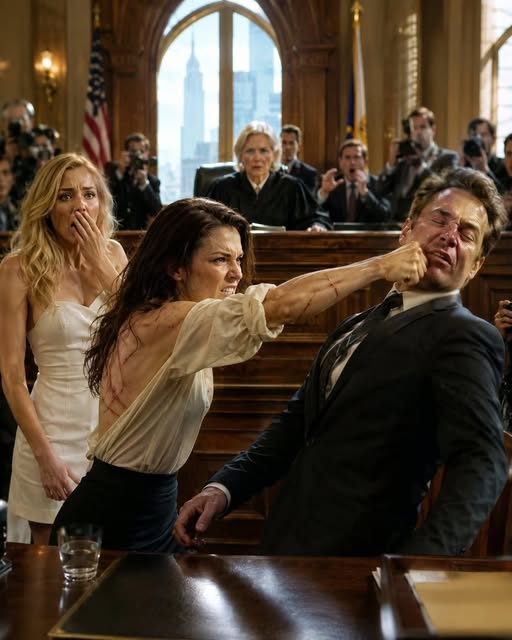
Judge Eleanor Walsh immediately raised her hand.
“Counsel, approach.”
My attorney, Daniel Brooks, stood.
Jason’s lawyer followed.
The judge’s expression had changed completely.
“This court will not conduct a criminal proceeding inside a divorce hearing,” she said firmly. “But if there is evidence of abuse, intimidation, fraudulent transfers, or witness interference, I need to know whether the appropriate filings have been made.”
Daniel opened the folder in front of him.
“They have, Your Honor.”
Jason stopped breathing.
Daniel continued.
“Yesterday evening we submitted sealed medical records, photographs authenticated by treating physicians, sworn statements, and a forensic financial report.”
Then he placed another document on the table.
“We also requested an emergency preservation order regarding Mitchell Medical Technologies.”
Jason shot to his feet.
“This is insane.”
The judge looked at him.
“Sit down, Mr. Mitchell.”
He did.
Slowly.
Madison removed her hand from his arm.
For the first time that morning, they no longer looked like a couple arriving to celebrate a victory.
They looked like two people wondering how much the other had already said.
I put my coat back around my shoulders.
Then I sat.
Daniel whispered:
“You did it.”
I shook my head.
“No.”
I looked at Jason.
“I finally stopped hiding it.”
Jason had always assumed silence meant lack of evidence.
That was his first mistake.
My doctors had records.
My therapist had records.
There were messages in which Jason apologized without ever using the word abuse.
I lost control.
You know how stressed I am.
Don’t make this bigger than it needs to be.
And the most important:
If you ever tell anyone, remember who owns the company, the house and every dollar you live on.
He had written that one himself.
No interpretation required.
His second mistake was financial.
Three days before I filed for divorce, Jason emptied several accounts and transferred money through two companies controlled by associates.
He believed moving money meant making it disappear.
It didn’t.
It created a trail.
Daniel had hired forensic accountant Rebecca Shaw six months earlier.
Quietly.
By the time Jason marched into court announcing that I would be starving in the streets, Rebecca had already traced most of the transfers.
The judge ordered that the remaining disputed assets be preserved until ownership could be determined.
Jason leaned toward his attorney.
“What does that mean?”
His lawyer whispered something.
Jason’s face darkened.
I knew the answer.
It meant he could no longer move money just because his name appeared on the account.
But the company was where his confidence truly collapsed.
During a recess, he cornered Daniel outside the courtroom.
“Mitchell Medical Technologies is mine.”
Daniel remained calm.
“Then you should be comfortable with an audit.”
“I built it.”
From several feet away, I finally spoke.
“No.”
Jason turned.
I continued:
“You marketed it.”
His eyes narrowed.
I had been a biomedical engineer before I became Mrs. Mitchell.
Years before our marriage, I helped develop a polymer-based medical sealing system with my university research team.
When Jason and I later founded Mitchell Medical Technologies, I made one decision my father insisted on.
I kept the core patents inside a separate intellectual-property company.
Iris Biomedical Holdings.
Mitchell Medical Technologies received an exclusive license.
Jason hated the arrangement.
He called it unnecessary paperwork.
But at the time, he needed the patents more than he needed control.
Years later, once the company became valuable, he started introducing himself as the sole founder.
Eventually, even I stopped correcting him.
That was my mistake.
Not anymore.
Daniel handed Jason’s attorney a copy of the licensing agreement.
Jason stared at it.
Then at me.
“You terminated the license?”
“No.”
He looked confused.
I said:
“I notified the board that your attempt to conceal marital assets triggered the governance review clause.”
His attorney closed his eyes.
Jason whispered:
“You’re trying to destroy the company.”
“No.”
I stepped closer.
“I spent twelve years building that technology.”
“I’m protecting it from you.”
That difference mattered.
The license remained active.
Employees kept their jobs.
Hospitals still received products.
But Jason was temporarily removed from unilateral control of major transactions while an independent committee reviewed the finances.
He had predicted I would walk away with nothing.
Instead, he walked out of court unable to move anything important without someone watching.
Madison broke before he did.
Three weeks later, Daniel called me.
“You should sit down.”
“What happened?”
“Madison retained separate counsel.”
I almost laughed.
“Already?”
“She’s cooperating with the financial investigation.”
Of course she was.
Love becomes strangely fragile when subpoenas arrive.
Madison admitted that Jason had used her to authorize hotel expenses under my name.
She claimed he told her it was necessary because the company’s executive travel policy recognized spouses but not girlfriends.
She also turned over messages.
One of them changed everything.
Jason had written:
Once Iris signs the restructuring papers, her rights disappear. After that, we can stop pretending.
I stared at the screen.
“What restructuring papers?”
Daniel looked at me.
“Do you remember the stack Jason had you sign after your surgery two years ago?”
My stomach turned cold.
I remembered.
He had placed documents beside my bed.
Insurance updates.
Tax forms.
Corporate renewals.
At least that was what he said.
One was a spousal consent supposedly approving a transfer of shares into Jason’s separate holding company.
My signature was there.
But the document had been altered after I signed.
Metadata from the original files proved it.
The company I supposedly gave away?
I never had.
Jason had not only hidden money.
He had tried to rewrite ownership.
The divorce hearing that he expected to finish in one afternoon took months.
The criminal investigation was separate.
So was the corporate review.
That mattered to me.
I did not want one dramatic courtroom scene to decide everything.
I wanted records.
Experts.
Independent decisions.
Evidence that would still exist after everyone stopped being shocked by my scars.
Jason’s attorney eventually stopped calling me vindictive.
The evidence made that strategy dangerous.
The divorce court ruled that the house and substantial portions of the company value were subject to division despite Jason’s attempts to characterize everything as solely his.
The fraudulent transfer documents were disregarded.
The drained funds were accounted for in the settlement.
I kept control of Iris Biomedical Holdings.
Mitchell Medical Technologies retained its license under new governance rules.
Jason lost his CEO position after the independent board concluded that his financial misconduct and undisclosed personal expenses created unacceptable risk.
He remained a shareholder.
He did not lose every dollar.
Reality was not that neat.
But he lost the thing he cared about most.
Unchecked control.
The abuse case moved more slowly.
I testified once.
Not for hours about every terrible memory.
Just enough to establish the pattern supported by records and witnesses.
Jason eventually accepted a plea arrangement on several charges rather than take the full case to trial.
There were legal restrictions on contacting me.
Mandatory counseling.
Financial penalties.
And consequences I no longer had to supervise.
People asked whether that felt like justice.
I never knew how to answer.
Justice did not erase ten years.
But it did something important.
It moved the truth out of my body and into the record.
For years, the evidence had existed only beneath clothes.
Now it existed where Jason could no longer tell me I imagined it.
Madison contacted me once.
One email.
I know you probably hate me. I didn’t know everything he did to you.
I believed that.
Then came the next sentence.
But I knew he was married, and I knew some of the receipts used your name. I’m sorry.
That part mattered more.
She did not pretend innocence.
I replied:
Thank you for cooperating with the investigation. I don’t want further contact.
She respected it.
We never became friends.
We did not need to.
Eighteen months later, I stood in the lobby of Mitchell Medical Technologies for the first time since the divorce.
The company had a new CEO.
A new board chair.
And my surname was no longer on the building.
That had been my choice.
The company was renamed Meridian Medical Systems.
During the announcement, one of the engineers approached me.
“You could have shut us down.”
“No.”
“After what he did?”
I looked through the glass wall toward the laboratory.
People were working.
Testing devices.
Running quality checks.
Building things that had nothing to do with my marriage.
“Jason hurt me,” I said.
“The engineers didn’t.”
The patents remained mine.
The company paid fair licensing fees.
I received exactly what the contracts said I should receive.
No more.
No less.
For the first time, business felt separate from marriage.
I liked it that way.
I bought a smaller house.
Not a mansion.
Something quiet.
There was a garden behind it and an office with large windows.
The first night, I slept badly.
Too much silence.
Then I woke before sunrise and realized something.
Nobody else had a key.
I laughed.
Not because it was funny.
Because peace can feel unfamiliar after chaos.
I spent the following years rebuilding slowly.
Work.
Therapy.
Friends I had stopped seeing because Jason disliked them.
My sister started visiting every Sunday.
I eventually returned to medical research full-time.
There was no miraculous new romance waiting at the finish line.
I didn’t need one.
I had spent too long believing being chosen by a man determined whether my life had succeeded.
It didn’t.
Years later, someone sent me an old photograph from the divorce hearing.
Jason standing beside Madison.
Confident.
Expensive suit.
That smile.
I was still wearing the gray coat.
Seconds before I removed it.
For a moment, I remembered his words.
The company, the house, the cars… they’re all mine now.
You’ll be begging on the streets.
He had believed possessions were power.
Maybe that was why he never understood me.
The most powerful thing I did that morning was not proving I owned patents.
It was not freezing accounts.
It was not exposing hidden transfers.
It was standing in front of a room full of strangers and refusing to carry his shame for him anymore.
Jason thought money had buried the truth.
It hadn’t.
It had only paid for better walls around it.
And when those walls finally came down, the courtroom did not forget it was watching a divorce because my scars were dramatic.
It forgot because everyone suddenly understood what the divorce actually meant.
I was not fighting to take Jason Mitchell’s life away from him.
I was taking mine back.
