The elevator stopped at the lobby.
The doors opened.
Pho Yen stepped out.
Dark suit.
Gold cufflinks.
Two executives behind him.
The moment Tan Nhu saw him, her entire posture changed.
“Deputy General Pho!”
She hurried toward him.
“There’s a woman causing trouble. She insists on occupying the presidential suite and keeps claiming she knows you.”
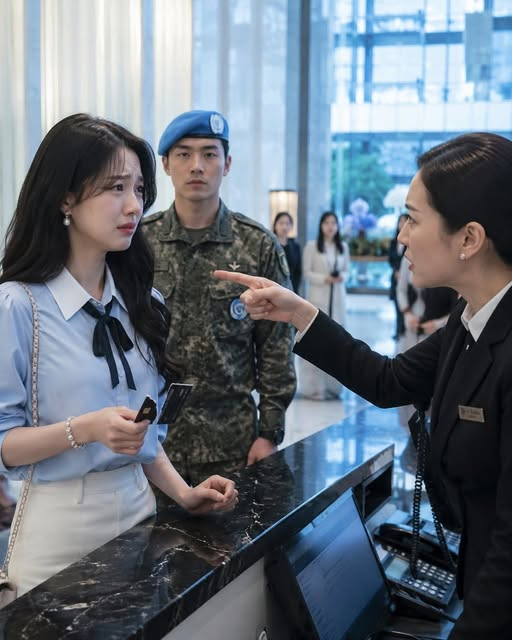
Then she pointed directly at me.
Pho Yen followed her hand.
And froze.
His expression changed so quickly that even Lam Chu noticed.
My brother gave a quiet laugh.
“Brother-in-law.”
Tan Nhu went pale.
She looked from him to me.
Then back again.
“Brother… in-law?”
Pho Yen ignored her.
His eyes went to the broken room card on the floor.
Then to my face.
“Lam An.”
I had not heard him say my name like that in years.
Not husband to wife.
Manager to crisis.
I smiled.
“Deputy General Pho.”
His jaw tightened.
“What happened?”
Before I could answer, Tan Nhu rushed in.
“She forged a reservation!”
“She demanded the presidential suite.”
“She insulted the staff.”
“And this man threatened me.”
Lam Chu took one step forward.
I caught his wrist.
“No.”
He looked at me.
I shook my head.
My brother had spent months in a peacekeeping unit.
I was not going to let a hotel manager turn his first day home into a disciplinary report.
Pho Yen frowned at Tan Nhu.
“You broke the key?”
She immediately softened her voice.
“I was protecting the hotel.”
Then she touched his sleeve.
It was a small gesture.
Too natural.
Too practiced.
My heart went cold.
I looked at her hand.
Then at him.
Pho Yen noticed.
He pulled his arm away.
Too late.
Tan Nhu’s face stiffened.
I bent down and picked up half of the broken card.
“This reservation was confirmed yesterday.”
I held up my phone.
“Presidential suite. Seven nights. Registered guest: Lam Chu.”
Pho Yen looked at the booking.
Then at the front desk manager.
“Why was it canceled?”
Tan Nhu said:
“Because that suite isn’t available.”
“Why?”
She hesitated.
Then answered:
“You said it was reserved permanently.”
Pho Yen’s expression changed.
I asked quietly:
“For whom?”
Nobody spoke.
Tan Nhu’s eyes became wet.
“For me.”
Lam Chu laughed once.
Not happily.
I looked at my husband.
“You permanently assigned the presidential suite to your reception manager?”
Pho Yen lowered his voice.
“An, let’s go upstairs.”
“No.”
“There are guests watching.”
“Good.”
His face hardened.
“Don’t make family matters public.”
I looked around the lobby.
“Interesting.”
“A minute ago, she was preparing to have security drag me out publicly.”
Tan Nhu immediately said:
“I didn’t know who you were.”
That sentence finished her.
I turned toward her.
“And if I were nobody?”
Silence.
“If my brother really were a cheap bodyguard?”
“If we really had no connection to Deputy General Pho?”
“Would breaking a guest’s room card and humiliating him be acceptable?”
Her lips parted.
Nothing came out.
Pho Yen stepped closer.
“Enough.”
There it was.
That tone.
The same tone he used whenever he wanted a problem to disappear without being solved.
I looked at him.
“No.”
His eyes narrowed.
I opened my bag.
Inside was a document folder.
I had brought it only because Lam Chu needed temporary residency documentation for the hotel registration.
Now it became useful for something else.
I removed a certified copy of the property certificate.
Placed it on the marble counter.
Tan Nhu glanced down.
Then her face changed.
Owner one:
PHO YEN.
Owner two:
LAM AN.
Fifty percent each.
The lobby became very quiet.
Tan Nhu whispered:
“What is this?”
I smiled.
“The land certificate.”
Pho Yen’s face darkened.
“Lam An.”
I ignored him.
“This hotel building was purchased ten years ago.”
“Half of the acquisition money came from my family’s commercial property sale.”
“The deed was registered jointly.”
I tapped my name.
“So I have a question.”
I looked directly at Tan Nhu.
“You said this was Deputy General Pho’s territory.”
“Which half?”
Someone behind the desk coughed.
Lam Chu looked away because he was trying not to laugh.
Tan Nhu’s face turned red.
Pho Yen grabbed the document.
“This proves ownership of the real estate, not hotel operations.”
“Correct.”
I nodded.
“That’s why I called the board before coming.”
He went still.
“What?”
The elevator chimed again.
This time, three people stepped out.
Pho Group’s legal director.
The chairman’s representative.
And the hotel’s regional operations chief.
Pho Yen’s face lost color.
The regional chief walked directly toward me.
“Mrs. Lam.”
“Thank you for coming.”
Tan Nhu backed away.
Pho Yen stared at me.
“You called them?”
“Yes.”
“When?”
“This morning.”
The truth was simple.
I had noticed something strange in the hotel records while arranging my brother’s stay.
The presidential suite had been blocked almost continuously for eleven months.
Not because of VIP guests.
Because someone had marked it:
Executive permanent reserve.
The charges were repeatedly waived under Deputy General authorization.
That alone was enough to make me curious.
Then I saw whose staff ID was attached to the room.
Tan Nhu.
I had not come to the hotel expecting a scandal.
I had come expecting an explanation.
Instead, she broke my room key.
Sometimes people confess before you ask the question.
The regional chief requested access logs.
The front-desk staff immediately produced them.
Tan Nhu had used the presidential suite thirty-eight nights in the previous six months.
Housekeeping records showed personal clothes stored there.
Luxury cosmetics.
Wine.
And several charges that had been transferred to the executive hospitality budget.
I looked at Pho Yen.
“Business?”
He said nothing.
Tan Nhu started crying.
“Deputy General Pho told me I could use the room.”
The legal director asked:
“For business accommodation?”
She hesitated.
Pho Yen interrupted:
“I authorized it.”
The director looked at him.
“Under what policy?”
Silence.
That was when I realized something painful.
Pho Yen was not frightened because Tan Nhu was lying.
He was frightened because she was telling the truth.
I asked the question I had been avoiding.
“Are you sleeping with her?”
Tan Nhu’s face went white.
Pho Yen immediately said:
“No.”
Too fast.
I looked at him.
“Then why does she have permanent access to the presidential suite?”
“She works late.”
“So do eighty other employees.”
“She lives far away.”
“So do half the staff.”
Tan Nhu suddenly said:
“You promised me you would explain everything.”
Pho Yen turned sharply.
“Shut up.”
Too late.
The lobby seemed to lose oxygen.
I looked at her.
“What exactly was he supposed to explain?”
Tears ran down her face.
“That your marriage…”
Pho Yen snapped:
“Tan Nhu.”
She shouted back:
“You told me you were separated!”
There it was.
My brother’s hand closed into a fist.
I placed my palm over it again.
“No.”
He looked at me.
I shook my head.
“This one is mine.”
Pho Yen stepped toward me.
“An, listen.”
I smiled.
“No.”
“For ten years I listened.”
“You worked.”
“I managed the house.”
“You traveled.”
“I took care of your parents.”
“You said the hotel needed you.”
“I believed you.”
My voice did not rise.
“And apparently while I was staying home, you gave another woman a permanent room in property that is half mine.”
He looked devastated.
“It wasn’t like that at first.”
I almost laughed.
Nothing ever is.
The board review began that afternoon.
Not because my husband had an affair.
Companies do not remove executives because their marriages fail.
They investigate when executives misuse corporate assets.
Tan Nhu’s room privileges.
Waived charges.
Hospitality expenses.
Staff scheduling adjusted around her.
Unauthorized use of the presidential suite.
And the possibility that senior management power had been used to protect a personal relationship.
Tan Nhu was suspended pending review.
Pho Yen was removed temporarily from hotel operations.
I did not demand either result.
I did not need to.
They had created the paperwork themselves.
That evening, Lam Chu finally entered another suite.
Not presidential.
He refused it.
“I sleep in barracks.”
He threw his bag onto the bed.
“This is already ridiculous.”
I laughed.
For the first time that day.
He looked at me.
“Are you okay?”
“No.”
He nodded.
“Good.”
I frowned.
“What?”
“If you said yes, I’d worry.”
Then he opened his arms.
I hugged my younger brother.
And finally cried.
Not much.
Just enough.
Ten years was still ten years.
The divorce took eight months.
Pho Yen wanted reconciliation.
He blamed stress.
Distance.
Weakness.
Tan Nhu’s dependence on him.
Everything except the choice.
Until one mediation session, when I asked:
“Did she force you to give her the suite?”
“No.”
“Force you to lie about being separated?”
“No.”
“Force you to charge her stays to the hotel?”
“No.”
“Then stop explaining her.”
He looked down.
“Explain yourself.”
That was the first time he truly did.
He liked being admired.
Tan Nhu made him feel powerful.
At work, everyone obeyed him.
At home, I knew his weaknesses.
His mistakes.
His ordinary side.
He had confused admiration with love.
And familiarity with something less valuable.
By the time he realized the difference, I no longer wanted to teach it to him.
The hotel survived.
Of course it did.
One deputy general was not an empire.
The board appointed professional oversight.
Expense policies changed.
Executive suite privileges required independent approval.
Tan Nhu eventually resigned.
Pho Yen retained shares in the group but lost responsibility for hotel operations for a long period.
As for my half of the building—
I did not seize the hotel.
I did not close it.
I negotiated.
When the divorce settlement was completed, Pho Group bought my interest at an independently assessed value.
For the first time in ten years, I had money that was entirely under my control.
I invested part of it.
Bought a smaller home.
And opened a rehabilitation center for returning peacekeeping personnel with two former military doctors Lam Chu knew.
My brother complained about the name.
“Why did you call it Harbor?”
“Because soldiers need somewhere to return.”
He stared at me.
Then quietly said:
“So do sisters.”
I pretended not to hear him.
Two years later, I went back to the hotel.
For a charity conference.
The lobby had changed.
New manager.
New staff.
Same marble floor.
The young receptionist smiled.
“Ms. Lam, your room is ready.”
“Which room?”
“Presidential suite.”
I laughed.
“No.”
She looked startled.
“Is there a problem?”
“None.”
I handed back the key.
“Give me something with a normal bed and a good shower.”
She smiled.
“Yes, ma’am.”
As I turned, I saw Pho Yen standing near the elevators.
Older.
Quieter.
He approached.
“An.”
“Pho Yen.”
He looked toward the reception desk.
“They still remember you.”
“I hope they remember guest-service policy more.”
He almost smiled.
Then his expression became serious.
“I’m sorry.”
“I know.”
“I was arrogant.”
“Yes.”
“I thought because I managed the hotel, everything inside belonged to me.”
I looked at him.
“That included me.”
His face changed.
“That was the worst part.”
He nodded.
“Yes.”
Before leaving, he asked:
“Do you regret ten years?”
I thought about it.
“No.”
He seemed surprised.
“I learned a lot.”
“About hotels?”
I smiled.
“About locks.”
He laughed softly.
Then I walked toward the elevator.
The day my brother came home from peacekeeping duty, I thought I was giving him one peaceful week in a five-star hotel.
Instead, a reception manager broke his room card in front of me and asked:
“Don’t you know whose territory this is?”
At the time, she meant Pho Yen.
My husband.
The deputy general.
The man she believed owned every door in the building.
She was wrong.
The deed had both our names.
But even that was not the important part.
What mattered was the lesson I learned afterward.
A name on a property certificate can give you rights.
A marriage certificate can give you status.
Neither guarantees respect.
That day, Tan Nhu broke a plastic room card because she thought power belonged to the person who could lock someone out.
Months later, I sold my half of the hotel and walked away with something far more useful than a key.
The knowledge that I never again had to stay anywhere simply because my name was on the door.
