I had packed only half a suitcase when Tran Lang appeared at the bedroom door.
He leaned against the frame, arms crossed.
“So dramatic.”
I folded another blouse.
He laughed.
“You really think your father is coming here to throw me out?”
I didn’t look at him.
“No.”
“Then what was that ridiculous phone call?”
I zipped the suitcase.
“He’s coming to collect his house.”
For the first time, Tran Lang stopped smiling.
“What?”
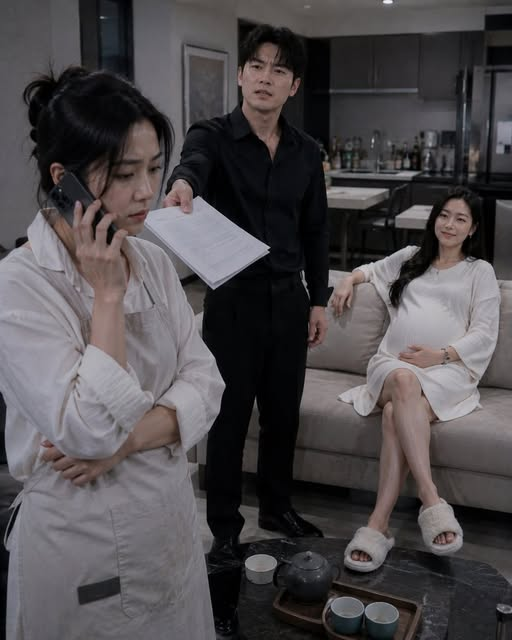
Behind him, Bach Vi appeared wearing my slippers.
Her hand rested protectively on her belly.
“Mr. Lang, don’t listen to her. She’s only trying to scare us.”
I picked up my document bag.
Then the doorbell rang.
Three times.
Tran Lang walked toward the entrance with an irritated expression.
The moment he opened the door, his face changed.
My father stood there.
Not alone.
Beside him was his attorney.
And behind them, the property manager who had handled the house for more than ten years.
My father looked past Tran Lang.
“Van Van.”
“I’m here.”
“Have you packed what belongs to you?”
“Yes.”
He nodded.
Then he turned to Tran Lang.
“Good evening.”
Tran Lang forced a smile.
“Dad, this is a marital issue. You shouldn’t interfere.”
My father’s expression did not change.
“Don’t call me Dad.”
The living room fell silent.
Bach Vi slowly stood from the sofa.
My father glanced at her.
Then at the slippers.
He recognized them.
His mouth tightened.
The attorney opened a folder.
“Mr. Tran, this property is registered to Mr. Lam.”
Tran Lang stared at him.
“That’s impossible.”
The attorney placed a certified copy of the deed on the table.
Tran Lang grabbed it.
His face slowly lost color.
Owner:
LAM QUANG MINH.
Not Tran Lang.
Not me.
My father.
Bach Vi whispered:
“But Mr. Lang said he bought it.”
I finally looked at her.
“He lies.”
Tran Lang snapped:
“Shut up.”
She flinched.
My father continued calmly.
“When my daughter married you, you were renting a one-bedroom apartment.”
Tran Lang said nothing.
“I allowed you both to live here because this house was close to her work and because I thought you would build a family.”
He looked around.
“No rent for the first three years.”
“Afterward, only a nominal monthly amount for maintenance.”
Tran Lang’s eyes widened.
“You told me those payments were installments.”
I almost laughed.
“No.”
“I told you they were housing expenses.”
“You decided that meant mortgage payments.”
His face became ugly.
“But I renovated this place.”
My father nodded.
“You replaced the kitchen cabinets.”
“And the curtains.”
“Neither makes you the owner.”
Bach Vi’s face turned pale.
She looked at the marble floor.
The chandeliers.
The custom cabinets she had probably already imagined filling with her things.
Then at Tran Lang.
“So this isn’t your house?”
He did not answer.
My father did.
“No.”
She stepped away from him.
It was a small movement.
But I noticed.
So did he.
Tran Lang threw the deed onto the table.
“Fine.”
His voice was harsh.
“We’ll leave.”
Then he looked at me.
“But the divorce agreement stands.”
I picked it up.
The first page claimed the house belonged to him.
The second said I waived all claims against “his” property.
The third demanded I leave immediately with no financial settlement.
I smiled.
“Your agreement is fiction.”
His face darkened.
“You didn’t contribute anything to this marriage.”
That was when my lawyer entered.
I had called her before my father.
Tran Lang stared.
“You hired a lawyer?”
“Yes.”
“You’ve been planning this?”
“No.”
I looked toward Bach Vi’s belly.
“You planned it for me.”
My attorney placed another folder beside his divorce papers.
“Mr. Tran, before Mrs. Lam signs anything, there will be full financial disclosure.”
He frowned.
“There’s nothing to disclose.”
She opened the first statement.
Transfers to Bach Vi.
Apartment rent.
Medical expenses.
Luxury purchases.
A car deposit.
Nearly eighteen months of payments.
Some came from Tran Lang’s personal salary.
Those were his problem.
Others came from our joint savings.
Those were mine too.
Bach Vi’s expression changed.
She clearly had not known how much of her new life had been financed from a marital account.
Tran Lang said:
“It was my money.”
My attorney replied:
“Then you’ll have no difficulty demonstrating that.”
He slammed his hand on the table.
“You people are trying to humiliate me.”
I finally laughed.
“No.”
“You brought a pregnant woman into my home.”
“Put divorce papers in my face.”
“Told me I would leave with nothing.”
I looked at him.
“You did not need help humiliating yourself.”
Bach Vi suddenly spoke.
“Mr. Lang…”
He turned.
She looked shaken.
“You said the house was yours.”
“It doesn’t matter.”
“It matters to me.”
He stared at her.
Then something almost funny happened.
The woman who had entered my home like a new mistress of the property suddenly looked around as though every object had become borrowed.
She took off my slippers.
Placed them beside the sofa.
Barefoot.
I almost admired the speed.
My father’s attorney handed Tran Lang a formal notice.
His right to occupy the house had been granted through me.
Once I no longer lived there, that permission ended.
He had thirty days to remove his belongings.
Not that night.
My father was not interested in theatrics.
Just paperwork.
That somehow made Tran Lang even angrier.
He looked at me.
“You’re really going to do this?”
I picked up my suitcase.
“No.”
“You already did.”
The divorce took seven months.
Tran Lang fought hard at first.
He claimed I had contributed little because I spent years managing the home instead of expanding my own career.
The records told a different story.
I had paid household expenses from my salary.
I had covered part of his professional certification.
I had used savings from before marriage to help him through two periods of unemployment.
And when his small trading business nearly collapsed in its second year, my father had introduced him to three clients.
That business later became the foundation of his current income.
My father never owned it.
Never demanded shares.
He simply helped his son-in-law.
Tran Lang had eventually rewritten that memory too.
By the time mediation began, he was calling himself “self-made.”
My father heard that once and laughed.
“Self-made people usually remember the hands that held the ladder.”
Tran Lang did not.
Bach Vi’s situation deteriorated quickly.
Not because I attacked her.
I never spoke to her again after that night.
But when the fantasy disappeared, reality arrived.
There was no luxury house.
No effortless divorce.
No enormous fortune waiting for her.
Tran Lang had money.
Just not the life he had advertised.
The car he promised her was financed.
The apartment he planned to give her was rented.
And part of the savings he claimed were his alone became subject to division during the divorce.
She left him three months before the baby was born.
At least temporarily.
I heard later they created a parenting arrangement.
I was glad for the child.
Children should not pay for the arrogance of adults.
As for me, I moved into a smaller apartment my father owned near my workplace.
At first, he refused to charge me anything.
I refused to accept.
So we compromised.
I paid rent.
Market rate.
Every month.
The first time I transferred it, Dad called immediately.
“Why did you send me so much?”
“Because I live here.”
“You’re my daughter.”
“And?”
He sighed.
“You’re stubborn.”
“Genetics.”
He laughed.
I returned to work full-time.
Then something unexpected happened.
Without Tran Lang’s meals, shirts, appointments, family gatherings and constant emergencies taking up my days, I had time.
Actual time.
I enrolled in a professional course I had postponed for four years.
Six months later, I was promoted.
The first thing I bought with the raise was a pair of slippers.
Bright yellow.
Completely ridiculous.
Mine.
One year after the divorce, I saw Tran Lang again.
We were both at the bank handling the final closure of an old joint account.
He looked thinner.
Less polished.
He stared at me for a while.
“You look different.”
“I sleep better.”
His mouth tightened.
Then he asked:
“Did you know about Bach Vi before that day?”
“No.”
“I thought you did.”
I looked at him.
“Why?”
“You were too calm.”
I almost smiled.
“Calm does not mean ignorant.”
He looked down.
“I thought you would cry.”
“I almost did.”
“And?”
“I decided packing was more useful.”
Silence.
Then he whispered:
“I really thought the house was partly mine.”
I believed him.
That was the strange thing.
He had lived there long enough that entitlement had become memory.
He no longer remembered the original agreement because remembering it would require gratitude.
He asked:
“Do you hate me?”
“No.”
His eyes lifted.
“Not anymore.”
“Could we ever—”
“No.”
The answer was so immediate that he laughed bitterly.
“I didn’t even finish.”
“You didn’t need to.”
He nodded.
Fair.
Before leaving, he said:
“Your father never liked me.”
I shook my head.
“That’s not true.”
“He helped you because I was your husband.”
“Yes.”
“That means he liked you enough to give you a chance.”
Tran Lang went quiet.
Then I added:
“You were the one who decided the chance belonged to you permanently.”
That was our last real conversation.
Two years later, my father transferred the smaller apartment into my name.
Not the old house.
That one he sold.
When I asked why, he said:
“Too many bad memories.”
I understood.
With part of the sale, he traveled with my mother for six months.
Apparently retirement became much more enjoyable once he stopped solving my marital problems.
The day Tran Lang brought Bach Vi home, he threw divorce papers in my face and told me:
“Sign and get out. This house is mine.”
Then she sat on my sofa, wore my slippers and thanked me for “taking care of him” until she arrived.
They thought I had lost everything.
The husband.
The house.
The future.
All in one night.
So I made one phone call.
Not because my father was rich.
Not because I needed him to rescue me.
But because there was one simple fact Tran Lang had forgotten after living comfortably for too long:
He was a guest.
In the house.
In my father’s generosity.
And eventually—
in my life.
He believed marriage had turned permission into ownership.
It hadn’t.
And when he ordered me out of the home he never owned—
I finally realized he had mistaken my love for property too.
