Chu Khai Minh stared at me.
“What qualifications do I have?”
His voice had gone cold.
“I’m the legal representative of this company.”
I nodded.
“Yes.”
“And you are not.”
“Yes.”
His shoulders relaxed slightly.
Then I opened my bag.
“But you still owe me 1.83 million yuan.”
His expression froze.
Hua Man immediately looked at him.
“What?”
I placed three documents on the table.
The first was the 376,000-yuan emergency salary transfer from my personal account.
The second was the remaining 600,000 yuan from the sale of my mother’s house that the company had never repaid.
The third was something Chu Khai Minh clearly hoped I had forgotten.
A handwritten financing acknowledgment from our second year.
He had signed it himself.
Any funds advanced by Lam Tri Ha during the start-up stage will be treated as founder financing and repaid before external profit distributions unless otherwise converted by mutual written agreement.
No conversion had ever happened.
No waiver existed.
Hua Man read it twice.
Then turned sharply toward him.
“You told me these were personal gifts.”
Chu Khai Minh’s face darkened.
“They were between us.”
I smiled.
“Exactly.”
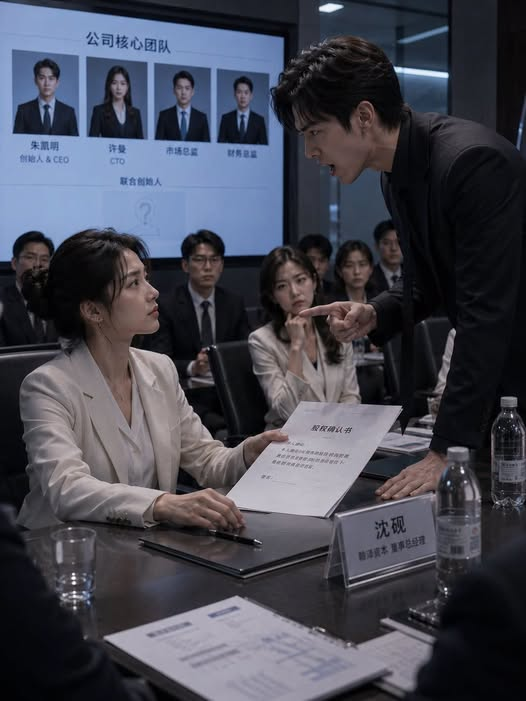
“So why does today’s agreement say I never participated in founding or financing the company?”
Silence.
I tapped the blue folder.
“If I sign this, I am not just accepting 800,000 yuan.”
“I would be declaring that all my early support was voluntary.”
“I would be helping you rewrite documented debt as a favor.”
Hua Man’s expression changed completely.
She finally understood why I had been invited to the capital call despite having no nameplate.
The investors did not need me because they cared about my feelings.
They needed me because due diligence had already found my fingerprints everywhere.
And unlike the presentation—
bank records could not be edited with PowerPoint.
There was a knock.
Tham Nghien entered.
“Ten minutes are over.”
Nobody spoke.
He looked at the papers on the table.
Then at me.
“May we continue?”
I stood.
“Yes.”
We returned to the conference room.
More than twenty investors were waiting.
Chu Khai Minh walked beside me.
Just before entering, he whispered:
“Tri Ha, don’t force me.”
I stopped.
Then looked at him.
“For eight years, every time the company was in trouble, you said we were partners.”
“Today, because the company is finally valuable, I became your personal friend.”
I smiled.
“You don’t need me to force you.”
“You already chose.”
The meeting resumed.
Tham Nghien pushed the investment confirmation toward me again.
“Miss Lam.”
I did not touch the pen.
Instead, I asked:
“Before I answer, may I ask what exactly you need me to confirm?”
He nodded.
“Three things.”
He counted them calmly.
“First, that there are no undisclosed founder loans or claims that could affect the financing.”
Chu Khai Minh’s face stiffened.
“Second, that the An Hoa commercial relationship will remain stable for at least the next contract cycle.”
“Third…”
Tham Nghien looked directly at Chu Khai Minh.
“That management’s statements about the company’s founding history are accurate.”
Nobody moved.
I almost laughed.
So that was why they had wanted my signature.
Not because I was irrelevant.
Because I was the last unresolved risk in the room.
I opened the blue agreement Hua Man had prepared.
Then I tore it once.
Not dramatically.
Just straight down the middle.
Hua Man stood.
“Miss Lam!”
I placed both halves on the table.
“I cannot confirm any of those three points.”
The room erupted into whispers.
Chu Khai Minh’s face went white.
“Tri Ha.”
I continued.
“The company still owes me documented founder-stage financing.”
“The An Hoa renewal has not been finalized.”
“And this morning, your CEO publicly stated that I merely ‘helped a little.’”
I looked around the table.
“So I would recommend that every investor here rely on the company’s official version.”
Silence.
Then Tham Nghien asked:
“And according to that official version, do you have any obligation to help preserve An Hoa?”
I smiled.
“No.”
Chu Khai Minh shot to his feet.
“Lam Tri Ha!”
The microphone was still on.
His voice echoed through the room.
Everyone turned.
He realized too late.
I looked at him.
“What?”
His face flushed.
“We should discuss private matters privately.”
I tilted my head.
“You just told twenty investors our relationship with the company was private.”
Someone at the far end coughed to hide a laugh.
Tham Nghien closed the investment folder.
“Our fund is suspending participation pending clarification.”
One investor immediately followed.
“So are we.”
Then another.
“We need revised disclosures.”
A fourth:
“And confirmation regarding An Hoa.”
Within five minutes, not one person had wired money.
Nobody stormed out.
Nobody shouted.
That was worse.
They simply stopped.
Capital is like water.
The moment it smells uncertainty, it waits.
After the meeting, Chu Khai Minh pulled me into the hallway.
His face was completely different now.
No arrogance.
Only panic.
“You knew they would suspend.”
“I suspected.”
“You planned this.”
“No.”
I looked at him.
“You planned this.”
I pointed toward the presentation room.
“You removed my name.”
“You prepared the waiver.”
“You offered me 800,000 to erase eight years.”
“All I did was refuse to cooperate.”
His breathing grew heavier.
“What do you want?”
There it was again.
He still believed everything had a price.
“Repayment of the documented debt.”
“Impossible right now.”
“Then negotiate with my lawyer.”
His eyes widened.
“Lawyer?”
“Yes.”
“And An Hoa?”
“I haven’t decided.”
His face changed.
“Tri Ha, if An Hoa doesn’t renew, the company loses more than half its revenue.”
“I know.”
“You built this with me!”
I stared at him.
That sentence almost hurt.
Almost.
“I thought I only helped a little.”
He had no answer.
That evening, Hua Man called me.
I nearly declined.
Then answered.
“Miss Lam.”
“What?”
Her voice was much less confident than before.
“I didn’t know the entire financing history.”
“That isn’t my problem.”
“I believed what General Manager Chu told me.”
“And now?”
Silence.
Then:
“Now I believe he wanted a clean founder story before the funding round.”
Of course.
Investors preferred simple structures.
One founder.
One cap table.
One clear decision-maker.
And Hua Man had been promised an equity option if the round closed.
My existence complicated both of their plans.
She continued:
“The 800,000 wasn’t really compensation.”
“I know.”
“It was consideration for the waiver.”
“I know that too.”
Another silence.
Then she said something I did not expect.
“You should not sign it.”
I laughed softly.
“At least we agree on something.”
Three days later, An Hoa invited me to headquarters.
The chairman, Mr. Chen, had known me for six years.
He poured tea himself.
“I heard about the capital meeting.”
“I’m sorry.”
“Why?”
“The disagreement may affect your supplier.”
He shook his head.
“Tri Ha, An Hoa works with companies.”
Then he looked at me.
“But companies are made of people.”
He slid a contract draft toward me.
Not a renewal.
A new framework.
The previous agreement had listed Khai Minh Company as supplier.
The new proposal required a dedicated project-management office led by a qualified external commercial director.
Mr. Chen tapped the page.
“We do not care whether that person belongs to Khai Minh.”
I understood.
“You want me to continue managing the account independently.”
“Yes.”
“You could hire me directly.”
“Or your company.”
I froze.
“My company?”
He smiled.
“You have spent eight years building someone else’s.”
“Have you never considered building your own?”
For the first time in days, I had no answer.
I did not steal An Hoa from Chu Khai Minh.
I did something simpler.
I informed him.
I sent the new framework to his office and requested a three-party discussion.
His call came nine minutes later.
“You’re taking An Hoa?”
“No.”
“Then what is this?”
“An Hoa wants independent project management.”
“And they named you.”
“Yes.”
His voice cracked.
“Because I introduced you!”
I closed my eyes.
Eight years.
And even now, he needed every achievement to pass through him first.
“No, Khai Minh.”
“They named me because I managed the account for six years.”
The following week, we sat across from each other with lawyers present.
The solution was not romantic.
It was commercial.
Khai Minh Company retained part of the technical execution work.
An Hoa contracted my new consulting firm for project governance, renewal strategy and partner coordination.
My documented founder loans were repaid over twelve months.
I received no imaginary “co-founder title.”
I stopped wanting one.
Because a title granted after humiliation would only be another favor from Chu Khai Minh.
I wanted records.
Contracts.
My own name.
The financing round eventually closed four months later.
At a lower valuation.
The investors required stronger governance and full disclosure of related founder claims.
Tham Nghien’s fund invested.
But not because Chu Khai Minh convinced him.
Because the risks had finally been written honestly.
Hua Man remained with the company.
Her equity option was reduced.
She accepted it.
Chu Khai Minh remained CEO.
But the days when he could casually rewrite history in a presentation were over.
There was now a board.
Minutes.
Controls.
People who asked uncomfortable questions.
As for us—
we ended.
He came to my new office six months later.
The sign outside read:
TRI HA PROJECT ADVISORY
He stood beneath it for a long time.
Then entered.
“You really did it.”
“Yes.”
There were twelve employees.
Nothing compared to his company.
But nobody there called me a personal friend.
He sat opposite me.
“I was wrong.”
I waited.
He continued:
“I thought if I acknowledged you publicly, investors would question why you had no formal equity.”
“They would.”
“And then I would have to explain that I kept postponing it.”
“Yes.”
His eyes reddened.
“I kept telling myself I would fix it after the next contract.”
“The next round.”
“The next year.”
I nodded.
Eight years had been built from “next.”
Then he whispered:
“I was afraid if I gave you what I promised, I would lose control.”
There it was.
Finally.
Not Hua Man.
Not investors.
Not presentation strategy.
Control.
I asked:
“And now?”
He laughed bitterly.
“Now I lost you instead.”
I said nothing.
He looked around my office.
“Can we start over?”
“No.”
His expression tightened.
“Because of the capital meeting?”
“No.”
I looked directly at him.
“Because the capital meeting only revealed what had already happened.”
“You stopped seeing me as the person who built beside you.”
“You started seeing me as a liability that needed to be removed before investors arrived.”
He lowered his head.
“I’m sorry.”
“I know.”
That was enough.
One year later, my firm handled projects for seven companies.
An Hoa remained our largest client.
But not our only one.
That mattered to me.
I never wanted my future dependent on one contract again.
At an industry forum, I ran into Tham Nghien.
He smiled.
“Miss Lam.”
“General Manager Tham.”
He handed me a coffee.
“Do you remember that capital call?”
“How could I forget?”
He laughed.
Then said:
“Everyone thought we were waiting for your permission to invest.”
“Weren’t you?”
“Partly.”
He became serious.
“We were waiting to see whether management would tell the truth when the truth was inconvenient.”
I looked at him.
“And?”
“You answered for them.”
That stayed with me.
For years, I thought my mistake was not demanding shares.
Not insisting my name be placed in the charter.
Not getting every promise in writing.
Those were mistakes.
But the biggest mistake was believing that because someone remembered your sacrifices in private, they would honor them when those sacrifices became expensive to acknowledge publicly.
Chu Khai Minh once held me in a freezing motel room and promised:
“Whatever I have in the future, half will be yours.”
Eight years later, in front of twenty investors, he reduced me to:
“She only helped a little.”
So I finally did exactly what a person who “only helped a little” was entitled to do.
I stopped helping.
The investors paused.
An Hoa reconsidered its structure.
The unpaid debts surfaced.
The story he had polished for the capital market cracked in one afternoon.
Not because I destroyed his company.
Because I refused to erase myself to save it.
And the 800,000 yuan he offered me that day?
I never took it.
Years later, my own company earned more than that from a single quarter.
The difference was simple.
This time, when the money arrived—
my name was already on the contract.
