The knock came again.
Before Daniel could move, Dr. Lena Ortiz pulled the curtain aside.
Two detectives stood in the doorway. Behind them was a hospital security officer and a woman in a charcoal suit carrying a sealed evidence bag.
Daniel recovered first.
“My wife is in no condition to speak with anyone.”
Detective Claire Nolan looked past him toward me.
“Mrs. Grant, do you want your husband in the room?”
Daniel answered for me.
“Of course she does.”
I held Lena’s hand and forced out one word.
“No.”
His face changed.
Not dramatically. Daniel was too controlled for that.
But I saw the instant he understood that the frightened woman he had brought into the hospital was no longer following his script.
The security officer stepped between us.
“Mr. Grant, you need to wait outside.”
“This is absurd. My wife suffered an accident.”
Detective Nolan opened the evidence bag.
Inside was a tablet.
“No,” she said. “Your wife survived a crime.”
EXHIBIT ONE: THE VIDEO
Lena placed the tablet where I could see it.
The footage had been recorded from a camera hidden beneath the kitchen cabinet. I had installed it two months earlier after discovering that documents in my locked study had been moved.
The image showed Vivian standing beside the stove.
It showed me entering the kitchen.
It showed her criticizing the time, the food and the fact that Daniel had not yet been served.
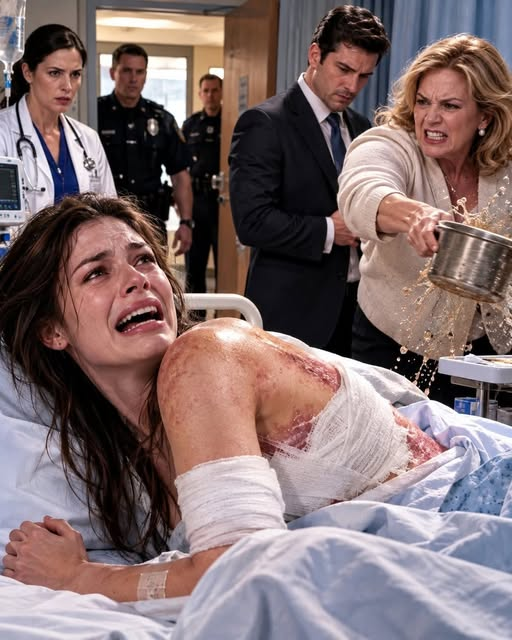
Then came the moment she lifted the pot.
Lena stopped the recording before the impact.
She did not need to play the rest.
Daniel’s voice came from the video.
Not frightened.
Not confused.
Calm.
“Put the pot back,” he told his mother. “Wipe the handle.”
Vivian could be heard asking whether they should call an ambulance.
Daniel answered:
“Not yet. We need the kitchen to look right.”
The room went silent.
He had waited eleven minutes before calling emergency services.
During those eleven minutes, he moved objects, cleaned part of the floor and rehearsed the story Vivian later repeated at the hospital.
She dropped a pot of soup.
She was clumsy.
She became emotional easily.
The same lies, arranged into a neat little cage.
Vivian began shaking her head.
“He told me what to do!”
Daniel turned on her instantly.
“Don’t say another word.”
Detective Nolan’s eyes narrowed.
“That sounded like another instruction.”
Vivian backed toward the door, but hospital security blocked her.
Daniel looked at me.
“You recorded us without permission?”
Even then, that was what angered him.
Not what had happened.
Not the pain I was in.
The fact that he had been caught.
“It was my kitchen,” I whispered.
“My house.”
“And my camera.”
Detective Nolan placed Vivian under arrest.
The moment the handcuffs closed, Vivian’s loyalty to her son vanished.
“I didn’t plan this!” she cried. “I only wanted to frighten her. Daniel was the one who said we needed another medical incident!”
Daniel went completely still.
I closed my eyes.
So that was what they had called the earlier incidents.
Medical incidents.
Not the time Vivian pushed me down the stairs.
Not the medication Daniel replaced and then blamed me for forgetting.
Not the night they locked me outside until I agreed to sign a financial authorization.
To them, my suffering had always been paperwork.
EXHIBIT TWO: THE PLAN
The woman in the charcoal suit stepped forward.
“Mr. Grant, my name is Maya Chen. I’m an investigator with the state financial crimes division.”
For the first time, genuine fear appeared in Daniel’s eyes.
Maya had worked beside me years earlier when I prosecuted a network of investment fraud cases.
Daniel knew her name.
He had simply never known we were still in contact.
“At 8:17 tonight,” Maya said, “our office received an encrypted file containing financial records connected to you, your mother and four shell companies.”
Daniel looked at me.
“You sent government files about your own husband?”
“No.”
Lena answered for me.
“They were sent automatically when Catherine was admitted under suspicious circumstances.”
Six months earlier, I had created a dead-man protocol.
If I were hospitalized, reported missing or declared mentally incapable, copies of everything would be delivered to Lena, Maya, my trustee and my divorce attorney.
Daniel had believed he was isolating me.
In reality, every person I trusted had been waiting for one signal.
Maya opened another document.
“We also received a draft petition seeking emergency control of your wife’s trust.”
Daniel said nothing.
The petition claimed I was emotionally unstable and incapable of managing money.
Attached to it was a psychiatric evaluation.
The doctor’s signature was real.
The examination was not.
I had never met him.
Maya continued:
“According to the metadata, this report was created five weeks ago.”
Lena’s face hardened.
“Five weeks before tonight’s so-called accident?”
“Yes.”
Vivian began crying harder.
“Daniel said it was only temporary! He said once the court gave him control, Catherine would calm down and everything would go back to normal.”
I looked at my husband.
He had spent three years telling people I was unstable.
Now I understood why.
It had never been casual cruelty.
He had been building a legal history.
Every time I objected, he called me irrational in front of witnesses.
Every time I cried, he documented an “episode.”
Every time Vivian provoked me, Daniel sent messages to relatives describing how difficult I had become.
He wasn’t merely destroying my confidence.
He was manufacturing evidence.
The hospital incident was supposed to be the final piece.
A serious injury.
A distressed wife.
A devoted husband asking the court for temporary control.
Then the trust would open.
And once Daniel had access to the money, temporary would become permanent.
“You cannot prove I created that report,” he said.
Maya held up his phone.
“You tried to erase the file from your cloud account eleven minutes ago.”
His mouth opened.
“Deleted data,” she said, “is still data.”
EXHIBIT THREE: THE MONEY
The investigation lasted seven months.
During that time, Daniel told three different versions of the truth.
First, he claimed Vivian acted alone.
Then he claimed I had manipulated an elderly woman into attacking me.
Finally, he claimed the entire case was revenge because our marriage was failing.
But numbers do not become confused under questioning.
They do not forget dates.
They do not change their story to protect themselves.
The records showed that Daniel had transferred nearly eight million dollars into companies linked to Vivian.
He had forged my approval on loan applications.
He had paid the physician who created the false evaluation.
And he had submitted altered trust documents to a bank, believing they were the originals I had signed.
That was his greatest mistake.
The papers I signed in front of him six months earlier were harmless administrative copies.
The missing pages he had tried to conceal would have granted him control.
I had removed them before the signing.
When Daniel later submitted the complete version carrying a copied signature, he did more than expose his intentions.
He created evidence of fraud in his own name.
Vivian accepted a plea agreement and testified against him.
She admitted that Daniel had promised her a new house, a monthly allowance and ownership in one of the shell companies once he controlled my trust.
She also admitted that after the attack, Daniel had ordered her to clean the kitchen before helping me.
She cried while saying it.
I felt nothing.
Her tears were not remorse.
They were the grief of a woman discovering that consequences also applied to her.
Daniel’s attorney tried to portray me as calculating.
He told the court I had spent months secretly collecting evidence instead of confronting my husband.
When it was my turn to speak, I looked directly at Daniel.
“I did confront him.”
The courtroom became still.
“I confronted him every time I asked where the money had gone.”
“Every time I demanded access to my own accounts.”
“Every time I told him his mother’s behavior was escalating.”
“He answered by telling everyone I was unstable.”
I turned toward the judge.
“So I stopped arguing.”
“And I started documenting.”
Daniel was convicted of financial fraud, conspiracy, obstruction and falsifying medical evidence. Vivian was sentenced for the attack and her role in the financial scheme.
The trust remained untouched.
The house was mine.
So was every asset my father had protected.
But I did not keep the house.
Too much of Daniel remained inside its walls.
I sold it and used part of the proceeds to establish a legal fund for people trapped through financial control and fabricated claims of instability.
The rest I kept.
Not because money mattered more than justice.
Because it was mine, and I was finished apologizing for protecting what belonged to me.
THE FINAL STATEMENT
The divorce was completed several weeks after Daniel’s sentencing.
As officers prepared to lead him from the courtroom, he turned toward me.
“You destroyed my life.”
For years, that sentence would have made me question myself.
That day, it almost made me smile.
“No, Daniel.”
I picked up my case file.
“You mistook my silence for permission.”
He stared at me as though waiting for another answer.
An apology.
A confession that I still loved him.
Anything that would make him important again.
I gave him nothing.
Lena was waiting outside the courthouse.
The afternoon sun was warm, and for the first time in years, my phone contained no tracking software, no screened calls and no messages demanding to know where I was.
“Where do you want to go?” she asked.
I looked back once at the courthouse doors.
Daniel and Vivian had believed they finally broke me in that kitchen.
They had believed pain would make me easier to control.
They had believed the hospital would become the place where their lie was officially recorded.
Instead, it became the place where every secret they had buried was released.
“Home,” I said.
Not the mansion.
Not my marriage.
Not any place Daniel had chosen for me.
Home was the life waiting beyond him.
They thought the woman lying beneath those white hospital sheets was powerless.
They forgot what I had once done for a living.
I built cases against people who believed they were untouchable.
And Daniel Grant had given me the one thing every good attorney needs.
Evidence.
