For the next three weeks, Noah lived inside the future he had designed without me.
He submitted documents.
Sold furniture.
Canceled our lease.
Talked endlessly about Boston.
And every night, he asked the same question.
“Did your application move forward?”
“Yes.”
I never lied.
He simply never asked which application.
The morning my return permit arrived, I placed it inside my passport and went to meet the research institute director who had been waiting for my answer.
Professor Liang looked at my academic record for a long time.
“You changed from astrophysics to theoretical physics?”
“Yes.”
“Why?”
I almost said because of my husband.
Instead, I answered:
“I made the wrong decision.”
He nodded.
“Do you want to correct it?”
My heart stopped.
He slid a folder toward me.
Inside was a newly funded national astrophysics program.
Satellite observation.
Deep-space modeling.
A field I had abandoned years earlier.
“We need someone with your mathematical background.”
I stared at him.
“But I haven’t worked directly in astrophysics for years.”
“You haven’t forgotten how to think.”
That sentence almost made me cry.
For years Noah had spoken as though changing paths had permanently closed the door.
Professor Liang spoke as though doors could be reopened.
I signed.
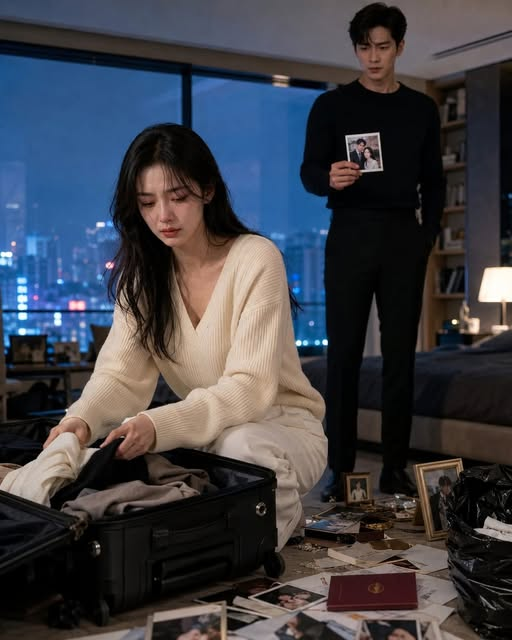
I told Noah about the divorce that evening.
He was packing books.
At first, he thought he had misheard me.
“What?”
“I’m returning home next week.”
He smiled automatically.
“Yes. After we finish the immigration process, we can visit—”
“Alone.”
His hands stopped.
I placed the divorce papers on the table.
“I’m not going to the United States.”
His face slowly changed.
“Claire, stop joking.”
“I’m not joking.”
“What about our plan?”
I almost laughed.
“Which plan?”
“Our life.”
“Noah, you already planned your life.”
I looked at him.
“You just assumed I would follow.”
He opened the papers but didn’t read them.
“Is this because of Elena?”
That was the first time he had said her name to my face.
“Yes.”
Then I shook my head.
“And no.”
He frowned.
“If Elena disappeared tomorrow, we would still be finished.”
His expression stiffened.
“Why?”
“Because I finally heard what you think of me.”
I repeated his words.
“Suitable to marry.”
His face went white.
“You heard that?”
“All of it.”
He sat down.
“Claire, I didn’t mean—”
“You did.”
“I was confused.”
“No.”
“You were honest because you thought I wasn’t listening.”
That silenced him.
Then he tried the argument I knew would come.
“You gave up astrophysics because we agreed to return.”
“I did.”
“And now you’re leaving me for your career?”
“Noah.”
I looked at him for a long time.
“I gave up my dream because I believed we were sacrificing for the same future.”
“You weren’t sacrificing.”
“You were waiting for Elena.”
His mouth opened.
Nothing came out.
I picked up my suitcase.
He suddenly grabbed my wrist.
“If you leave now, don’t expect me to come after you.”
In another life, that sentence might have frightened me.
This time, I gently removed his hand.
“I don’t.”
A week later, I landed home.
Nobody was waiting with flowers.
No dramatic music.
No applause.
My father simply took my suitcase and said:
“You’ve lost weight.”
My mother hugged me until I could barely breathe.
And for the first time in years, I slept in my childhood bedroom.
The next morning, I reported to the institute.
That was how my second life began.
Quietly.
I had to relearn things.
I embarrassed myself in meetings.
Younger researchers knew software I had never used.
For six months, I wondered whether Noah had been right—that I had left astrophysics too long ago.
Then one night, at almost three in the morning, our team solved a modeling problem that had delayed the project for weeks.
Professor Liang looked at the screen.
Then at me.
“Still think you came back too late?”
I smiled.
“No.”
I finally understood.
I had not returned too late.
I had simply spent several years walking in the wrong direction.
Noah went to the United States.
Elena was waiting.
At first, everything looked exactly like the future he had imagined.
They worked at the same university.
They traveled.
They appeared together at conferences.
Julian occasionally sent me news until I asked him to stop.
I didn’t want to know.
But some stories find their way back anyway.
Two years later, Elena accepted a position on the West Coast.
Noah wanted her to stay in Boston.
She refused.
Apparently, Elena had never asked him to sacrifice anything for her.
That had been his fantasy.
She had loved the attention.
The history.
The idea that someone had crossed an ocean for her.
But she had never promised to build her life around him.
Noah followed her again.
Then she left again.
Within another year, they were finished.
I heard only one sentence about it.
Elena had told him:
“I never asked you to abandon your wife.”
For once, she was right.
That choice had been his.
By then, my life had become very different.
Our research program expanded.
I published again.
Then I began leading my own team.
The girl who had once rejected an elite astrophysics program because her husband questioned her loyalty was eventually invited to speak at one.
The irony did not hurt anymore.
It amused me.
Then, five years after our divorce, Noah emailed me.
Subject:
I’m coming home.
I almost deleted it.
Instead, I opened it.
He wrote that he had made mistakes.
That America no longer felt like home.
That he wanted to return permanently.
And that perhaps, once he returned, we could talk.
I answered with one line.
I hope your application goes smoothly.
It didn’t.
Years earlier, during his immigration process, Noah had made choices regarding his original nationality that he believed would never matter.
At the time, returning had seemed unnecessary.
His future was America.
His career was there.
Elena was there.
He had treated nationality almost like another document to reorganize for convenience.
Now he wanted it back.
His first application was rejected.
Then his second.
Then another.
He appealed.
Submitted additional records.
Waited.
Tried again.
Rejected.
Julian told me Noah became obsessed.
“He keeps saying he was born here.”
I said nothing.
“He says it’s his home.”
Still nothing.
Finally Julian asked:
“Don’t you feel sorry for him?”
I looked through the observatory window at the city lights below.
“No.”
Not because I hated Noah.
But because I had finally learned the difference between tragedy and consequence.
He had always believed some things would wait forever.
His country.
His wife.
His old life.
Me.
The last time I saw him was at an international academic conference.
Eight years had passed.
He looked older.
So did I.
He found me after my presentation.
“Claire.”
I turned.
For several seconds, neither of us spoke.
Then he smiled sadly.
“I heard you became director of the program.”
“Yes.”
“And astrophysics.”
“Yes.”
He lowered his eyes.
“You went back to it.”
“I did.”
He gave a short laugh.
“You must hate me.”
“No.”
That answer seemed to hurt him more.
He asked:
“Do you know my application was rejected again?”
“I heard.”
“This was the fifth time.”
“I’m sorry.”
He stared at me.
“I thought coming back would be easy.”
I looked at him.
“That was always your problem, Noah.”
He frowned.
“You thought leaving was your choice…”
I paused.
“…and returning would also be your choice.”
He became silent.
Then he whispered:
“If I hadn’t gone to America, would we still be married?”
I thought about Cambridge.
About his speeches.
About the dream I abandoned.
About Elena’s name whispered beside me in the dark.
“No.”
He looked surprised.
“Why?”
“Because America didn’t destroy our marriage.”
I smiled faintly.
“It only gave me enough distance to see it clearly.”
A colleague called my name from across the hall.
I turned to leave.
Noah stopped me one final time.
“Claire.”
“What?”
“If I manage to return someday…”
I already knew what he wanted to ask.
Would there still be a place for him?
I shook my head.
“Come back for yourself.”
“Not for me.”
Then I walked away.
Years earlier, Noah had believed I was the perfect wife because I knew how to give in.
He thought that meant I would always follow.
He went to America for the woman he could never forget.
I returned home for the woman I had forgotten.
Myself.
And in the end, that was the cruelest difference between us.
Noah spent years trying to return to a country he once chose to leave.
I came home once—
and never needed to look back again.
