Almost a year passed before Julián knocked on my door again.
By then, he no longer came home after midnight trying not to be seen.
The old car that used to disappear around the corner was gone too.
He had replaced it with a small secondhand hatchback that made a strange noise every time he started it, but he seemed proud of it.
That afternoon, he stood on my porch wearing clean work clothes and holding an envelope.
“Carmen, do you have a minute?”
I smiled.
“You already paid the rent.”
“I know.”
“And the forty euros.”
“I know.”
“Then why are you carrying an envelope like someone coming to settle a debt?”
He looked embarrassed.
“Because maybe I still have one.”
Inside was a handwritten letter.
And a key.
I looked at him.
“What is this?”
“The machine shop promoted me.”
His smile appeared slowly.
“I’m supervising the afternoon shift now.”
“That’s wonderful.”
“And I rented a small apartment closer to work.”
For some reason, hearing that made my chest tighten.
“So you’re leaving.”
“Next month.”
I tried to sound cheerful.
“That’s what young people are supposed to do.”
He nodded.
But he didn’t move.
Finally, he said:
“I wanted to tell you something before I left.”
We sat at the kitchen table.
The same table where, after my husband died, I had spent countless nights pretending I wasn’t frightened about money.
Julián turned the coffee cup between his hands.
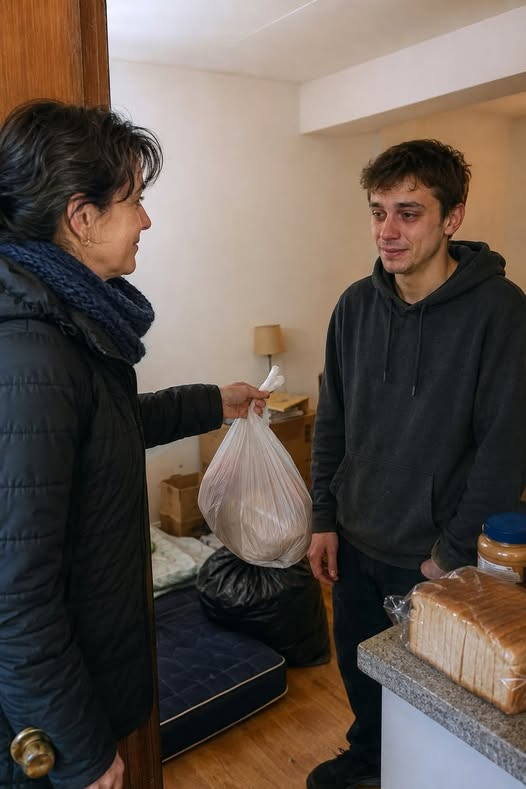
“Do you remember the night you came downstairs with groceries?”
“Of course.”
“I hadn’t actually planned to stay until Sunday.”
I looked at him.
He continued quietly.
“I was planning to disappear that same night.”
“Why?”
“Because I was ashamed.”
Not because of anything dramatic.
Not because anyone had threatened him.
He simply couldn’t bear the idea of looking another person in the eye and admitting that he had lost control of his life.
He had packed everything.
He had sold almost everything worth selling.
He had convinced himself that leaving without saying goodbye was somehow more dignified than asking for help.
“Then you knocked.”
His eyes lowered.
“And instead of demanding money, you brought eggs and pasta.”
I smiled slightly.
“Very glamorous.”
He laughed.
Then his expression became serious again.
“You gave me enough room to stop feeling like a failure.”
That sentence stayed with me.
Not money.
Not food.
Room.
Sometimes that is what people need most.
A little room to recover without everyone standing around measuring how quickly they do it.
Julián pushed the key toward me.
“This is the basement key.”
“I recognized it.”
“I wanted to give it back properly.”
Then he slid the letter across the table.
“You can read that later.”
After he left, I opened it.
The first line made me stop.
“Carmen, you probably think you only gave me a few groceries and forty euros.”
The letter continued.
“You gave me something I hadn’t received in a long time: the possibility of having one bad season without becoming a bad person.”
I read it twice.
Then folded it and put it in the drawer where I kept my husband’s old photographs.
Years passed.
The basement studio had other tenants.
Some stayed months.
Others stayed years.
One afternoon, nearly six years after Julián moved out, a black van stopped outside.
A man stepped out wearing a navy work jacket.
For a moment I didn’t recognize him.
Then he smiled.
“Still renting the basement?”
“Julián?”
He laughed.
He looked older.
More confident.
But his eyes were the same.
He wasn’t alone.
A young woman climbed out from the passenger side carrying a little girl.
“My wife, Daniela.”
Then he lifted the child into his arms.
“And this dictator is Emma.”
The girl waved solemnly.
Julián had come because the machine shop where he started had been sold.
Together with two former coworkers, he had bought the equipment and opened a smaller workshop of their own.
They now employed fourteen people.
“I have one rule,” he told me.
“What rule?”
“If someone is going through a difficult month, we talk before we judge.”
I looked at him.
He smiled.
“You taught me that.”
Before leaving, he handed me another envelope.
“Oh no.”
“This one isn’t money.”
Inside was a photograph.
Fourteen workers stood in front of a workshop.
Underneath, Julián had written:
“Everyone deserves enough time to stand up again.”
I kept that photograph too.
A few months later, my water heater broke.
I mentioned it casually when Julián called to wish me a happy birthday.
The following morning, a van arrived.
Two men replaced it.
When I asked for the bill, the technician laughed.
“Already paid.”
I called Julián immediately.
“You didn’t have to do that.”
His answer came without hesitation.
“Neither did you.”
I went quiet.
Then he added:
“But someone did.”
That was when I finally understood something I hadn’t understood the night I carried those groceries downstairs.
Kindness does not always return to the person who gave it.
Sometimes it travels.
Someone receives it.
Carries it for years.
Then gives it to somebody else.
Julián had arrived at my basement believing one missed rent payment had erased everything good about him.
It hadn’t.
He had simply needed someone to remind him that a difficult chapter is not the whole story.
And perhaps that was why, after all those years, I still remembered the sentence I had told him at the door:
A roof should never be used against anyone.
Because sometimes the difference between someone falling apart and finding their feet again…
is simply discovering that, when life becomes difficult, there is still one person willing to see a human being before seeing a debt.
