Twenty years later, the clasp on Grandma’s bracelet finally became loose.
I was afraid of losing it.
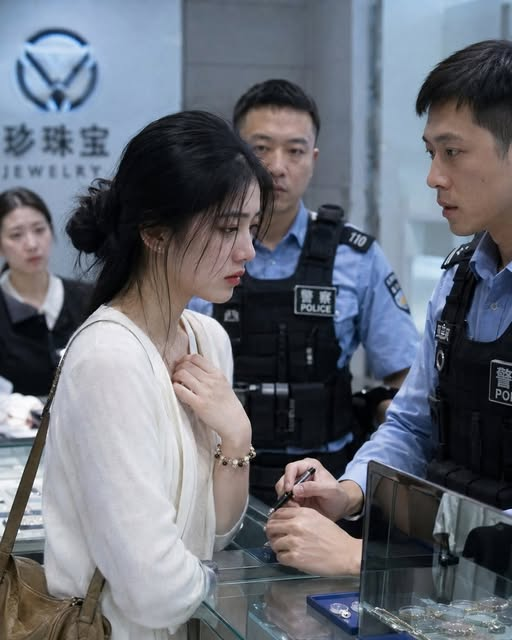
So after work, I walked into a large jewelry store and asked whether they could repair it.
The appraiser took one glance and stopped smiling.
He put on gloves.
Examined the inside.
Then examined it again under a lamp.
“Miss Shen, where did you get this?”
“My grandmother gave it to me.”
“When?”
“When I was eight.”
His expression changed.
He called the manager.
The manager came.
Then another appraiser.
Three adults stood around the dark bracelet my entire family had laughed at for twenty years.
Finally, the manager lowered his voice.
“Please don’t leave yet.”
My stomach tightened.
“Why?”
He turned the bracelet slightly.
Under years of dark oxidation was a tiny symbol I had never noticed.
A plum blossom.
Underneath it:
S-017.
The manager took out his phone.
Then said something I never expected to hear.
“Call 110.”
I stood up immediately.
“What?”
“Don’t be afraid.”
He raised both hands.
“We’re not accusing you of anything.”
“Then why are you calling the police?”
The appraiser looked at my wrist.
“Because this piece has been listed in an old missing-property record for twenty years.”
My mind went blank.
The police arrived thirty minutes later.
An officer photographed the bracelet and asked me the same question.
“Who gave it to you?”
“My grandmother. Shen Yulan.”
The officer’s expression changed.
“Shen Yulan?”
“Yes.”
He exchanged a glance with his colleague.
Then opened an archived record on his tablet.
There was an old photograph.
My grandmother.
Younger.
Standing beside a jewelry craftsman.
On the table were several pieces of jewelry.
And in the center—
my bracelet.
Except it wasn’t black.
It shone with a deep, warm golden tone.
I stopped breathing.
“That’s…”
The appraiser nodded.
“Yours.”
The bracelet had been custom-made decades ago by a famous traditional goldsmith.
Not ordinary gold.
It was an antique high-purity piece made with an old technique, engraved by hand and produced as part of a private family collection.
The store estimated its current auction value at several million yuan.
I stared at everyone.
Then started laughing.
The officer looked worried.
“Miss Shen?”
I covered my face.
For twenty years, my aunt had called it scrap metal.
My cousin had waved her gold necklace in my face.
My father had told me Grandma must have “remembered wrong.”
And the thing around my wrist had been worth more than every piece they took from her room combined.
But then the officer said:
“The bracelet isn’t the most important part.”
My laughter stopped.
He enlarged the old archive.
“The serial number is connected to an estate inventory.”
“What estate inventory?”
“Your grandmother’s.”
The record had been filed three weeks before Grandma died.
Not by my aunt.
Not by my uncle.
By a law firm.
Grandma had arranged a notarized estate inventory because she knew the family was already fighting over her assets.
The list included:
Two apartments.
Savings.
Jewelry.
Several investment certificates.
And the bracelet numbered S-017.
Beside it was one name:
Beneficiary: Shen Nian.
My hands began shaking.
“What about the will my aunt read at the funeral?”
The officer looked at me.
“What will?”
I described it.
A single sheet.
Aunt holding it.
Gold necklace for Shen Yuan.
Cash for Uncle.
Ring for someone else.
And for me:
An old bracelet.
The officer’s expression became serious.
“That document is not in the notarized archive.”
I felt cold.
Twenty years later, I finally understood why Grandma had personally taken the bracelet from beneath her pillow and put it into my hands.
Why she had said:
Put it on.
Don’t take it off.
She had known.
She knew people were searching her cabinets.
She knew they were waiting for her to die.
She knew an eight-year-old girl could not protect property documents.
But she could protect one bracelet simply by wearing it.
The one thing they considered worthless.
The one thing nobody bothered to steal.
The police contacted the law firm’s successor office.
Most of the original staff had retired.
But the archive survived.
So did Grandma’s notarized will.
When the lawyer placed the scanned copy in front of me, I could not read past the first paragraph.
To my granddaughter Shen Nian…
My vision blurred.
Grandma had left me the bracelet.
One apartment.
A portion of her savings.
And a small education fund.
Not because she hated the others.
Her will divided property among all three sons and grandchildren.
But my share was larger than what the family had told me.
Grandma had written a reason.
Nian Nian has no stable home between her parents. The property left to her is intended to ensure that when she grows up, she will always have somewhere that belongs to her.
I lowered my head.
For twenty years, I had wondered whether Grandma loved me less.
Meanwhile, she had been the only adult thinking about where I would live after she was gone.
I cried so hard I could barely breathe normally.
Not because the bracelet was worth millions.
Because an eight-year-old girl had spent years believing a lie that the only person who truly loved her had never allowed to become true.
My aunt arrived at the police station that evening.
So did Uncle.
Shen Yuan came too.
The moment she saw my bracelet lying inside an evidence tray, she laughed automatically.
“What? Did the scrap metal finally cause trouble?”
Nobody laughed with her.
The officer pushed the archived inventory across the table.
Aunt read the first page.
Her smile disappeared.
Then the second.
Her hand started shaking.
Uncle whispered:
“Where did this come from?”
“The notarized archive.”
Silence.
I sat across from them.
For the first time in my life, nobody in that family was laughing at me.
The officer asked:
“Who produced the document used to distribute Mrs. Shen Yulan’s estate after her death?”
Everyone looked at my aunt.
She immediately said:
“Her mother gave it to me.”
“Do you have the original?”
“It was twenty years ago!”
“Do you have any record of notarization?”
“No.”
“Witnesses?”
“She signed it herself.”
The officer placed Grandma’s verified signature beside the signature on the so-called family will.
Even I could see the difference.
The room went silent.
My aunt looked at me.
Then suddenly changed tactics.
“Nian Nian.”
Her voice became soft.
Family-soft.
The voice people use when they remember blood relations only after money appears.
“It was such a long time ago.”
I stared at her.
“You laughed at me for twenty years.”
Her face stiffened.
“We were joking.”
“You told an eight-year-old girl that her grandmother hated her.”
“Nobody meant it seriously.”
I looked at Shen Yuan.
She immediately lowered her eyes.
The gold necklace Grandma supposedly gave her was no longer around her neck.
She whispered:
“I didn’t know.”
I believed her.
She had been a child too.
Cruel, yes.
But taught that cruelty by adults who wanted the story repeated until it became fact.
My aunt was different.
She had been holding the paper.
She had known.
The investigation did not end with people being dragged away dramatically.
Reality was slower.
Lawyers.
Archives.
Property records.
Bank histories.
Civil proceedings.
But one fact survived every argument:
Grandma’s notarized documents were real.
The “will” read at the funeral was not.
One of Grandma’s apartments had never been sold.
My uncle’s family had been collecting rent from it for years.
The ownership issue was eventually corrected through legal proceedings.
Other missing assets were harder to recover after two decades.
Some jewelry was gone.
Some money could no longer be traced.
But I did not care about recovering every last yuan.
I cared about one thing.
The truth was finally written somewhere they could not laugh away.
Grandma had remembered me.
My father came to my apartment after the case began.
He stood outside holding fruit.
Just like people do when they have no idea how to apologize.
I let him in.
He sat for a long time before saying:
“I really didn’t know.”
I looked at him.
“I know.”
He seemed relieved too quickly.
Then I continued:
“But you also never tried to know.”
His face changed.
“You were there when they laughed at me.”
“I was afraid of your eldest uncle.”
“I know.”
“You depended on him for work.”
“I know.”
He lowered his head.
I asked:
“Do you remember when I was twelve and asked if Grandma loved me?”
His eyes reddened.
“Yes.”
“You told me maybe she had remembered wrong.”
He covered his face.
“I’m sorry.”
For years, I had wanted my father to defend me.
Now the apology arrived twenty years late.
Strangely, I didn’t need to punish him.
I only needed him to understand.
“Dad.”
He looked up.
“You being afraid did not make me less hurt.”
He nodded.
“I know.”
“No.”
I looked at him.
“You know now.”
That was enough.
Shen Yuan came to see me later.
She brought the gold necklace.
The same one she had worn every New Year to tease me.
She placed it on the table.
“I had it appraised.”
I raised an eyebrow.
“And?”
Her face became red.
“Gold-plated.”
I stared at her.
Then, despite myself, laughed.
She started laughing too.
Twenty years of showing off.
Twenty years of cleaning it at jewelry shops.
And the famous “pure gold necklace” was worth less than some of the clothes she wore.
After a moment, her smile disappeared.
“I’m sorry, Nian Nian.”
I looked at her.
“For what?”
“For repeating everything Mom said.”
She swallowed.
“I knew it hurt you.”
That mattered.
I nodded.
“I accept the apology.”
Her eyes brightened.
Then I added:
“But that doesn’t make the past disappear.”
“I know.”
For once, she did.
I never sold the bracelet.
The jewelry store offered to restore it.
I refused the full restoration.
I only asked them to repair the clasp and clean a tiny section inside so the plum blossom and serial number could be seen.
The outside remained dark.
Old.
Uneven.
Exactly as Grandma had given it to me.
The appraiser seemed surprised.
“Aren’t you worried people won’t recognize its value?”
I smiled.
“I spent twenty years learning that other people recognizing its value doesn’t change what it is.”
He nodded.
Then returned it to me.
I put it back on my wrist.
The same wrist where Grandma had placed it when I was eight.
It fit more tightly now.
But it still fit.
The apartment Grandma left me was eventually returned.
The first time I unlocked the door, the rooms were empty.
Sunlight fell across the wooden floor.
I stood there alone for a long time.
Then I remembered the sentence from her will:
So that when she grows up, she will always have somewhere that belongs to her.
I sat on the floor and cried.
Twenty years earlier, my parents had both treated me like a burden.
My relatives laughed at the only inheritance I received.
My father stayed silent.
And an eight-year-old girl went to sleep believing maybe Grandma had loved everyone else more.
She was wrong.
Grandma had seen further than all of them.
She knew gold could be stolen.
Savings could disappear.
Documents could be replaced.
So before she died, she put the one piece nobody wanted directly onto my wrist.
They thought it was scrap.
That was why it survived.
And twenty years later, when a jewelry store called the police after seeing it, I finally learned the truth.
The bracelet was worth millions.
The property Grandma left me was worth even more.
But neither was the most valuable thing I recovered.
What I got back that day was the answer to the question I had been asking since I was eight:
Did Grandma really love me?
I looked at the dark bracelet around my wrist.
And for the first time in twenty years, the answer no longer hurt.
She had loved me enough to plan for a future she knew she would never live to see.
