The first examination began at eight thirty.
Before entering the room, every student had to leave bags and electronic devices in numbered lockers outside.
I placed my transparent folder on the inspection table.
Credential.
Identification.
Two pens.
One eraser.
Nothing else.
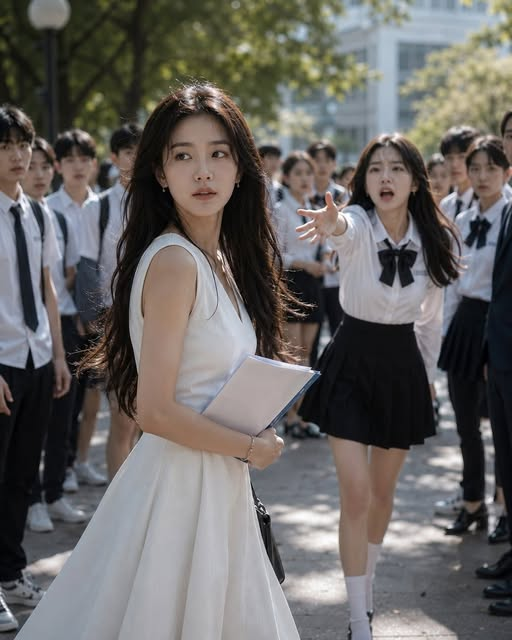
The supervisor checked the white dress once and waved me through.
Sofía stood three students behind me.
Her face remained perfectly calm.
But the right pocket of her jacket was no longer bulging.
Interesting.
She had hidden the phone somewhere else.
I took my assigned seat.
Desk 18.
Sofía was placed two rows behind me.
Exactly like the first time.
In my previous life, twenty-seven minutes after the examination began, a phone had appeared in my pocket.
This time, I had no pocket.
So I waited.
Ten minutes.
Twenty.
Twenty-five.
At minute twenty-seven, I heard the soft scrape of a chair behind me.
My heartbeat accelerated.
A teacher immediately spoke.
—Student 31, remain seated.
Sofía smiled apologetically.
—Sorry, teacher. I dropped my eraser.
She bent down.
Then something slid across the floor.
A black phone.
It stopped beside my left shoe.
For half a second, nobody reacted.
Then Sofía gasped.
—Emma!
Every head turned.
She pointed at the device.
—Your phone fell out!
There it was.
Plan B.
If she couldn’t put it inside my clothes, she would place it near me and make everyone believe I had dropped it.
In my previous life, panic had destroyed me.
This time, I didn’t move.
I didn’t touch the phone.
I raised both hands above the desk.
—Teacher, please don’t let anyone pick it up yet.
Sofía froze.
The supervisor frowned.
—Why?
—Because it isn’t mine.
Sofía immediately said:
—Emma, don’t lie. I saw it fall beside you.
I looked at the teacher.
—Please check the entrance inspection record.
My dress had no pockets.
My folder had been searched.
And before entering, the examiner had recorded every object I carried.
The supervisor’s expression changed.
Another teacher approached.
I continued:
—And please preserve the fingerprints on the phone.
Sofía’s face went pale.
—Fingerprints?
I finally looked back at her.
—If it’s mine, mine should be all over it.
Silence.
The phone remained untouched until the chief examiner arrived.
They photographed its position first.
Then placed it in an evidence bag.
My exam continued.
Sofía’s did not.
She tried to protest.
—This is ridiculous! Emma probably hid it under her dress!
The female supervisor looked at my fitted white dress.
Then at Sofía.
—Where?
A few students almost laughed.
Sofía stopped talking.
But I knew this wasn’t enough.
She was clever.
The phone would contain nothing connecting it directly to her.
That had been the beauty of her trap the first time.
So when the first exam ended, I didn’t celebrate.
I went directly to the examination office.
The director was waiting.
Sofía was already there with her parents.
Her mother immediately pointed at me.
—My daughter says Emma brought the phone.
I placed my transparent folder on the table.
—Then check everything.
Sofía suddenly began crying.
—Emma has always hated me because my grades are better.
I almost admired her speed.
The director asked:
—Do either of you recognize the device?
I shook my head.
Sofía did too.
Then I asked:
—Can you check the cameras?
She looked at me.
There.
That tiny movement.
Fear.
The director hesitated.
—Students were told some corridor cameras were undergoing maintenance.
I smiled.
—I know.
Sofía’s shoulders relaxed.
Then the director finished:
—But the examination rooms have independent recording systems.
Her face collapsed.
He opened the footage.
Minute twenty-seven.
Sofía dropped her eraser.
Bent down.
Her left hand reached beneath the desk.
The camera angle didn’t clearly show the phone leaving her hand.
Not enough.
Her mother immediately said:
—See? There is no proof!
I had expected that too.
So I asked for the footage from before the security checkpoint.
They found it.
Sofía arrived with her right hand inside her jacket pocket.
The pocket bulged visibly.
At the metal detector, she removed her keys.
But the rectangular shape remained.
Then another camera showed something even better.
After passing security, Sofía went into the restroom.
She came out ninety seconds later.
Her jacket pocket was flat.
The director paused the footage.
—Where did the phone go?
Sofía’s lips trembled.
—Maybe… maybe that wasn’t a phone.
I said nothing.
The director requested a female staff member inspect the restroom.
Ten minutes later, she returned carrying a small magnetic pouch.
It had been taped beneath the sink.
Empty.
But inside was a receipt.
Electronics repair shop.
Device serial number.
The director compared it with the phone.
Match.
The room became completely silent.
Sofía’s mother stopped talking.
The director looked at her.
—Miss Rivera, would you like to explain why the receipt for this phone was inside a pouch you apparently used this morning?
Sofía started crying harder.
—Someone put it there!
Her father whispered:
—Sofía.
—It wasn’t me!
I watched her.
For years, everyone believed Sofía because she cried beautifully.
Teachers.
Classmates.
Parents.
Even mine sometimes.
But evidence doesn’t care who looks prettier while crying.
The school immediately separated us.
My examination status remained valid.
Sofía’s case was sent to the disciplinary committee.
I thought it was over.
I was wrong.
That afternoon, my mother picked me up.
She hugged me so tightly I could barely breathe.
—They called me. Are you okay?
I nodded.
For a second, I almost told her everything.
That I had lived through this once before.
That I remembered losing everything.
That waking up on June 6 had given me one impossible chance to change it.
But I couldn’t explain something I barely understood myself.
So I simply said:
—Mom, if anyone says something about me, don’t believe it until you hear me first.
She stared at me.
Then nodded.
—I promise.
That promise mattered more than she knew.
The next morning, I returned for the second exam.
Sofía was absent.
By lunchtime, rumors were everywhere.
Some claimed I had framed her.
Others said she had tried to frame me.
Then something unexpected happened.
A boy named Daniel from our class approached me.
—Emma.
He looked nervous.
—There’s something you should see.
He showed me screenshots from a private class group.
Sofía had deleted the messages the previous night.
Daniel had saved them.
One week earlier, she had written:
“After the exam, Emma won’t be competition anymore.”
Someone replied:
“What are you planning?”
Sofía:
“Just wait. Perfect girls don’t need dirty hands when other people are stupid enough to destroy themselves.”
My blood ran cold.
Daniel said:
—I thought she was joking.
Another screenshot appeared.
Two months earlier.
Sofía had asked whether anyone knew where to buy an old phone that couldn’t be traced to a current account.
Then another.
She had asked a classmate working at an electronics shop to reset one completely.
The same shop printed on the receipt.
This was no longer an unfortunate misunderstanding.
It was preparation.
The school disciplinary committee reached its decision three days later.
Sofía was removed from the examination center and her case was reported to the educational authorities.
Because the attempt involved deliberate interference with another student’s exam, she faced serious academic consequences.
Her parents appealed.
They hired lawyers.
They accused me.
They even claimed my pocketless dress proved I had “planned the entire conflict.”
That argument failed spectacularly.
The director answered:
—Protecting yourself from foreseeable misconduct is not misconduct.
I wanted to frame that sentence.
But the most unexpected confrontation came from Sofía herself.
She waited for me outside school after the final exam.
Her face looked different without the usual crowd surrounding her.
—You knew.
I stopped.
—Knew what?
—That I was going to do it.
I didn’t answer.
Her eyes narrowed.
—That’s why you wore the dress.
Silence.
She stepped closer.
—How?
I could never tell her.
So I said:
—I finally learned not to trust you.
That seemed to anger her more than any accusation.
—Everyone trusts me.
—I know.
—Teachers love me.
—Yes.
—My grades are better than yours.
—Sometimes.
Her face twisted.
—Then why are you acting like you won?
I looked at her.
—Because I’m still taking my exam.
She went silent.
That was the entire difference.
The first time, her plan had taken my future.
This time, it only revealed hers.
Months passed.
The results were released in July.
My mother insisted on refreshing the website herself.
When the score appeared, she screamed so loudly our neighbor came running.
I had ranked among the highest students in the province.
The university I had dreamed about accepted me with a merit scholarship.
My father printed the admission letter and carried it around for two days as though it were a national certificate of honor.
As for Sofía, her family transferred her to another school while the disciplinary consequences followed their course.
I never saw her again.
Years later, I sometimes wondered why she had hated me enough to risk everything.
Maybe because teachers had begun comparing our academic results.
Maybe because perfection becomes terrifying when someone’s identity depends on always being first.
Maybe there was no explanation that would ever feel sufficient.
Eventually, I stopped asking.
At university, I kept the white dress.
I never wore it again.
It stayed folded inside a box.
Not as a reminder of Sofía.
As a reminder of myself.
The girl I had been the first time believed that being innocent was enough.
The girl who woke up the night before the exam understood something different.
Innocence does not mean leaving yourself defenseless.
Years later, my mother found the dress while helping me move.
—Why did you keep this old thing?
I touched the fabric.
No pockets.
No hidden seams.
Nothing anyone could slip into without my knowledge.
I smiled.
—It got me into university.
She laughed.
—Your brain got you into university.
Maybe she was right.
But I knew the truth.
The most important decision I made before that exam wasn’t choosing the correct answers.
It was choosing not to walk into the same trap twice.
Sofía had expected the same Emma.
The trusting Emma.
The frightened Emma.
The girl who would panic the moment a phone appeared beside her.
Instead, she met someone who had already learned exactly how much one lie could cost.
She prepared the perfect trap.
I simply arrived wearing a dress with nowhere to hide it.
