The nurse’s name was Lin Yao.
For two years, she had been one of the people assigned to my grandmother’s rehabilitation.
She knew exactly what my grandmother meant to me.
She knew why I had returned to Pho Van Than.
She had seen him send flowers after every scandal.
She had seen me sit beside my grandmother’s bed while entertainment reporters waited downstairs.
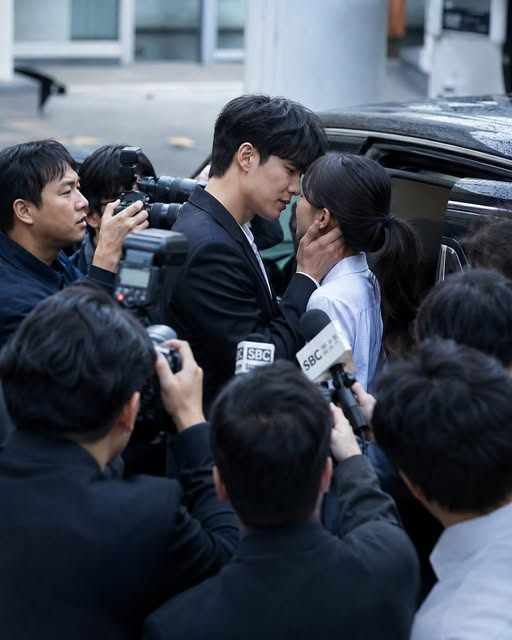
And yesterday, in the underground parking lot of Thanh Tam Hospital, she had wrapped both arms around my husband’s waist while he lowered his head and kissed her forehead.
A photographer caught everything.
By noon, Hong Kong knew.
By two, Pho Van Than called me.
His voice was almost amused.
—Ah Me, you’ve probably seen it.
—I have.
—Lin Yao is different.
I stood beside my grandmother’s bed and looked at the sunlight falling across her blanket.
—You’ve said that before.
He ignored me.
—She looks like you did when we first arrived in Hong Kong.
That sentence finally made me smile.
—Eighteen?
He became silent.
Then he laughed.
—Don’t be sarcastic.
—I’m not.
I looked at the woman sleeping peacefully before me.
—I’m just trying to understand your taste.
His voice cooled.
—The reporters will contact you. Handle it like usual.
There it was.
Not I’m sorry.
Not Let’s talk.
Just:
Handle it.
—How much this time? —I asked.
He thought I was negotiating.
—Whatever it takes.
—No.
Silence.
—What?
—I said I’m not buying this story.
His tone changed immediately.
—Ah Me.
—I spent three years buying your mistakes.
—Don’t make decisions while you’re angry.
I almost laughed.
He still believed anger was the only reason I could ever disobey him.
—I haven’t been angry for a long time, Van Than.
That frightened him more than shouting would have.
—Where are you?
—With Grandma.
—I’ll come tonight.
—Don’t.
I ended the call.
Then I opened the contact I had saved three years earlier.
Editor Lau.
The first journalist who ever asked how much I would pay to suppress one of Pho Van Than’s scandals.
He answered immediately.
—Mrs. Pho?
—You asked me this morning how much I’m spending.
He laughed awkwardly.
—I hope you don’t take offense. Business is business.
—I understand.
—So?
—Zero.
Silence.
Then:
—Excuse me?
—I won’t buy your photographs.
I paused.
—But I have another story for you.
His voice became alert.
—What kind?
—The kind Pho Van Than has spent ten years making sure nobody publishes.
He stopped laughing.
—What’s your price?
I looked down at the small object in my palm.
A faded pawn ticket.
More than ten years earlier, after my mother died, she had left me one piece of jewelry.
I sold it for three hundred yuan.
With that money, I bought train tickets and food and helped Pho Van Than escape to Hong Kong when people were searching for him.
Three hundred yuan.
That was the price of the beginning.
So I said:
—Three hundred.
Editor Lau thought he had heard wrong.
—Three hundred thousand?
—Three hundred yuan.
—Mrs. Pho—
—Take it or leave it.
He became quiet.
—What exactly are you selling?
I looked at the folder beside me.
Inside were years of records.
Payments made to newsrooms.
Threatening messages sent after I moved out.
Documents showing who arranged for my old photographs to reappear on public screens.
Records proving that several people who harassed me had been paid through intermediaries connected to Pho Van Than.
Most importantly, there was one audio recording.
Three years ago, after my grandmother collapsed, Pho Van Than had sat beside her hospital bed believing I was asleep.
He told his assistant:
“Keep pressure on her until she comes home. Once she returns, stop everything.”
I had heard every word.
I had simply pretended not to.
For three years, I collected evidence.
Because after the first divorce attempt failed, I finally understood something.
Pho Van Than wasn’t keeping me through love.
He was keeping me through fear.
And fear only works while the other person believes there is nowhere safe to go.
I had spent three years building somewhere safe.
Editor Lau asked:
—If this is real, do you understand what publication could do?
—Yes.
—To your husband?
I corrected him.
—My soon-to-be ex-husband.
That afternoon, I transferred my grandmother.
Not secretly.
Not illegally.
Her condition had stabilized months earlier.
I had simply delayed moving her because Pho Van Than controlled the hospital and used that control as a chain around my neck.
But during the previous year, I had quietly arranged consultations elsewhere.
A rehabilitation hospital in Kowloon had already accepted her.
At 4:20 p.m., an ambulance transferred her.
At 4:47, Thanh Tam Hospital’s director called Pho Van Than.
At 4:51, he called me.
This time, I answered.
—Where did you take Grandma?
—Somewhere you don’t own.
His breathing stopped.
—Bring her back.
—No.
—Her doctors are here.
—Her medical records have already been transferred.
—Ah Me, don’t play with her life just because you’re angry with me.
My grip tightened around the phone.
—You used her life to force me back into your house.
Silence.
—Don’t ever pretend again that you’re the person protecting her.
He lowered his voice.
—Who helped you arrange this?
I smiled.
There it was.
He still couldn’t imagine I had done anything without permission.
—Me.
—With what money?
I almost laughed.
Pho Van Than had never realized how much I had learned while cleaning up after him.
For years, he handed me accounts and told me:
“Make this disappear.”
I negotiated with lawyers.
Settled legitimate claims.
Managed crisis teams.
Reviewed contracts.
Kept records.
And unlike him, I saved.
I had my own account.
My own investments.
My own contacts.
My own lawyer.
I simply stopped advertising any of them.
—You’ll know soon.
I hung up.
At six that evening, Editor Lau published the first story.
Not about Lin Yao.
About me.
The headline was simple:
PHO VAN THAN’S WIFE: “FOR THREE YEARS, I PAID TO HIDE HIS AFFAIRS. TODAY I’M DONE.”
The article included no intimate photographs of me.
I had made that a condition.
It included documents.
Dates.
Transfers.
Messages.
And my own signed statement.
For the first time, the public wasn’t looking at me as the humiliated wife standing behind a powerful man.
They were looking at the machinery that had kept me there.
Then the second article appeared.
It concerned the harassment after my first attempt to leave.
The third concerned the screens that had displayed material meant to shame me.
The fourth contained the recording.
By midnight, the question had changed.
Nobody was asking:
“How much will Mrs. Pho pay this time?”
They were asking:
“How much did Pho Van Than spend to stop his wife from leaving?”
He came home at 1:17 a.m.
I was waiting.
One suitcase stood beside the door.
Not mine.
His.
Pho Van Than stopped when he saw it.
Lin Yao was not with him.
His eyes were bloodshot.
—You sold me to the press.
I sat on the sofa.
—For three hundred yuan.
His expression twisted.
—You think that’s funny?
—No.
I took the old pawn receipt from my pocket.
—Do you remember this?
He stared at it.
Then his face changed.
Of course he remembered.
The train station.
Two hungry teenagers.
Him bleeding from a fight he refused to explain.
Me selling my mother’s last possession.
Me pushing three hundred yuan into the ticket window.
He whispered:
—Ah Me…
—That was what it cost to bring you here.
I placed the receipt on the table.
—I thought it was appropriate that the truth cost the same amount to send you out of my life.
His eyes reddened.
—I did everything because I couldn’t lose you.
I laughed.
—You cheated because you couldn’t lose me?
—Those women meant nothing.
—That’s worse.
He froze.
I stood.
—If they meant nothing, then you hurt me repeatedly for nothing.
He tried to take my hand.
I stepped back.
—Don’t.
His arm dropped.
For the first time, I saw fear on Pho Van Than’s face.
Not anger.
Not wounded pride.
Fear.
—You’re serious.
—Yes.
—You can’t divorce me.
That old sentence.
Three years ago it had frightened me.
Tonight it sounded pathetic.
—My lawyer filed this afternoon.
His face went blank.
—Your father won’t allow it.
I looked at him.
Then smiled.
—My father has been dead for eight months.
Pho Van Than froze.
He hadn’t known.
My father and I had been estranged for years.
The threat he once made—that I would never be permitted to leave Pho Van Than—had died with him.
I had not told my husband.
Because I wanted to know how long he would continue using a dead man’s shadow to control me.
Apparently, forever.
—Why didn’t you tell me?
I looked at him.
—Because by then I knew I was leaving.
Something in his face collapsed.
He sat down.
—And Grandma?
—Safe.
—And me?
The question was so absurd I nearly laughed.
—What about you?
He looked up.
The powerful Pho Van Than.
The man whose name once made entire rooms fall silent.
He suddenly looked like the nineteen-year-old boy I had dragged onto a train with three hundred yuan in my pocket.
—What am I supposed to do without you?
There it was.
Maybe the most honest thing he had said in years.
Not:
Who will love me?
But:
What will I do without the person who fixes everything?
I answered quietly:
—Learn.
The following weeks were chaos.
Several business partners distanced themselves.
Not because of the affair.
Hong Kong had tolerated his affairs for years.
But the documents suggesting intimidation and abuse of influence were different.
Authorities opened investigations into conduct connected to the harassment.
His board demanded an independent review.
Some executives who had spent years obeying him suddenly discovered their own memories.
The wall around Pho Van Than did not fall because I was powerful enough to knock it down.
It fell because I stopped standing in front of it every time it cracked.
And Lin Yao?
She lasted exactly eleven days.
Once she discovered that I would no longer manage the press, settle his scandals or protect the public image surrounding him, being “the woman he was serious about” became far less glamorous.
She gave one interview.
She said Pho Van Than had promised her:
“My wife will handle everything.”
When I read that sentence, I finally understood the entire marriage.
He had never believed I would forgive him.
He had simply believed I would clean up afterward.
Lin Yao left Hong Kong shortly thereafter.
I didn’t contact her.
She had made her choices.
Pho Van Than had made his.
Neither belonged to me anymore.
The divorce took almost a year.
He fought every stage.
Then begged.
Then threatened.
Then apologized.
Then offered property.
Jewelry.
Shares.
The old wedding house.
I refused anything I wasn’t legally entitled to.
At our final mediation, he stared at me for a long time.
—What do you want?
I thought about that girl at the train station.
She had wanted almost nothing.
Just for him to survive.
Just for them to stay together.
Just for the suffering to have meant something.
I answered:
—My name back.
He lowered his eyes.
That was all.
After the divorce, I stopped being “Mrs. Pho.”
The newspapers found the adjustment difficult.
For months, headlines still called me:
“Pho Van Than’s ex-wife.”
Then slowly, that changed too.
I opened a crisis-management consultancy.
It was almost ironic.
For years I had protected one man’s reputation for free.
Now corporations paid me very well to tell them one rule:
Never solve a reputation problem by creating a bigger truth problem underneath it.
My grandmother lived another four years.
They were peaceful.
One afternoon, while sitting beside her window, she asked:
—Do you regret saving him back then?
I knew exactly who she meant.
Pho Van Than.
I thought for a long time.
—No.
Grandmother looked surprised.
—Why?
—Because the girl I was then did what she believed was right.
I smiled.
—I won’t punish her because the man he became wasn’t worth it.
Grandmother squeezed my hand.
That answer finally freed me from something.
Not Pho Van Than.
Myself.
Years later, I saw him once more.
At a ferry terminal.
No reporters.
No bodyguards around him.
He looked older.
Quieter.
We stood several meters apart.
He walked over.
—Ah Me.
Nobody had called me that in years.
—Van Than.
His eyes moved over my face.
—You look well.
—I am.
He nodded.
Then asked:
—Do you still have the pawn receipt?
I smiled.
—No.
His expression changed.
—I threw it away.
For so long, that scrap of paper had represented everything I thought he owed me.
My mother’s keepsake.
Three hundred yuan.
A train ride.
My youth.
My body.
My marriage.
But eventually I understood that no repayment could return those things.
So I stopped keeping the receipt.
Pho Van Than looked toward the water.
—I spent years thinking you would never leave because you loved me too much.
I said nothing.
He laughed bitterly.
—Turns out you stayed because I made leaving too expensive.
For once, he understood.
I nodded.
Then he whispered:
—I’m sorry.
I believed him.
It simply didn’t matter anymore.
My ferry was boarding.
I picked up my bag.
He called after me:
—Ah Me.
I turned.
—If we could go back to that train station—
I smiled.
—We can’t.
Then I boarded.
Hong Kong disappeared slowly behind the glass as the ferry moved away.
Once, I had sold the last thing my mother left me for three hundred yuan to buy Pho Van Than a ticket toward his future.
Ten years later, I sold the truth about him for exactly the same amount.
People called it revenge.
They were wrong.
The first three hundred yuan bought his escape.
The second bought mine.
And this time, I didn’t turn around to see whether he followed.
