I looked at the black Rolls-Royce.
Then at Truong Hang.
Finally, I laughed.
“Tell Co Tram Chu something for me.”
His eyes narrowed.
“What?”
“Six years ago, I walked out of his house because he asked me to.”
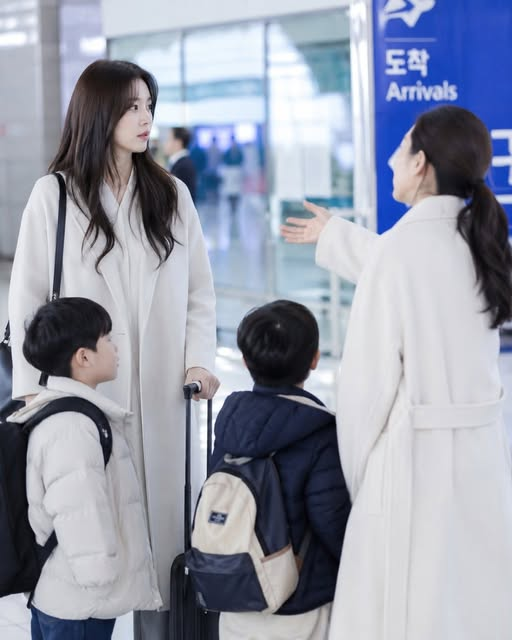
I pulled both children closer.
“This time, if he wants to see me, he can come himself.”
Then I took out my phone.
Truong Hang’s expression changed.
“Dr. Lam, what are you doing?”
“Calling airport security.”
For the first time, his confidence cracked.
“You don’t need to make things difficult.”
“No.”
I looked directly at him.
“You made it difficult when you surrounded a woman and two children with bodyguards.”
Five minutes later, two airport officers approached.
The bodyguards stepped aside.
Truong Hang’s face went dark.
I walked away without looking back.
Lam Uc tugged my sleeve.
“Mommy.”
“Yes?”
“Is that uncle really your friend?”
I looked down at her.
“No.”
Lam An, always more perceptive than his sister, asked quietly:
“Is he connected to our father?”
My steps stopped.
Six years.
I had always known this question would come.
I just hadn’t expected it to come at the airport.
I crouched in front of them.
“Yes.”
Both children became silent.
Lam Uc blinked.
“Then… is the scary boss our dad?”
I held her little hands.
“I’ll explain everything when we get home.”
Behind us, an engine started.
The Rolls-Royce never moved.
But through the dark window, I could feel someone watching us leave.
Co Tram Chu had come.
He simply hadn’t gotten out.
Just like six years ago.
Always close enough to control the situation.
Never close enough to take responsibility.
This time, I didn’t turn around.
I had not returned to Van Thanh because of him.
Harvard and the National Institute of Molecular Medicine had created a joint laboratory for a new cardiac regeneration program.
I was the principal scientific investigator.
My work focused on repairing damaged heart tissue using patient-specific cellular scaffolds.
Ironically—
heart disease.
The same illness Tham Vu Han had used to drag Co Tram Chu away from me again and again.
Three days after my arrival, the institute held its opening ceremony.
I wore a white suit.
Lam An and Lam Uc stayed with my mother.
At nine sharp, I entered the conference hall.
Then stopped.
Co Tram Chu was sitting in the first row.
Six years had barely touched him.
He was thirty-eight now.
Still cold.
Still composed.
Still the kind of man who made an entire room unconsciously lower its voice.
But when he saw me—
his composure broke.
Only for one second.
Then his eyes moved behind me, apparently searching for the children.
I walked directly to the stage.
The institute director introduced me.
“Dr. Lam Van, Harvard postdoctoral fellow, winner of the Crawford Biomedical Research Award, and lead investigator of the Van Thanh Cardiac Regeneration Project.”
Applause filled the room.
Co Tram Chu did not clap.
He simply stared.
Maybe he was remembering another Lam Van.
The woman who spent entire afternoons choosing his shirts.
The woman who declined Harvard because he said newlyweds should not live on different continents.
The woman who waited outside his study with dinner growing cold.
That woman no longer existed.
After the presentation, he intercepted me outside.
“Lam Van.”
I stopped.
“President Co.”
His eyes hardened slightly at the title.
“We need to talk.”
“No.”
“You brought my children back without telling me.”
I looked at him.
“Your children?”
His jaw tightened.
“The twins.”
“Six years ago, you told me never to interfere with your life again.”
“I didn’t know you were pregnant.”
“That’s correct.”
“Why didn’t you tell me?”
I almost laughed.
“When?”
His face changed.
“The morning you gave me the divorce agreement?”
Silence.
“Or when you moved Tham Vu Han into the villa three days later?”
His eyes sharpened.
“She never lived there.”
I paused.
“What?”
“She stayed in the guest house for two weeks after surgery.”
I shook my head.
“That distinction stopped mattering six years ago.”
He took a step closer.
“I have the right to know my children.”
“And they have the right not to be dragged into your life because you suddenly discovered they exist.”
His voice turned cold.
“I want a paternity test.”
“Fine.”
That surprised him.
I continued:
“Through lawyers.”
“No private hospital.”
“No people surrounding us at airports.”
“No taking them anywhere without my consent.”
“And if you ever send bodyguards near my children again…”
I smiled faintly.
“…the next people waiting for you will be attorneys.”
He stared at me.
Then, unexpectedly, nodded.
“Fine.”
I walked away.
Behind me, he called:
“Lam Van.”
I stopped.
His voice was lower now.
“Are they mine?”
For the first time, I heard something other than authority.
Fear.
I turned.
“Yes.”
And left him standing there.
The DNA results came five days later.
Probability of paternity:
99.99%.
Co Tram Chu read the report three times.
Then asked his lawyer:
“When can I see them?”
The lawyer looked at me.
I answered:
“When they agree.”
His face hardened.
“They are six.”
“Exactly.”
“They are not property.”
That shut him up.
The first meeting happened in a public botanical garden.
Lam Uc hid behind me.
Lam An stood in front of his sister like a tiny guard.
Co Tram Chu arrived alone.
No assistant.
No driver following.
No expensive gifts.
That surprised me.
He crouched several feet away.
Lam An studied him.
“So you’re our father?”
Co Tram Chu’s throat moved.
“Yes.”
“Why weren’t you there when we were born?”
Silence.
I had never coached my son to ask that.
Children simply know where the empty spaces are.
Co Tram Chu looked at me.
I did not rescue him.
Finally he answered:
“Because I didn’t know you existed.”
Lam An frowned.
“Why?”
Another silence.
“Because I made mistakes with your mother.”
Lam Uc peeked from behind me.
“Big mistakes?”
For the first time, the powerful Co Tram Chu looked completely helpless.
“Yes.”
“Very big.”
She considered that.
Then walked forward and handed him half of the cookie she was eating.
“Okay.”
He stared at it.
“You can have this.”
His eyes suddenly reddened.
He accepted it as though she had given him his entire empire.
I looked away.
Not because I felt moved.
Because I refused to confuse a father’s first tender moment with redemption.
Those were different things.
Co Tram Chu began seeing them twice a week.
Supervised.
He never missed a visit.
He learned that Lam An hated carrots.
That Lam Uc could not sleep without a stuffed rabbit.
That both children spoke Mandarin, English and enough French to argue with each other privately.
He bought them expensive toys once.
They ignored almost all of them.
Lam Uc spent forty minutes playing with the cardboard box.
After that, he stopped bringing gifts.
He began bringing time.
Books.
Puzzles.
Questions.
One afternoon, I arrived early and heard Lam An ask:
“Dad, do you love Mom?”
I froze outside the room.
Co Tram Chu was silent for a long time.
Then he answered:
“I hurt your mother very badly.”
“That isn’t what I asked.”
My son had inherited my stubbornness.
Co Tram Chu finally said:
“Yes.”
My fingers tightened around the door handle.
Lam An asked:
“Then why did you divorce her?”
Co Tram Chu answered quietly:
“Because at that time, I didn’t understand the difference between needing someone and loving someone.”
I closed my eyes.
Six years too late.
Then Tham Vu Han returned.
I saw her at the institute’s charity dinner.
She was thinner than I remembered.
Elegant.
Fragile.
Exactly the same image that had once made everyone protect her.
She approached me during the reception.
“Lam Van.”
“Miss Tham.”
Her smile stiffened.
“I heard about the twins.”
“I assume everyone has.”
She lowered her voice.
“You shouldn’t misunderstand what happened back then.”
I almost smiled.
“I stopped misunderstanding six years ago.”
“Tram Chu only looked after me because my heart condition was serious.”
“I know.”
“He never loved me.”
That made me pause.
She looked almost bitter.
“For years, I thought he did.”
I studied her.
“What do you want?”
Her eyes flickered.
“I want you to keep the children away from him.”
I laughed softly.
There it was.
“Why?”
She looked toward the ballroom entrance.
Co Tram Chu had just arrived.
His eyes immediately found me.
Then her.
Tham Vu Han’s expression tightened.
“Because if the twins are recognized by the Co family, everything changes.”
My smile disappeared.
“What changes?”
She hesitated.
Then whispered:
“The family trust.”
I stared at her.
“What trust?”
She realized too late that I truly didn’t know.
That night, my lawyer found the answer.
Co Tram Chu’s grandfather had established a succession trust years earlier.
The controlling block of Co Holdings would eventually pass to the next generation.
But if Co Tram Chu had biological children, those children automatically became primary beneficiaries.
Before the twins appeared, the next beneficiary was—
Tham Vu Han’s younger brother.
My lawyer looked at me.
“So her family stood to inherit a significant interest if President Co remained childless.”
Everything suddenly changed shape.
Tham Vu Han’s miraculous illnesses.
The emergencies.
The timing.
The divorce.
I whispered:
“Find my old medical records.”
My lawyer frowned.
“Why?”
“Because I want to know why I believed I couldn’t get pregnant.”
Six years earlier, after two years of marriage without a child, the Co family doctor had told me that my hormone levels were abnormal.
He said pregnancy would be “extremely unlikely.”
A year later, I became pregnant with twins almost immediately after leaving.
At the time, I thought stress reduction had changed my body.
Now I was no longer sure.
The review took nine days.
The result made my hands shake.
My original laboratory report had been normal.
The copy given to me had been altered.
And the physician who signed it?
He had received consulting payments from a foundation controlled by the Tham family.
I put the report in front of Co Tram Chu.
His face turned colder with every page.
“Who gave you this?”
“My lawyer.”
He read it again.
Then looked up.
“You think Vu Han did this?”
“I think someone did.”
His jaw tightened.
“I’ll investigate.”
“No.”
He frowned.
“You already spent six years choosing her version first.”
I gathered the documents.
“This time, I’ll investigate.”
His voice hardened.
“Lam Van.”
I stopped.
“I was wrong about many things.”
I turned toward him.
“That doesn’t make you automatically right now.”
He fell silent.
Good.
He was finally learning.
The investigation uncovered more than either of us expected.
Tham Vu Han had not fabricated her heart condition.
It was real.
But her family had deliberately exaggerated several episodes.
They knew Co Tram Chu felt responsible because her father had once helped his family during a financial crisis.
They encouraged that guilt.
Then, after discovering the succession trust, they began controlling information around my fertility.
They wanted Co Tram Chu childless.
And eventually—
unmarried to me.
The most painful discovery was a text sent by Tham Vu Han to the family physician three days before my divorce:
If Lam Van believes she can never give him an heir, she will leave sooner or later.
And another:
Tram Chu already feels trapped by the marriage. Just give him a reason to cut it cleanly.
I stared at those messages for a long time.
Then closed the file.
Co Tram Chu stood across from me.
His face looked almost gray.
“I didn’t know.”
“I believe you.”
His eyes lifted.
“But?”
“But you didn’t need to know about this conspiracy to hurt me.”
Silence.
“You still chose to throw divorce papers at me.”
“You still told me our marriage was temporary.”
“You still made me believe three years of my life meant nothing.”
His eyes reddened.
“I said those things because I thought—”
“I know.”
I interrupted.
“You thought Tham Vu Han needed you more.”
Then I smiled sadly.
“That was always enough.”
The Tham family’s access to the Co trust was frozen during litigation.
The physician lost his position and faced professional investigation.
Tham Vu Han disappeared from public life.
But I refused to turn the scandal into a romantic excuse for my ex-husband.
That surprised everyone.
Especially Co Tram Chu.
One evening, after bringing the children home, he stood outside my door.
“Lam Van.”
“Yes?”
“The truth is out.”
“I know.”
“Vu Han manipulated both of us.”
“Yes.”
He hesitated.
“Then…”
I already knew what he was going to ask.
“No.”
His face changed.
“I haven’t even said it.”
“You want us to start again.”
Silence.
I smiled.
“Co Tram Chu, she may have manipulated circumstances.”
I looked directly at him.
“But she did not hold your hand when you signed the divorce agreement.”
He closed his eyes.
“She did not force you to call me a temporary plan.”
“She did not make you watch me walk away without stopping me.”
His shoulders lowered.
Those choices were his.
And finally, after six years, he admitted it.
“Yes.”
One word.
But it mattered.
I stayed in Van Thanh.
Not for him.
My laboratory received permanent funding.
The cardiac program became one of the institute’s flagship projects.
Lam An and Lam Uc started school.
Co Tram Chu became part of their lives.
Slowly.
Carefully.
He never tried to take them from me again.
Perhaps he finally understood that being their father did not make him their owner.
A year later, Lam Uc had a school performance.
Co Tram Chu arrived twenty minutes early.
He saved me a seat.
When I approached, he stood.
“This one is yours.”
I looked at the empty chair beside him.
Years earlier, he had removed me from his life without hesitation.
Now he waited silently to see whether I would sit.
I did.
Not because we were reconciled.
We weren’t.
But because our daughter was about to walk onto a stage looking for both parents.
When the lights came up, Lam Uc spotted us.
Her entire face brightened.
Co Tram Chu clapped until his hands turned red.
I smiled.
For the first time, being in the same room with him did not hurt.
That was enough.
After the performance, he walked us to the car.
Lam An ran ahead.
Lam Uc was asleep against my shoulder.
Co Tram Chu quietly asked:
“Do you hate me?”
I thought about it.
“No.”
His eyes changed.
“Do you still love me?”
I looked at the man I had once loved enough to give up Harvard for.
Then at the laboratory badge still hanging from my neck.
At my children.
At the life I had built after he discarded me.
“Part of me probably always will.”
Hope appeared in his eyes.
I finished:
“But love is not the same thing as returning.”
The hope softened into something sadder.
Acceptance.
Maybe that was the first truly mature thing we had ever shared.
He nodded.
“I understand.”
And this time—
I believed him.
Six years earlier, Co Tram Chu had thrown a divorce agreement at a woman who had given up everything for him.
He assumed she would disappear.
She did.
But the woman who returned was not the abandoned wife he remembered.
She was Dr. Lam Van.
A scientist.
A mother.
A woman who had rebuilt every part of herself he once treated as temporary.
He wanted the twins.
He wanted another chance.
Eventually, perhaps, he even learned how to love without possession.
But there was one thing he never got back automatically.
Me.
Because the greatest thing I brought home after six years abroad was not two children.
Not a Harvard résumé.
Not an award.
It was the certainty that I no longer needed to be chosen by the man who had once thrown me away.
I had already chosen myself.
