On the seventh morning, my father was having breakfast with Lillian when the courier arrived.
The package was thick.
Almost twenty centimeters.
He signed without looking at the sender.
Then he smiled when he saw my mother’s name.
“Here it comes.”
Lillian stirred her coffee.
“What?”
“The regret.”
My father tore open the package.
“I knew Eleanor couldn’t last a week.”
Inside there was no letter asking him to come back.
No photograph.
No wedding ring.
There were four binders.
A property certificate.
A shareholder agreement.
Forty-five years of bank records.
And a single handwritten note.
Charles, you always wanted marriage to be an account. I have closed it for you.
My father’s smile disappeared.
Lillian leaned closer.
“What is all this?”
He opened the first binder.
On the first page was a document dated 1981.
Back then, my father was twenty-seven.
He had no Mercedes.
No expensive watches.
No company.
He was an ordinary junior salesman earning less than my mother.
The company that would later make him rich consisted of six people working in two rented rooms.
And it was about to collapse.
The founder needed 180,000 yuan to survive.
No bank would lend it.
My grandfather could.
My mother had inherited money from her grandmother shortly before marrying Dad.
Instead of buying a house, she invested almost all of it into that failing company.
My father had always told me a different story.
“I joined when nobody believed in the business.”
Technically, that was true.
He simply forgot to mention who had provided the money that allowed the business to exist long enough for him to join it.
Lillian picked up another page.
“Eleanor owned shares?”
My father snatched it from her.
“Impossible.”
But there it was.
Twelve percent.
Not in Charles Chen’s name.
In Eleanor Lin’s.
My mother had never sold them.
She had never collected the dividends personally either.
They had accumulated for decades inside a family investment account.
My father stared at the numbers.
The twelve percent was now worth more than everything he owned.
Combined.
Then he reached the second binder.
That was when his hands began to shake.
The house.
My father had always said:
“It’s in my name.”
And it was.
But the money used to purchase it twenty-six years earlier had come from a loan issued by a holding company.
A holding company controlled by my mother.
The contract clearly stated that the property was collateral until repayment.
My father had never repaid the principal.
Why?
Because Eleanor had never asked.
She had allowed him to live there.
Renovate it.
Call it his.
Boast about it.
For twenty-six years.
Lillian’s voice became cautious.
“So… the house isn’t actually yours?”
My father slammed the binder shut.
“This is some trick.”
He called his lawyer.
The lawyer arrived ninety minutes later.
By then Dad had gone through half the documents.
He looked twenty years older.
“Tell me this is nonsense.”
The lawyer examined everything.
First the share certificate.
Then the property documents.
Finally, the retirement agreement.
His expression became increasingly uncomfortable.
“Charles…”
“What?”
“Did you read the executive partnership agreement you signed when you became president?”
“That was thirty years ago.”
“There is a retirement repurchase clause.”
My father frowned.
“I know. The company buys back part of my management stock.”
“All of it.”
Silence.
“What?”
“Your executive shares were conditional management shares. They existed only while you served in an active executive role.”
My father stood.
“I built that company!”
“You were paid for building it.”
“Five million a year!”
“Yes.”
The lawyer pushed the document toward him.
“But you never owned the controlling interest you believed you owned.”
My father stared at him.
Then at the shareholder list.
There were several investment vehicles.
One name appeared repeatedly.
Lin Family Holdings.
My mother’s.
Lillian whispered:
“How much does Eleanor control?”
The lawyer calculated for several minutes.
Then he looked up.
“Directly and indirectly?”
“Yes.”
“Twenty-eight point six percent.”
My father laughed.
A strange, hollow sound.
“That’s impossible. She earns four thousand yuan a month.”
The lawyer looked at him almost sympathetically.
“Her salary and her wealth are not the same thing.”
That sentence destroyed something inside him.
For forty-five years, Dad had measured my mother by the amount printed on her payslip.
He had never asked why she never complained about money.
Never wondered why my grandparents’ old contacts treated her with such respect.
Never noticed that senior executives at his company always stood when she entered a banquet.
He had assumed it was because she was the president’s wife.
The truth was that some of them knew she was one of the company’s oldest shareholders.
My mother had simply never needed him to know.
My phone rang that afternoon.
Dad.
I answered.
“What did your mother do?”
Not How is she?
Not Can I speak with her?
That.
“What did your mother do?”
“I think the documents explain it.”
“Where is she?”
“I don’t know.”
That was partially true.
Mom had moved into a serviced apartment belonging to one of her investment companies.
Dad did not know the address.
“You tell her to come home.”
I almost laughed.
“Which home?”
Silence.
Then he exploded.
“Natalie!”
“You divorced her.”
“She planned this!”
“No.”
I lowered my voice.
“She planned nothing. You did.”
He hung up.
That evening, Dad drove to my mother’s old office.
She had worked in the accounting department of a small cultural foundation for more than thirty years.
He found her packing books into boxes.
When she saw him, she didn’t look surprised.
“You received it.”
My father threw the shareholder agreement onto the desk.
“You lied to me.”
Mom continued packing.
“About what?”
“You had money.”
“You never asked.”
“We were married!”
“Yes.”
“You owned part of my company!”
Mom finally looked at him.
“Your company?”
Those two words silenced him.
She walked toward the window.
“My father introduced you to Mr. Zhou.”
Dad’s face tightened.
“My money kept the business alive during its worst year.”
She turned.
“You were offered a job there because I asked.”
My father’s lips parted.
“You told me Zhou discovered me.”
“He did.”
“Because of you?”
“He met you because of me. What you did afterward was your own work.”
She wasn’t trying to take away his achievements.
That somehow made it worse.
She had never needed to.
Dad sat down.
“Why didn’t you tell me?”
Mom smiled faintly.
“I tried.”
“When?”
“Our third year of marriage.”
He frowned.
She remembered the exact conversation.
I later heard it from her.
My mother had said:
“Charles, maybe we should combine part of our finances now that Natalie is coming.”
My father had answered:
“No. Money destroys marriages. What’s mine is mine. What’s yours is yours. That’s fair.”
So she followed his rule.
Exactly.
My father swallowed.
“The house…”
“Was bought through my company.”
“You let me believe it was mine.”
“You insisted it was yours.”
“You never corrected me.”
“You never listened.”
He had no answer.
Then he remembered the divorce.
“If you owned all this, why didn’t you claim anything from me?”
Mom’s expression almost became amused.
“Claim what?”
“My savings.”
“You spent forty-five years making sure I understood that your money was yours.”
She closed the final box.
“I respected your principle.”
Dad stared at her.
“Then why send me all this?”
“Because you retired.”
“What does that have to do with anything?”
“The founder’s agreement required the company to repurchase your management shares upon retirement.”
“I know.”
“And the board votes on the repurchase valuation tomorrow.”
His face changed.
Mom picked up her handbag.
“I’m on the board.”
That night, my father called her seventeen times.
She answered none.
The following morning, he arrived at company headquarters before anyone else.
The building he had entered for three decades as president suddenly felt unfamiliar.
His access card no longer opened the executive floor.
The receptionist stood.
“Mr. Chen, the board meeting begins at ten.”
Mr. Chen.
Not Chairman Chen.
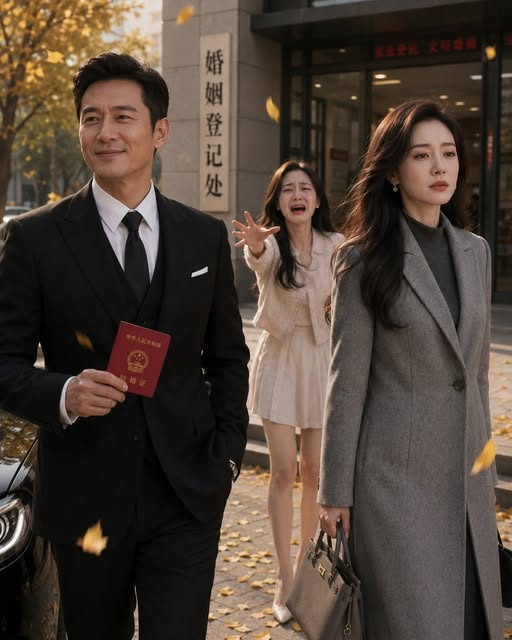
Not President Chen.
Just Mr. Chen.
At ten, the boardroom doors opened.
My father entered.
Twelve directors sat around the table.
And in the chair directly opposite him sat my mother.
Simple gray coat.
Old leather handbag.
No jewelry except a small jade bracelet.
Dad stopped.
The chairman cleared his throat.
“Mr. Chen, today we will finalize the mandatory repurchase of your retirement shares.”
The price was fair.
More than fair.
He would still retire wealthy.
But not remotely as wealthy as he had imagined.
The shares he believed would make him a billionaire were never permanently his.
He had earned millions in salary.
He had spent millions.
He had saved surprisingly little.
The Porsche he bought after the divorce suddenly looked ridiculous.
Then another director spoke.
“There is also the matter of the executive residence.”
Dad’s face tightened.
Mom said nothing.
“The property’s underlying loan remains unpaid. Lin Family Holdings has requested enforcement of the collateral agreement.”
My father turned to her.
“You’re throwing me out?”
Mom calmly replied:
“No.”
Everyone looked at her.
“I’m giving you thirty days.”
Dad almost smiled.
Then she finished:
“You gave me forty-five years to learn how to live without your money. Thirty days should be enough for you to learn how to live without mine.”
The room went silent.
Three days later, Lillian left him.
Not dramatically.
Not with tears.
She simply discovered that the mansion was going back to my mother’s company, the Porsche had been financed, and Dad no longer controlled Grant Industries.
Suddenly the sixty-four-year-old retired executive looked less romantic.
She sent one message.
Charles, I think we want different futures.
I found him alone that evening.
He was sitting in the enormous living room surrounded by unopened boxes.
For the first time in my life, my father looked small.
“Natalie.”
I stopped.
“Where is your mother?”
“I’m not telling you.”
“I need to talk to her.”
“About the company?”
“No.”
His answer surprised me.
He looked toward the empty place where Mom’s old armchair used to stand.
“Does she really hate me?”
I thought about it.
“No.”
His eyes lifted.
“She stopped needing to hate you.”
That hurt him more.
Seven days later, he appeared outside my mother’s apartment.
No Mercedes.
No driver.
No Armani suit.
He carried flowers.
My mother opened the door.
Dad looked at her for a long time.
Then, exactly as she had predicted to me after the divorce…
Charles Chen got down on one knee.
“Eleanor.”
His voice broke.
“I was wrong.”
Mom looked at him.
“About Lillian?”
“About everything.”
He began talking.
Forty-five years.
The money.
The humiliation.
The way he had treated every sacrifice like an invoice.
He admitted that he had believed earning more meant contributing more.
That he had confused financial power with human value.
Finally he pulled out a small ring.
“Marry me again.”
My mother looked at that ring for several seconds.
Then she smiled.
Dad’s eyes filled with hope.
She closed the jewelry box.
“No.”
He froze.
“You said…”
“I said you would kneel and ask.”
She gently placed the box back into his hand.
“I never said I would accept.”
Dad’s shoulders dropped.
“Eleanor…”
She wasn’t cruel.
She invited him inside.
Made tea.
And for the first time in forty-five years, they spoke without pretending they were still a marriage that could be repaired.
My mother did not remarry him.
She traveled.
She joined the board formally.
She bought herself the first new winter coat she had owned in almost a decade.
Not an expensive one.
Just one she liked.
Dad rented an apartment.
He learned to cook.
He learned how much electricity cost.
He learned that groceries did not magically appear.
And slowly, painfully, he learned something he should have understood decades earlier:
Paying half the bills never meant carrying half the family.
A year after the divorce, he came to my mother’s birthday dinner.
He brought no expensive gift.
He simply arrived early and spent two hours cooking noodles because they were the ones she liked when they were young.
Mom ate them.
She even smiled.
But when Dad left, he left alone.
I once asked her whether she regretted not revealing her wealth earlier.
She shook her head.
“If money had made him respect me, Natalie, then it wouldn’t have been respect.”
Then she looked at the old coat hanging beside her new one.
“For forty-five years, your father thought I stayed because I had nowhere else to go.”
She smiled.
“The greatest luxury I ever had was knowing I could leave at any time.”
“And why didn’t you?”
Her expression softened.
“Because I loved him.”
She paused.
“And why did you finally leave?”
Mom looked through the window toward the city.
“Because one day I remembered that loving someone and abandoning yourself are not the same thing.”
