By the time Adrián returned to the hotel, my suitcase was gone.
So were my clothes.
My laptop.
My rehabilitation equipment.
Even the small silver coffee machine I had bought during his first year of recovery.
The only thing waiting for him on the bed was a white envelope.
And my wedding ring.
According to Marcos, Adrián stood in the doorway for almost a full minute before moving.
Then he laughed.
“Very funny.”
Nobody answered.
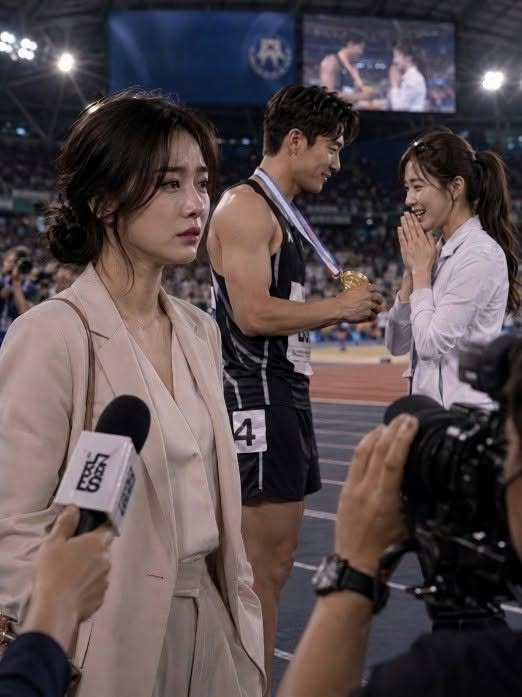
Sophia was standing behind him, still wearing his gold medal around her neck.
That detail mattered.
Because less than an hour earlier, Adrián had assured every journalist who asked that the gesture had been “purely professional.”
Yet somehow the medal had followed Sophia back to the hotel.
Marcos placed the black rehabilitation folder on the table.
“Mrs. Robles left this for the team.”
Adrián frowned.
“What is it?”
Marcos stared at him.
For three years, that folder had traveled everywhere with us.
Training camps.
Hospitals.
Competitions.
Physical evaluations.
I had carried it so often that the corners had become worn.
Adrián had never once opened it.
“Your rehabilitation protocols,” Marcos answered.
Adrián shrugged.
“Give them to Sophia.”
Sophia smiled.
“Of course. I can manage.”
Marcos didn’t move.
His expression made Adrián finally notice something was wrong.
“What?”
“Mrs. Robles designed everything in that folder.”
“I know.”
“No, sir.”
Marcos swallowed.
“I don’t think you do.”
He opened it.
The first pages contained photographs from three years earlier.
Adrián lying in a hospital bed.
His right leg significantly weaker after a severe tendon injury.
Doctors’ assessments.
Surgical reports.
The recommendation that had destroyed him at twenty-nine:
Return to elite competition unlikely.
Sophia’s smile slowly disappeared.
Adrián stared at the sentence.
“I’ve seen that.”
Marcos turned another page.
Then another.
Hundreds of handwritten notes.
Pain response.
Range of motion.
Sleep quality.
Inflammation.
Caloric intake.
Force distribution.
Every adjustment I made when his body stopped responding to traditional rehabilitation.
“I spent three years studying him,” I had once told Marcos.
Not as a husband.
As an athlete.
I knew which muscle tightened when Adrián became fatigued before he did.
I knew that when his left hip dropped by less than two centimeters, his damaged leg was already compensating.
I knew what happened if his hydration dropped before a race.
I knew the exact combination of stretching, compression, temperature therapy and recovery timing that allowed him to train without triggering the injury again.
Sophia flipped through the folder.
Her face grew increasingly tense.
“These protocols are unconventional.”
Marcos nodded.
“They’re Emma’s.”
“I can adapt them.”
“No.”
Everyone looked at him.
The shy twenty-three-year-old assistant who normally apologized before speaking had just contradicted the team doctor.
Marcos pointed to a section marked in red.
“Mrs. Robles specifically wrote not to change this.”
Sophia frowned.
“I’m a physician.”
“And she rebuilt his career.”
Silence.
Adrián slammed the folder shut.
“Enough.”
He picked up the envelope from the bed.
Inside were divorce papers.
Already signed.
No financial demands.
No house.
No percentage of his sponsorship income.
No claim to his prize money.
Nothing.
Adrián read the first page twice.
Then looked up.
“She wants nothing?”
Marcos didn’t answer.
Adrián’s expression hardened.
“That’s ridiculous.”
Sophia touched his shoulder.
“Maybe she just needs time.”
He pulled away without seeming to realize it.
“No.”
Something in his face had changed.
Emma asking for half his fortune would have made sense to him.
Emma demanding an apology would have made sense.
Emma screaming, crying, threatening him—
He knew how to handle all of those versions of me.
But a woman who wanted absolutely nothing?
That frightened him.
He called me.
My phone was already disconnected.
He called the hotel desk.
I had checked out.
He called our house in Mexico City.
Nobody answered.
Then he called my former clinic.
The receptionist said calmly:
“Dr. Robles no longer works here.”
Adrián almost shouted.
“I know that. I’m asking where she is.”
There was a pause.
Then the receptionist answered:
“Actually, sir, she does work here.”
Adrián froze.
“What?”
“She bought the clinic back this morning.”
Three days earlier, I had signed the purchase documents.
Nobody knew.
Not Adrián.
Not his management team.
Not even Sophia.
The clinic I had sold to finance the most desperate year of Adrián’s rehabilitation was mine again.
Smaller than before.
Older.
But mine.
When I entered the next morning, my old receptionist, Teresa, hugged me so tightly I almost cried.
“Welcome home.”
Home.
I had forgotten what that word felt like when it referred to something belonging to me.
I spent the morning seeing former patients.
By afternoon, my professional page had been reactivated.
At 4:10, I posted a single photograph.
Me standing beneath the clinic sign.
No makeup.
No stadium.
No famous husband.
The caption contained four words:
Back where I belong.
Within an hour, the photograph had more comments than anything I had posted during my marriage.
But the real explosion came from somewhere else.
A sports journalist uploaded the video from the stadium.
First, Adrián placing the medal around Sophia’s neck.
Then my response.
He who puts the band-aid last always gets the applause.
Then the journalist added archival footage.
Three years earlier.
Adrián leaving a hospital in a wheelchair.
I was behind him.
Then another clip.
Me supporting him during his first steps on a rehabilitation track.
Another.
Me sleeping on a chair beside a training table.
Another.
Adrián telling reporters eighteen months earlier:
“My wife sacrificed everything to give me another career.”
The video ended with yesterday’s medal ceremony.
Within six hours, millions had watched it.
The comments were brutal.
Not toward me.
Toward him.
Sponsors began calling.
Adrián’s manager panicked.
But the worst problem wasn’t public opinion.
It was his body.
On the fourth morning after I left, Adrián woke with tightness behind his right knee.
Sophia examined him.
“Probably fatigue.”
Marcos looked worried.
“What did Emma’s protocol say?”
Sophia’s face hardened.
“I don’t need Emma’s protocol for basic muscle fatigue.”
She approved training.
Thirty minutes later, Adrián felt the first sharp pull.
He stopped.
“What was that?”
Sophia examined him again.
“Minor overload.”
Marcos opened my folder.
His face went pale.
“Stop training.”
Adrián looked at him.
“What?”
“Emma wrote about this exact pattern.”
Sophia grabbed the folder.
Three warning signs were listed.
They already had all three.
Underneath, in my handwriting:
If these appear together, no sprinting for forty-eight hours. Risk of recurrence increases dramatically.
Adrián stared at the page.
Then at Sophia.
“You said I could train.”
She flushed.
“I made the decision based on my examination.”
Marcos whispered:
“Emma based hers on three years.”
Adrián left the track without another word.
That evening, he appeared outside my clinic.
Alone.
No cameras.
No medal.
No Sophia.
I was locking the door when I saw him.
For the first time since becoming champion, Adrian Lu looked frightened.
“Emma.”
I kept turning the key.
“You shouldn’t be here.”
“My leg hurts.”
I stopped.
He must have noticed the old reflex in me.
The immediate urge to turn around.
To examine him.
To fix him.
For three years, one sentence like that would have erased every argument between us.
My leg hurts.
And Emma would come running.
I slowly faced him.
“Go see your doctor.”
His jaw tightened.
“She says it’s fine.”
“Then believe her.”
“You know it isn’t.”
I said nothing.
He stepped closer.
“Emma, please.”
That word was new.
Please.
“I need you to look at it.”
I stared at the man whose body I had reconstructed piece by piece.
Then I finally understood the cruelest truth.
He had never thought my work was invisible.
He had simply assumed it would always be available to him.
“No.”
Adrián looked stunned.
“What?”
“I’m not your rehabilitation specialist anymore.”
“You’re my wife.”
“Check the papers.”
His face tightened.
“Don’t do this because of a medal.”
I laughed.
“You still think this is about the medal?”
“Then tell me what you want!”
There it was.
The champion.
The millionaire.
The man accustomed to solving problems by identifying the price.
I stepped closer.
“I wanted you to remember who was beside you when nobody believed you would walk normally again.”
His eyes changed.
“I wanted you to recognize my work without needing a stadium full of cameras.”
I swallowed.
“And more than anything, I wanted my husband not to make me feel like an embarrassing part of the story once he became successful again.”
“Emma…”
“But that woman doesn’t want anything anymore.”
I opened the clinic door.
“Go home, Adrián.”
He didn’t move.
Then his phone rang.
Marcos.
Adrián answered irritably.
“What?”
I watched the color slowly leave his face.
“What do you mean?”
A pause.
Then:
“When?”
Another pause.
His eyes lifted toward me.
“Are they sure?”
He hung up.
I immediately knew something serious had happened.
“What?”
For several seconds, pride kept him silent.
Then he whispered:
“The federation reviewed my medical file.”
I frowned.
“And?”
“They found discrepancies.”
My stomach tightened.
“What discrepancies?”
His voice became almost inaudible.
“Someone altered the original rehabilitation reports before they were submitted to the national team.”
I stared at him.
“That’s impossible.”
He shook his head.
“No.”
Then he looked directly into my eyes.
“Every protocol with your name was replaced by one signed by Sophia.”
I stopped breathing.
Adrián’s phone vibrated again.
This time it was a photograph sent by Marcos.
A scanned contract.
At the bottom were two signatures.
Sophia Song.
And Adrián’s manager.
Dated seven months earlier.
The exact week Sophia joined the team.
Adrián looked at me, finally understanding that the medal had only been the smallest part of the betrayal.
Then I noticed one line in the contract.
A clause granting Sophia a percentage of his future sponsorship income if she was publicly recognized as the medical professional responsible for his recovery.
I raised my eyes.
“Adrián…”
His face had gone white.
And before either of us could say another word, his injured leg suddenly buckled beneath him.
