Leonardo did not move.
From the next room came another newborn cry.
His mother, Beatriz, finally lowered the jade rosary.
—Leonardo —she said quietly—, go and find out what is happening.
He looked at me.
For months, Clara and I had been treated like two horses racing toward the same finish line.
Now one of us had delivered twins.
And the other had delivered a question no one in the Luciano family had prepared for.
Leonardo walked out.
Beatriz followed.
I remained in bed.
I should have felt victorious.
Instead, I looked at my son and daughter sleeping inside their cribs and felt something unexpected.
Shame.
Not because of them.
Because for six months, I had allowed these people to turn pregnancy into a competition.
My children had been alive for less than an hour, and grown adults were already discussing them as heirs, percentages and surnames.
I reached toward my daughter’s tiny hand.
Her fingers curled around mine.
That was when I made my first real decision as a mother.
Whatever happened next, my babies would never become pieces on the Luciano family’s chessboard.
Twenty minutes later, shouting erupted in the corridor.
Clara.
—You are disgusting!
Then Leonardo:
—I asked you a question!
The door to my suite opened.
Beatriz entered first.
Her face had changed completely.
Behind her came Leonardo.
The elegant, controlled businessman was gone.
His tie was loose.
His eyes were red.
—Clara says the baby is mine.
I looked at him calmly.
—Then perhaps you should believe her.
His jaw tightened.
—Valeria, this isn’t funny.
—I wasn’t joking.
Beatriz closed the door.
—A child’s appearance alone proves nothing. The hospital will arrange a paternity test.
For once, I agreed with her.
Leonardo turned toward the window.
—She refuses.
That made me look at him.
—Why?
He gave no answer.
Beatriz did.
—Because Clara admitted there was another man.
Silence.
I almost laughed, but the pain from my incision stopped me.
Leonardo spun around.
—She says it happened once.
—Of course —I murmured.
His eyes flashed.
—You knew?
—No.
I adjusted my blanket.
—But I find it fascinating that infidelity suddenly offends you.
Beatriz looked away.
Leonardo stared at me.
For three years, I had never openly challenged him.
That day, apparently, childbirth had removed my patience along with everything else.
A nurse entered.
—Mrs. Luciano, someone has arrived to see the babies.
Behind her appeared an elderly man leaning on a black cane.
Every person in the room straightened.
Don Augusto Luciano.
Leonardo’s grandfather.
He was eighty-two and looked carved from stone.
He ignored Leonardo.
Ignored Beatriz.
He came directly to the two cribs.
First he looked at my son.
Then my daughter.
His expression softened for only a second.
—Two.
—Yes —I said.
He turned toward me.
—You did well.
I hated the sentence.
Not because he meant harm.
Because it sounded like I had completed an assignment.
Then Don Augusto looked at Leonardo.
—And the other child?
Leonardo’s face hardened.
—We’re arranging a test.
The old man’s cane struck the floor once.
—Then arrange it quietly.
Leonardo exploded.
—Quietly? Grandfather, Clara may have lied to me for nine months!
Don Augusto raised an eyebrow.
—And how many years have you lied to your wife?
The room went still.
Leonardo’s expression froze.
I looked at Don Augusto.
He knew.
The old man turned toward me.
—Did you believe nobody told me about his women?
My mouth became dry.
Don Augusto continued:
—A man who creates disorder should not complain when disorder enters his own house.
Leonardo clenched his fists.
—This is between Clara and me.
—No.
His grandfather pointed toward my babies.
—Everything changed the moment those two were born.
Then he faced me.
—The promised shares will be transferred to you.
Leonardo immediately looked up.
—to Valeria?
—Did you expect them?
Don Augusto’s voice was almost bored.
—The promise was recognition for the mother who gave the family its first legitimate male heir.
He gestured toward my son.
—She did.
Leonardo took a step forward.
—Those shares should be held through me.
That was when I understood.
There it was.
The real panic.
Not Clara.
Not even the possibility that the other baby wasn’t his.
The shares.
Don Augusto smiled without warmth.
—Now I see why Valeria needs them in her own name.
Leonardo looked at me.
I had never seen him afraid of me before.
That evening, the preliminary DNA samples were collected.
Official results would take time.
Leonardo spent most of the night moving between Clara’s room, lawyers and angry phone calls.
He visited our twins only twice.
Both times, he took photographs.
Neither time did he hold them.
The following morning, Clara came to see me.
She was pale, exhausted, moving slowly with the help of a nurse.
—Leave us —she said.
The nurse hesitated.
I nodded.
When the door closed, Clara looked at my babies.
Her face twisted.
—Congratulations.
—Thank you.
She laughed bitterly.
—You won.
I stared at her.
—Was that what you thought this was?
Her eyes filled with tears.
—You don’t understand.
—Then explain.
Clara sat carefully.
For several seconds she said nothing.
Then:
—Leonardo promised me he would divorce you after I gave him a son.
My chest tightened.
Not because I loved him.
Because hearing the plan aloud still hurt.
—When?
—Four months ago.
She swallowed.
—He said your marriage was useful to the company, but after the inheritance issue with Don Augusto was settled, he wouldn’t need it anymore.
I looked toward the window.
Of course.
Even our cold marriage had been colder than I understood.
Clara continued:
—I wanted to believe him.
—And the baby’s father?
Her face collapsed.
—I’m not sure.
At least she finally told the truth.
“There was someone before Leonardo started seeing me exclusively.”
—Does Leonardo know who?
She shook her head.
—He does now.
The hospital confirmed the answer three days later.
The boy was not Leonardo’s son.
The laboratory report did not leave room for arguments.
Leonardo read it twice.
Clara cried.
Beatriz sat motionless.
Don Augusto simply said:
—Enough.
But the scandal did not end there.
Clara’s former relationship became public after photographers caught reporters surrounding the hospital entrance.
Leonardo’s carefully controlled private life began appearing across business pages.
Yet the most important change happened behind closed doors.
When I was discharged, Leonardo expected me to return to the Luciano mansion.
I didn’t.
My father’s car was waiting outside.
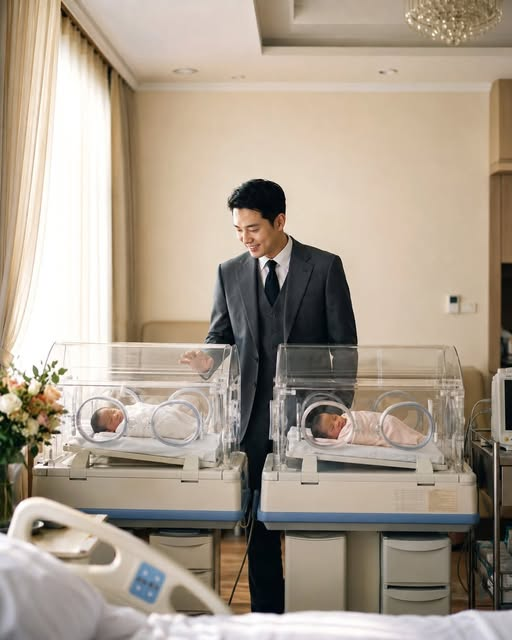
Leonardo stood beside the hospital wheelchair.
—Where are you going?
—Home.
—Our house is home.
I looked at him.
—No. Your house was an arrangement.
He lowered his voice.
—Valeria, don’t make decisions while you’re emotional.
I almost smiled.
—For three years, you liked me because I wasn’t emotional.
I nodded toward our children.
—Now you dislike me because I’m finally decisive.
His face tightened.
—They’re Lucianos.
—They’re my children before they’re anything else.
—You can’t keep them from me.
—I have no intention of doing that.
I had already spoken to lawyers.
There would be no disappearing with the babies.
No childish revenge.
Leonardo was their father and would have legal rights.
But so would I.
And for the first time, I intended to use mine.
Six weeks later, I filed for divorce.
Leonardo came to my parents’ house the same evening.
—You’re serious?
—Completely.
—Because of Clara?
I stared at him.
Even now, he didn’t understand.
—No.
That seemed to hurt him more.
—Then why?
I looked through the glass doors.
My mother was holding my daughter.
My father had fallen asleep on the sofa with my son against his chest.
Neither child knew anything about shares.
Legitimacy.
Family wars.
They were simply loved.
—Because when our children were born, I finally saw our marriage clearly.
Leonardo stepped closer.
—I can change.
—Perhaps.
I believed that.
People could change.
But change did not erase consequences.
He looked exhausted.
—Clara is gone.
—She was never the real problem.
—Then what was?
I met his eyes.
—You.
He flinched.
The divorce took nine months.
Don Augusto kept his promise.
The shares were transferred directly to me, placed under structures that prevented anyone from using my children as financial leverage.
Clara left the city with her baby after identifying the child’s biological father privately.
I never contacted her again.
Leonardo remained in his children’s lives.
At first, awkwardly.
Then more consistently.
Strangely, losing control of his family was the first thing that forced him to learn how to belong to one.
One afternoon, nearly two years later, he came to collect the twins for the weekend.
Our son ran toward him.
Our daughter followed screaming:
—Papa!
Leonardo crouched and caught both.
Then he looked at me.
There was no arrogance left in his expression.
Only something quieter.
Regret, perhaps.
—They’ve grown.
—Children do that.
He smiled.
Before leaving, he stopped beside me.
—Do you ever think about what would have happened if Clara’s baby had been mine?
I considered the question.
Once, it would have consumed me.
Now it felt strangely small.
—Nothing important would have changed.
He frowned.
—Why?
I looked at our children climbing into his car.
—Because Clara’s baby didn’t destroy our marriage, Leonardo.
He went still.
—Our marriage was already empty. That baby only made enough noise for both of us to finally hear it.
He lowered his eyes.
Then he left.
That night, after the twins returned, my daughter crawled into my bed and fell asleep against my chest.
My son arrived five minutes later carrying his blanket.
I lay between them in the darkness.
No competition.
No Luciano heir.
No legitimate son and convenient daughter.
Just my children.
And finally, I understood something I wished I had understood before entering that hospital.
I had spent months believing the woman who gave Leonardo the “right” baby would win.
But motherhood was never about winning a man.
The real victory was making sure my children never grew up believing their worth depended on being chosen by one.
