When I woke up again, it was already dark outside.
My fever had dropped.
The apartment smelled faintly of medicine, disinfectant, and something burned.
I turned my head.
Adrian was standing in my tiny kitchen, staring at a pot as though it had personally offended him.
For a company director who could negotiate contracts worth hundreds of millions without blinking, he had apparently lost a battle against oatmeal.
“You’re still here?”
He turned.
His expression immediately returned to its usual coldness.
“You finally woke up.”
I struggled to sit.
“How did you get inside?”
“Your brother gave me the access code.”
My eyes widened.
“My brother?”
“Yes.”
That was impossible.
My brother knew exactly who Adrian was.
More importantly, he knew exactly what had happened five years ago.
“Why would he give it to you?”
Adrian carried a glass of water toward me.
“Because your temperature was almost forty degrees and you weren’t answering your phone.”
I accepted the glass.
“Thank you.”
He remained standing beside the bed.
He didn’t leave.
I looked up.
“Is there something else?”
His eyes narrowed slightly.
“You really don’t remember?”
“Remember what?”
“Last night.”
My stomach tightened.
The fever.
The oatmeal.
His arms around me.
I remembered fragments.
Nothing dangerous.
Hopefully.
“What did I say?”
Adrian smiled.
It wasn’t friendly.
“You called me Captain Lu.”
My fingers froze around the glass.
That name.
Nobody at the company called him that.
Nobody had called him that in years.
It belonged to his eSports days.
More specifically, it belonged to one person.
The mysterious male player he had once publicly admitted liking.
Me.
I laughed awkwardly.
“You were famous. Everyone knew that nickname.”
“Really?”
“Yes.”
He leaned down slightly.
“Then why did you also say, ‘I told you the blue-side ambush would work’?”
My heart stopped.
I had said that?
No.
No, no, no.
That strategy had never been public.
Only my brother, our old team, and Adrian knew.
Because I had whispered it to him after the tournament final when I approached him disguised as my brother.
Adrian watched my face carefully.
“Daniela.”
“I was delirious.”
“You were.”
“People say strange things with a fever.”
“They do.”
His voice became quieter.
“Sometimes they also tell the truth.”
I looked away.
Five years ago, I would have panicked.
But I had spent too long rebuilding my life to collapse because of an old secret.
“I don’t know what you want me to say.”
He stared at me for several seconds.
Then he straightened.
“Nothing.”
That was worse.
Adrian picked up his coat.
“Rest. Human Resources extended your medical leave.”
He reached the door.
Then stopped.
Without turning around, he said:
“By the way, your brother and you still have exactly the same eyes.”
The door closed.
I didn’t breathe for ten full seconds.
Then I grabbed my phone and called my brother.
He answered immediately.
“How are you?”
“What did you tell Adrian?”
Silence.
That was enough.
“Mateo.”
“I told him you were sick.”
“What else?”
“Nothing.”
“He knows.”
Another silence.
My brother sighed.
“Daniela…”
“He knows about the tournament.”
“I warned you this would happen someday.”
I closed my eyes.
Nine years earlier, I had entered that tournament because Mateo injured his hand three hours before the final.
Our team would have been disqualified without him.
So I cut my hair shorter, wore his oversized uniform, put on a cap, and played under his account.
Nobody noticed.
Except Adrian noticed something.
Not that I was a woman.
Something worse.
He became fascinated with me.
After the game, I chased him for his number.
He rejected me.
Then the next day he told reporters that for the first time in his life, he might actually be interested in a man.
When Mateo showed me the article, I laughed so hard I cried.
Then I panicked.
Two weeks later, Adrian discovered the truth.
Not because I confessed.
Because he came to our university looking for “Mateo Jiménez” and found me arguing with my twin brother outside the library.
He stared at us.
Then at me.
Then said the most ridiculous sentence I had ever heard.
“So I’m not gay?”
I laughed.
He didn’t.
He grabbed my wrist, dragged me behind the building, and demanded:
“Why did you lie to me?”
“You never asked.”
“You let me question my entire identity for two weeks!”
“You refused to give me your number!”
He stared at me.
Then suddenly smiled.
“Ask again.”
That was how we started.
Four years together.
Four years that should have ended in marriage.
Instead, I disappeared.
Without a letter.
Without a call.
Without even letting him know whether I was alive.
And now he was my boss.
The next morning, Adrian behaved as though nothing had happened.
No questions.
No accusations.
No mention of the tournament.
For two weeks, our relationship remained perfectly professional.
Almost too professional.
Then the company announced its annual eSports charity exhibition.
Every department would form a team.
The winning team would receive a substantial charity fund.
During the meeting, Human Resources asked:
“Director Lu, who will represent management?”
Adrian looked across the conference table.
Directly at me.
“Miss Jiménez.”
My pen stopped.
Several colleagues turned toward me.
I forced a smile.
“I haven’t played competitively in years.”
Adrian leaned back.
“Your résumé says you adapt quickly.”
“That has nothing to do with gaming.”
“Are you refusing an assignment?”
Bastard.
Three hours later, I was sitting at a gaming station beside four coworkers.
Adrian stood behind us.
The match started.
For the first five minutes, I deliberately played badly.
Missed timing.
Ignored openings.
Pretended not to recognize rotation patterns.
Then our team fell behind.
One teammate cursed.
“We’re finished.”
Something inside me woke up.
Old instinct.
Old rhythm.
My fingers moved before I could stop them.
I changed formation.
Called a flank.
Forced the opposing team toward the lower lane.
Then executed the exact ambush that had defeated Adrian nine years earlier.
Silence exploded around me.
We won.
My teammates started cheering.
I slowly removed my headset.
Adrian was standing behind me.
He wasn’t smiling.
He simply said:
“Found you.”
My blood ran cold.
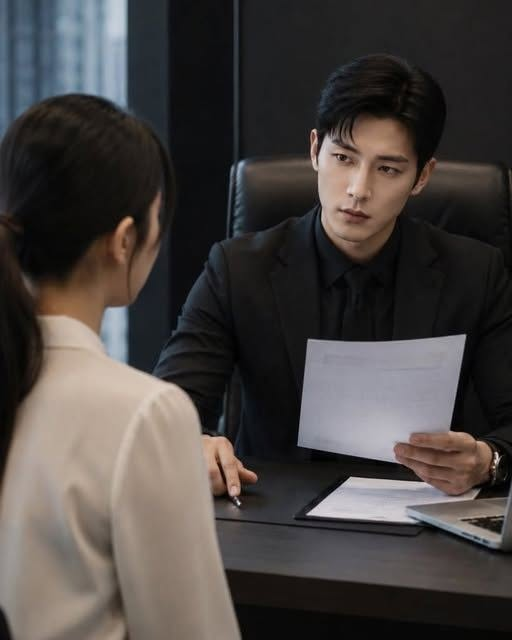
That evening he called me into his office.
The moment the door closed, I spoke first.
“If this is about nine years ago—”
“It isn’t.”
He placed an old photograph on the desk.
My breath stopped.
It showed us five years earlier.
Airport departure hall.
Me carrying a suitcase.
Adrian standing several meters behind me.
I had always believed he never knew I left.
But the photograph proved otherwise.
“You were there?”
He looked at me.
“I arrived twelve minutes after your flight closed.”
My throat tightened.
“You never told me.”
“You disappeared.”
His voice remained controlled, but his eyes didn’t.
“I went to your apartment. Empty.”
He placed another document beside the photograph.
“My calls were blocked.”
Another.
“Your university records were sealed.”
Another.
“Your brother told me you didn’t want to see me.”
I looked down.
Then Adrian produced one final piece of paper.
A photocopy of the letter I had written him five years ago.
The letter I had personally placed inside his apartment mailbox the night before leaving.
I stared at it.
“That’s impossible.”
Adrian’s voice became almost a whisper.
“I never received the original.”
My heart began hammering.
The photocopy had a handwritten note across the top.
Not mine.
Not Adrian’s.
I recognized the handwriting immediately.
My mother’s.
DO NOT LET ADRIAN SEE THIS. DANIELA MUST LEAVE WITHOUT KNOWING THE REAL REASON.
I felt the floor disappear beneath me.
Adrian watched my face.
“You didn’t abandon me because you stopped loving me.”
I couldn’t answer.
Because suddenly the memory of that night came back differently.
My mother crying.
My father ordering me to accept the overseas scholarship immediately.
Mateo refusing to look at me.
And one sentence my mother had repeated until I finally left:
“If you stay with Adrian Lu, you will destroy him.”
Adrian pushed another envelope across the desk.
“I met your mother yesterday.”
My hands went cold.
“What did she tell you?”
“Nothing.”
He paused.
“She gave me this.”
I opened the envelope.
Inside was a medical report dated five years earlier.
My name appeared at the top.
But the diagnosis beneath it was something I had never seen before.
And clipped behind the report was a genetic compatibility test.
Two names.
Mine.
And Adrian Lu’s.
At the bottom, one sentence had been circled in red.
Adrian looked at me across the desk.
Then said quietly:
“Daniela, whatever made you leave five years ago… your family wasn’t protecting me from you.”
His fingers tightened against the table.
“They were protecting you from my family.”
