The first document was not a photograph.
It was a hospital record.
Three years old.
Emergency treatment.
Multiple injuries documented by a physician who had written one sentence in the margin:
“Patient states injuries occurred inside marital residence. Patient appears afraid to identify responsible party.”
Tae-jun’s lawyer stood immediately.
“Your Honor, this has no relevance to the division of assets.”
Judge Lee looked over his glasses.
“Sit down.”
My lawyer, Park Ji-ho, opened the second file.
“This record matters because Mrs. Han alleges coercive control, financial concealment, intimidation, and repeated efforts to prevent her from reporting mistreatment.”
The courtroom went silent.
Tae-jun stared at me.
“You’re lying.”
I looked at him.
For ten years, those two words had been enough.
Not anymore.
Ji-ho placed a small external drive on the evidence table.
“The court has already received authenticated copies.”
Tae-jun’s mother went pale.
She knew what was on it.
Recordings.
Security footage.
Messages.
I had not collected them in one dramatic week.
It had taken years.
A housekeeper had saved footage before the Kang family ordered security archives erased.
A former driver had preserved voice messages Tae-jun sent after drinking.
My doctor had documented injuries even when I refused to speak.
And once I finally contacted Ji-ho, he helped me build something the Kang family had never expected from me.
A record.
Not a story.
Evidence.
The first audio played.
Tae-jun’s voice filled the courtroom.
“No one in Seoul will believe you over me.”
Then another:
“If you leave, every account disappears.”
Then his mother:
“A wife who embarrasses this family can be removed from it without anyone asking questions.”
Nobody laughed anymore.
Chae-rin slowly removed her hand from Tae-jun’s arm.
He noticed.
“So now you’re afraid?”
She whispered:
“You told me she was unstable.”
I looked at her.
That was what he had told everyone.
I was emotional.
Jealous.
Difficult.
Dependent.
The perfect explanation for anything I might say later.
Ji-ho opened another folder.
“Now we come to the financial issue.”
That was the part Tae-jun had been confident about.
He almost smiled again.
“The villa is mine.”
Ji-ho nodded.
“Registered in your name.”
“And the shares?”
“Also transferred.”
Tae-jun leaned back.
“Exactly.”
Ji-ho looked at the judge.
“Transferred where?”
The smile disappeared.
For eight months before filing for divorce, Tae-jun had moved assets through three holding companies.
One in Singapore.
One in Hong Kong.
One controlled through an executive at Han Group.
He believed that because the assets no longer appeared directly under his name, I could not claim them.
Unfortunately for him, transfers leave trails.
Bank approvals.
Board resolutions.
Beneficial ownership declarations.
And emails.
One message from Tae-jun to the group CFO read:
“Move everything before Seo-yeon’s lawyer sees the accounts.”
Another:
“Once the divorce is filed, bring the shares back through the family office.”
Judge Lee read the pages silently.
Then looked at Tae-jun.
“You told this court that those assets no longer existed.”
His lawyer rose.
“My client relied on corporate accounting—”
The judge interrupted.
“Your client signed the declarations.”
Nobody spoke.
Then came the document I had waited longest to reveal.
The original capitalization records from twelve years earlier.
Before I married Tae-jun, I had inherited shares in a small logistics technology company from my father.
After marriage, I sold them.
The proceeds went into one of Han Group’s failing subsidiaries.
At the time, Tae-jun called it “temporary family support.”
That subsidiary later became the logistics platform that multiplied Han Group’s international value.
The money had not come from the Kang family.
It had come from me.
Ji-ho placed the verified records before the court.
“Mrs. Han’s contribution was concealed through an internal nominee structure.”
Tae-jun’s mother stood.
“That money became family property.”
Ji-ho turned toward her.
“Then why did your family sign an agreement recognizing it as Mrs. Han’s separate investment?”
Her face froze.
Because they had.
Years earlier, when they still needed my money, they had been very careful to reassure me it remained mine.
Later, they simply assumed I had forgotten.
I hadn’t.
The hearing lasted six hours.
By the end, Tae-jun was no longer smiling.
The judge ordered preservation of disputed assets and referred evidence of false financial declarations for further review.
The abuse allegations were transferred to the proper authorities for separate investigation.
The divorce case itself continued privately.
But the damage to the Kang family’s reputation could no longer be contained.
They had spent generations selling an image of discipline, honor, and perfect family control.
Now reporters were asking why assets had been moved before a divorce.
Why security records had vanished.
Why a daughter-in-law had accumulated years of medical documentation while the family insisted nothing had happened.
Han Group’s board convened an emergency meeting.
Tae-jun was removed from executive duties pending investigation.
His mother lost several honorary positions.
Investors demanded independent governance reviews.
The empire did not collapse overnight.
Real companies rarely do.
But the first crack became impossible to hide.
Chae-rin disappeared from Tae-jun’s side almost immediately.
She contacted me once.
“I didn’t know.”
I believed her.
Not completely.
But enough.
She had known he was married.
She had not known the rest.
“I’m sorry,” she said.
“You don’t owe me an apology for what he did.”
She hesitated.
“What happens now?”
I looked out my apartment window.
“I live.”
That answer surprised even me.
For so long, survival had meant making it through one more night inside that house.
Now living meant something different.
Choosing breakfast.
Walking without checking whether a car was following me.
Opening my own bank account.
Sleeping with the bedroom door unlocked.
Small things.
Enormous things.
The divorce was finalized eleven months later.
I received a substantial share of the assets proven to have been concealed, restoration of my original investment interest, and full ownership of property that had been purchased with my separate funds.
The Cheongdam villa remained part of the settlement.
I sold it.
I never wanted to sleep there again.
Tae-jun received criminal and civil consequences from the matters uncovered in the investigations.
I did not attend every proceeding.
I had spent ten years letting his actions dictate my days.
I refused to spend another ten watching him answer for them.
Two years later, I founded a legal support program for spouses trapped in financially controlling marriages.
We helped women collect records safely.
Understand ownership.
Find representation.
And learn something I wished someone had told me earlier:
Being financially controlled does not mean you are powerless.
It means someone has worked very hard to convince you that you are.
One afternoon, Ji-ho visited my office.
He looked at the framed newspaper clipping on the wall.
Not the scandal.
The headline from our foundation’s first anniversary.
He smiled.
“Do you ever think about that first hearing?”
“Sometimes.”
“You were shaking.”
“I was terrified.”
“You didn’t look terrified.”
I laughed.
“That’s because Tae-jun taught me how to hide fear very well.”
Ji-ho’s smile faded.
I added:
“He just never expected me to use that skill against him.”
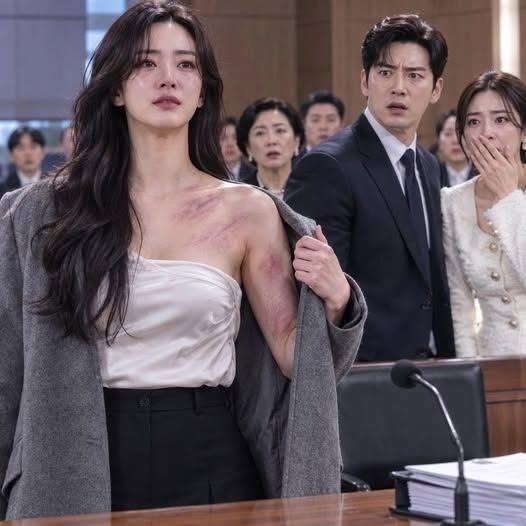
Years later, people still remembered the moment I removed my coat in court.
They thought that was when I became brave.
It wasn’t.
I became brave months earlier, when I stopped asking whether anyone would believe me and started preserving the truth anyway.
Tae-jun had taken the house.
Emptied the accounts.
Hidden the shares.
And stood before a courtroom certain that he had left me with nothing.
He was wrong.
Because after ten years, I still had the one thing the Kang family had never managed to take.
Evidence.
And once I finally stopped being afraid to use it, their name was no longer powerful enough to silence mine.
