Two days passed like that.
He didn’t contact me.
I didn’t contact him either.
On the third day, Chu Dien posted another photo.
This time it was a lakeside resort outside the city.
There were four people around a barbecue.
And beside him sat Linh Ha, his college junior—the woman whose name had caused our argument before he abandoned me at the airport.
She had uploaded the photograph herself.
“Some people always show up when you need them most.”
Chu Dien had liked it.
I stared at the screen for several seconds.
Then I closed the app.
Strangely, I didn’t feel jealous.
I only remembered why we had argued.
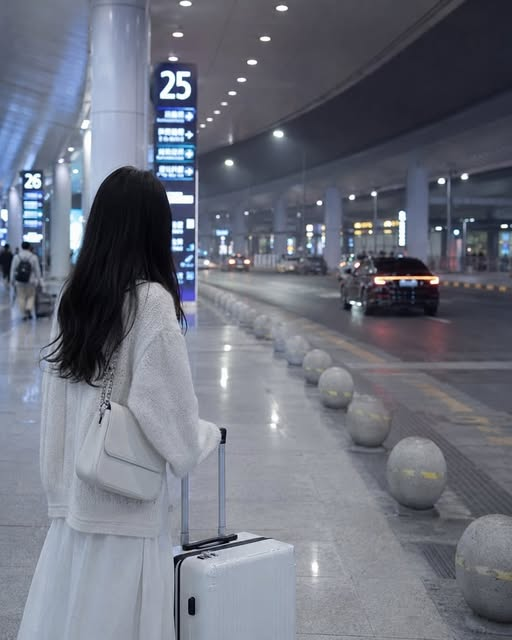
Before my flight from Beijing, I had called him and asked whether he could pick me up.
He said yes.
But when I landed, Linh Ha called him.
Her car had broken down.
I was exhausted and asked:
“Can’t she call roadside assistance?”
Chu Dien immediately became annoyed.
“She’s alone. Why are you always so calculating?”
I had said nothing else.
He drove to the airport anyway.
But the moment I got into the car, he received another message from Linh Ha.
Then he looked at me.
“If you’re going to keep making a problem out of everything, take a taxi home yourself.”
I thought he was angry.
I never imagined he would actually unload my suitcase onto the sidewalk and drive away.
Now, seeing their photograph together, I finally understood.
The airport wasn’t the problem.
It was simply the moment I stopped pretending I had a place in his priorities.
That afternoon, Human Resources called me.
“Have you decided about Singapore?”
I looked at the transfer contract sitting in my inbox.
The company had offered me a three-year assignment months earlier.
I had refused because Chu Dien said:
“I don’t want a long-distance marriage.”
So I had stayed.
I had rejected the promotion.
Rejected the relocation allowance.
Rejected the apartment.
All because I thought marriage meant building a life together.
I opened the contract.
Signed.
Then sent it back.
“I accept.”
On the fourth day, I contacted a lawyer.
On the fifth, I packed.
Not dramatically.
I took my clothes.
My books.
My documents.
The coffee machine my mother had given me.
I left everything belonging to Chu Dien exactly where it was.
His shoes.
His cigarettes.
His gaming console.
Even the wedding photograph in the hallway.
I stared at it for a while.
In the picture he was looking at me as if there were no one else in the world.
Maybe he had loved me then.
Maybe I had simply spent too long expecting the man in the photograph to come back.
I turned the frame face down.
Then I left the divorce agreement on the dining table.
On the sixth day, Chu Dien finally sent me a message.
Did you water the plants?
That was all.
Not:
Are you okay?
Not:
I’m sorry.
Not:
Can we talk?
The plants.
I replied:
No.
He responded almost immediately.
They’re going to die.
I looked at the boxes surrounding me in my temporary apartment.
Then typed:
Then come home and take care of them.
He didn’t reply.
Apparently, he thought I was still sulking.
Good.
Let him think whatever made the next two days comfortable.
On the eighth day, I flew to Singapore.
My new apartment overlooked the river.
Small.
Bright.
Nothing luxurious.
But when I entered, nobody’s coat was hanging over a chair.
Nobody’s cigarette smoke stayed trapped in the curtains.
Nobody expected me to wait for them.
I slept for eleven hours.
When I woke up, my phone had seventeen missed calls.
Chu Dien.
Then a message:
Where are you?
Another:
Why haven’t you come home from work yet?
I stared at it.
For several seconds, I couldn’t believe it.
Eight days.
It had taken my husband eight days to realize I wasn’t coming home.
I answered:
I came home. Just not to yours.
The phone rang immediately.
I answered this time.
“What does that mean?”
His voice was sharp.
“Exactly what it says.”
“I’m standing in the apartment.”
I could hear him walking.
“Your clothes are gone.”
“Yes.”
“Your books too.”
“Yes.”
Then silence.
He had reached the dining table.
I knew what he had found.
“What is this?”
“The divorce agreement.”
“You’re divorcing me?”
“Yes.”
“Because I left you at the airport?”
I laughed softly.
He sounded almost offended.
“No.”
“Then because of Linh Ha?”
“No.”
“Then what?”
That question told me everything.
He genuinely did not know.
So I answered calmly.
“Because it took you eight days to notice your wife had disappeared.”
Silence.
“Chu Dien, you left me at an airport at ten at night because another woman needed you.”
“You disappeared for days.”
“You didn’t ask whether I got home safely.”
“You didn’t ask whether I had eaten.”
“You didn’t even notice I packed half the apartment.”
I paused.
“But you remembered the plants.”
His breathing became heavier.
“I thought you were punishing me.”
“I wasn’t.”
“That’s worse.”
He went silent.
I continued:
“I stopped waiting for you to care.”
Then his tone changed.
“Where are you?”
“Singapore.”
“What?”
“I transferred.”
“You rejected that position!”
“I changed my mind.”
“You can’t make a decision like that without discussing it with me.”
I almost laughed.
“You left your wife on an airport sidewalk without discussing it.”
“That was anger.”
“And this is clarity.”
He said my name softly.
For the first time, fear entered his voice.
“Come back.”
“No.”
“I’ll go to Singapore.”
“No.”
“We can fix this.”
“Chu Dien.”
I looked through the window at a city I didn’t know yet.
“I spent years fixing things you didn’t even notice were broken.”
“I’m tired.”
He had no response.
He signed the divorce three months later.
Not immediately.
First came the apologies.
Flowers to my office.
Emails.
A flight reservation to Singapore I told him to cancel.
Then anger.
Then bargaining.
Finally, honesty.
During our last video call, he said:
“I always thought you’d be there.”
“I know.”
“That’s why I could leave when I was angry.”
“Yes.”
“Because I thought no matter what I did, you’d come home.”
I smiled sadly.
“Exactly.”
That was the whole marriage in one sentence.
He had mistaken my loyalty for permanence.
My patience for lack of limits.
My returning for proof that I could never leave.
He asked:
“Was there someone else?”
“No.”
That seemed to hurt him more.
Because there was no man to blame.
No affair.
No rival.
He had lost me entirely by himself.
Linh Ha disappeared from his life soon afterward.
I heard through mutual friends that nothing serious had ever happened between them.
Perhaps that was true.
It didn’t matter.
I had never left because she stole my husband.
I left because my husband repeatedly showed me that someone else’s inconvenience could become more urgent than my safety.
That was enough.
A year later, I returned to the city for a conference.
Chu Dien and I accidentally met in the lobby of a hotel.
He looked older.
Calmer.
He asked:
“Singapore?”
“Still there.”
“Happy?”
I thought about my work.
My apartment.
My friends.
The fact that when my flight landed now, I simply ordered a car instead of wondering whether someone loved me enough to show up.
“Yes.”
He nodded.
Then smiled faintly.
“I still think about those eight days.”
“So do I.”
“I thought I was teaching you not to take me for granted.”
I looked at him.
“And what did you learn?”
His smile disappeared.
“That I was the one taking someone for granted.”
For once, there was nothing left to argue about.
We said goodbye.
And walked in opposite directions.
The night Chu Dien left me at the airport, he believed I would chase him.
When I didn’t, he assumed I was angry.
When I stopped calling, he assumed I was waiting for him to apologize.
When I packed, he didn’t notice.
When I left the city, he still didn’t notice.
It took him eight days to ask why I hadn’t come home from work.
By then, I had already learned the difference between being abandoned for one night—
and realizing you had been emotionally alone for years.
I did not leave because he drove away from the airport.
I left because, after he drove away, I finally stopped running after him.
