The following Monday, the head teacher called me into her office again.
This time, the counselor was there.
So was Julián, the janitor.
And on the table sat the green scarf Iván had left in my drawer.
I frowned.
“What happened?”
The head teacher pushed a folder toward me.
“Nothing bad.”
That sentence alone made my shoulders drop.
She opened the folder.
Inside was a proposal.
CLASSROOM 14 SUPPORT POINT.
Food.
Hygiene products.
School supplies.
Emergency clothing.
All available discreetly, with the counselor responsible for connecting families to longer-term assistance when necessary.
I stared at the document.
“You’re making the drawer official?”
“Not exactly.”
She smiled.
“We’re making sure it doesn’t depend on one teacher’s salary.”
For years, I had bought whatever I could.
Sometimes twenty euros.
Sometimes fifty.
Once, during a particularly difficult winter, much more than I should have.
I had never kept track.
Now the school wanted a small permanent fund.
Local supermarkets had agreed to donate basic products.
A pharmacy would provide hygiene kits.
Several families had offered anonymous monthly contributions.
And there would still be no public list of who took what.
“No child has to explain their situation in front of classmates,” the counselor said.
“If repeated need suggests something bigger is happening, we approach the family privately.”
I looked at the scarf.
“And this?”
Julián scratched his chin.
“That was my idea.”
He looked embarrassed.
“I thought we could hang it beside the cupboard.”
“For decoration?”
“No.”
He pointed toward a small card.
On it were Iván’s grandmother’s words:
IF SOMEONE HELPS YOU UP, DON’T STAY ON THE GROUND.
I had to look away for a moment.
Iván pretended not to care when he found out.
That was his specialty.
He entered History late, dropped into his chair and muttered:
“So now there’s going to be a whole charity shop?”
“No.”
I continued writing on the board.
“There will be a cupboard.”
“That’s worse.”
“A very boring cupboard.”
He almost smiled.
Then I heard him whisper:
“Did you tell them about me?”
I put down the chalk.
“No.”
His shoulders relaxed.
“Your mother chose to write to the school. Everything else remains private.”
He nodded.
After a pause, he asked:
“Is the scarf still there?”
“Yes.”
“I thought maybe someone already needed it.”
“Someone will.”
He looked out the window.
“Good.”
That was all he said.
But the following morning, two cans of tuna appeared in the cupboard.
Nobody admitted leaving them.
I had my suspicions.
Over the next months, something changed in the school.
Not dramatically.
There were still arguments in corridors.
Still unfinished homework.
Still teachers complaining about mobile phones.
Still students arriving late with excuses so creative they deserved literary prizes.
But the cupboard began filling faster than it emptied.
A girl left unopened shampoo after her family bought too much.
One boy quietly added a packet of pencils.
Another student’s father owned a bakery and started sending individually wrapped rolls twice a week.
Then something happened I had not expected.
The students began protecting the system themselves.
One afternoon, a first-year boy joked loudly:
“Who keeps taking all the cereal bars? Someone must be starving.”
Before I could respond, Iván turned around.
His expression was hard.
“Or maybe somebody is hungry.”
The other boy stopped laughing.
Iván continued:
“You eat them if you need them. If not, shut up.”
Silence.
Then everyone returned to their work.
I said nothing.
There are moments when a teacher should teach.
And others when a teacher should recognize that the lesson has already been learned.
Iván changed slowly.
He still arrived late sometimes.
He still had that defensive look when adults asked too many questions.
But the fights became less frequent.
The counselor helped his mother apply for assistance she had not known she qualified for.
The school arranged breakfast without requiring Iván to stand in a separate line.
His little sister joined an after-school music program.
And one morning, he arrived ten minutes early.
I looked at the clock theatrically.
“Should I call an ambulance?”
He rolled his eyes.
“Very funny.”
Then he placed an essay on my desk.
University application essay.
I stared at him.
“You’re applying?”
“Maybe.”
“To study what?”
He shrugged.
“Social work.”
I tried not to react too strongly.
“Why?”
He looked toward the cupboard.
“Somebody should know how all those forms work.”
That time I could not hide my smile.
Two years passed.
Then came my final year before retirement.
By then, the old drawer had become three discreet cupboards across the school.
No bright signs.
No photographs for social media.
No ceremonies where embarrassed children were asked to smile beside donated boxes.
Just access.
Quietly.
Respectfully.
The school board wanted to name the program after me.
I refused.
Absolutely not.
I told them:
“If you put my name on it, I’m retiring early.”
They believed me.
Instead, the students chose the name.
NO ONE FALLS HERE.
That I allowed.
My last day arrived in June.
I had imagined retirement differently.
I expected a cake.
Maybe some flowers.
A speech from the head teacher.
All of that happened.
What I did not expect was Iván.
He was eighteen now.
Taller than me.
Hair finally cut properly.
Still wearing the same expression that suggested the world had better explain itself before approaching him.
He waited until everyone else had left Classroom 14.
Then he placed something on my desk.
The green scarf.
I stared at it.
“I thought this belonged to the cupboard.”
“It did.”
“Then why are you giving it to me?”
He sat on the edge of a desk.
“Because I bought another one.”
I looked toward the cupboard.
A new thick scarf hung beside it.
Dark blue.
Underneath was the same message from his grandmother.
I touched the old green wool.
“I can’t take this.”
“Yes, you can.”
“Iván—”
“My grandmother made it for people who needed warmth.”
He shrugged.
“You’re retiring. Old people get cold.”
I stared at him.
Then started laughing.
“So this is gratitude?”
“Basically.”
But his eyes had turned red.
Mine too.
He looked down.
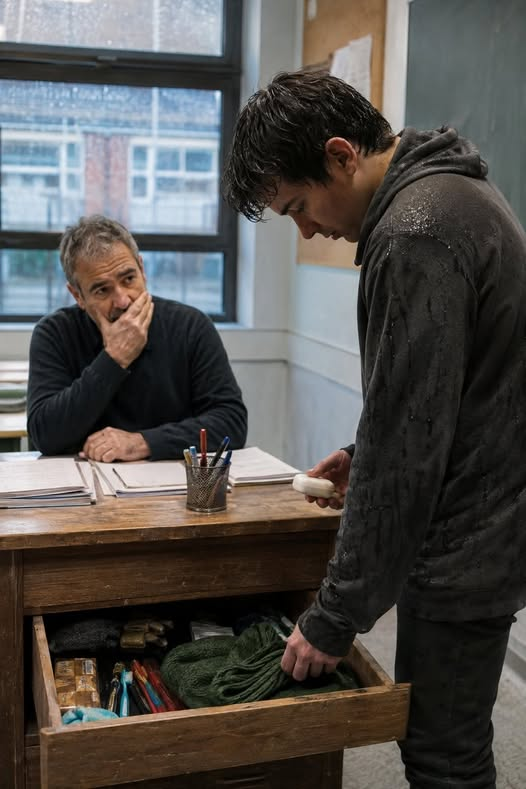
“I remember that day.”
“The soap?”
He nodded.
“I hadn’t showered properly in four days.”
His voice became quieter.
“Some boys had started calling me names.”
I said nothing.
“My sister had that school performance, and I was going to tell her I couldn’t go.”
He rubbed his hands together.
“Then I remembered your drawer.”
For years, I had thought hunger was the thing I was helping with.
He corrected me.
“I could handle being hungry.”
He looked at me.
“What I couldn’t handle was thinking everyone could tell.”
There it was.
The truth I had sensed but never fully understood.
Poverty hurts.
But shame isolates.
It convinces a person that needing help means becoming smaller in everyone else’s eyes.
Iván continued:
“You never looked at me differently afterward.”
“Why would I?”
He shrugged.
“Most people do.”
I folded the scarf carefully.
“Well, most people are badly trained.”
He laughed.
Then he stood and hugged me.
Briefly.
Awkwardly.
Perfectly.
Three years after I retired, I returned to the school for an anniversary event.
Classroom 14 had new desks.
New paint.
Even a smartboard I absolutely would have hated.
But the bottom cupboard was still there.
I opened it.
Soap.
Socks.
Biscuits.
Notebooks.
Period products.
Bus cards.
And a handwritten note:
Take what you need. Leave what you can. Nobody owes an explanation.
Beside it hung the blue scarf.
The head teacher approached me.
“You know who was here last week?”
I looked at her.
“Iván.”
My heart jumped.
“He’s at university.”
“Social work?”
She nodded.
“He comes back sometimes to help the counselor.”
I smiled.
Of course he did.
Before leaving, I sat for a moment at my old desk.
For decades I had taught wars, constitutions, revolutions, dates students forgot immediately after exams.
I used to wonder what they would actually remember from my classroom.
Now I knew.
Perhaps Alba remembered a cereal bar.
Perhaps Lucía remembered a toothbrush she could take without explaining why.
Perhaps Iván remembered entering a room afraid of smelling bad and leaving with soap, dry socks, and his dignity intact.
And perhaps one day, when one of them saw someone struggling, they would remember the simplest rule we ever taught in Classroom 14:
Need should never become a spectacle.
I had three years left before retirement when a boy opened my drawer looking for soap.
He left his dead grandmother’s scarf behind.
At the time, I thought he was repaying me.
He wasn’t.
He was teaching me.
Hunger can empty a stomach.
Cold can numb your hands.
But shame can convince a child that they do not deserve to ask for warmth at all.
And sometimes the most important thing an adult can give them is not food, money, or advice.
Sometimes it is simply a place where they can open a drawer—
and still leave with their dignity untouched.
