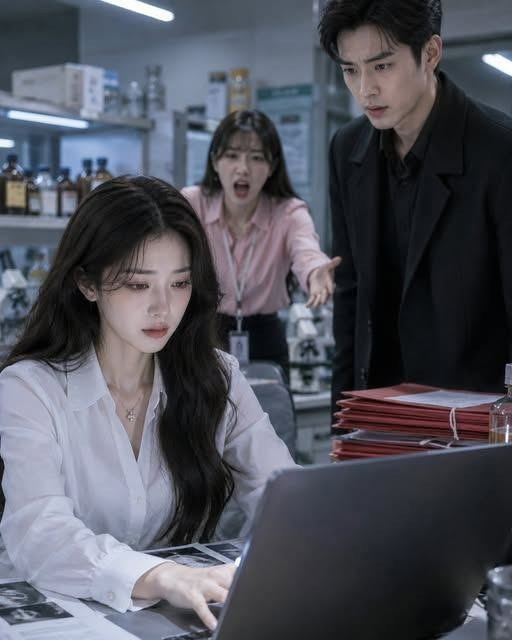
The laboratory went completely silent.
Álvaro looked at the two members of the disciplinary commission.
Then at my tutor.
Then at me.
His face slowly hardened.
“Professor, this is a misunderstanding.”
My tutor placed the red folder on the table.
“Then you’ll have an opportunity to explain it.”
Sonia grabbed Álvaro’s sleeve.
“What exactly did they find?”
One of the commissioners opened the file.
“At 11:56 p.m., Mr. Campos accessed the postgraduate recommendation system using student-association administrative credentials.”
Álvaro immediately interrupted.
“I had permission to access student data.”
“Not to modify postgraduate applications.”
His mouth closed.
The commissioner continued.
“At 11:57, Clara’s uploaded documents were removed.”
“At 11:58, another file was inserted under her application ID.”
“At 11:59, the change was reversed from a separate authenticated account.”
Everyone looked at me.
I said nothing.
The professor turned another page.
“The substituted file belonged to Sonia Ruiz.”
Sonia’s legs seemed to weaken.
“No.”
“It wasn’t like that.”
“I didn’t touch the system.”
The commissioner looked at her.
“That is why we are investigating both of you separately.”
Her eyes immediately turned toward Álvaro.
That tiny movement told me everything.
When people believe they are going to win together, loyalty feels easy.
It becomes much harder when consequences arrive.
The inquiry lasted three weeks.
I was interviewed twice.
I submitted the mistaken message Álvaro had sent me.
Screenshots.
System logs.
The original thesis file.
My tutor’s timestamped copy.
Then the university examined something I had not even reported.
Sonia’s research record.
Several graphs in her scholarship application were almost identical to data from my project.
Not merely similar.
Identical.
Including one labeling mistake I had corrected months earlier.
The commission asked Sonia where she obtained them.
She said:
“We worked together.”
We had not.
Then she said:
“Clara gave them to me.”
I produced the project access history.
She had never been authorized.
Finally she cried and said Álvaro had given her the files because “Clara had plenty of results anyway.”
I remember hearing that sentence and feeling something inside me become completely calm.
Plenty.
As though work were bread on a table.
As though because I had more, anyone who wanted some could simply take it.
Álvaro came to find me the evening before the final disciplinary hearing.
He waited outside the library.
“Clara.”
I kept walking.
He stepped in front of me.
“Five minutes.”
“No.”
“Please.”
That word sounded strange coming from him.
For three years, I had been the one asking.
For time.
For attention.
For honesty.
Now he wanted five minutes.
I stopped.
He spoke quickly.
“Sonia manipulated me.”
I almost laughed.
“She forced you to log into the system?”
“No.”
“But she kept telling me her life would be over if she had to return home.”
“And therefore mine was disposable?”
His face tightened.
“That’s not what I thought.”
“It is exactly what you thought.”
He lowered his voice.
“You would succeed anywhere.”
I stared at him.
There it was again.
The excuse everyone used when taking from the person who worked hardest.
You’ll be fine.
As if being capable made betrayal harmless.
“You knew Beijing was my goal.”
“Yes.”
“You watched me work toward it for three years.”
“Yes.”
“And two minutes before the deadline, you tried to give it away.”
Álvaro’s eyes reddened.
“I thought once you calmed down, you’d understand.”
I smiled.
“You still don’t understand me at all.”
He reached for my hand.
I stepped back.
“Clara, if I’m expelled, everything I’ve worked for is gone.”
I looked at him calmly.
“Now you know what you tried to do to me.”
Then I walked away.
The university announced the decision four days later.
Sonia’s recommendation eligibility was revoked.
Her scholarship application was suspended pending a separate academic-integrity review.
Several portions of her research record had to be withdrawn.
She was allowed to complete her degree, but the disciplinary finding remained in her file.
Álvaro lost his student-association position immediately.
Because he had abused administrative access, he received a formal disciplinary sanction and became ineligible for the university’s internal postgraduate recommendation that year.
He was not expelled.
I was glad.
I did not want their lives destroyed.
I wanted the truth documented.
There is a difference.
Consequences should fit actions.
Revenge only needs anger.
The strangest part came afterward.
Some classmates said I had gone too far.
“She already lost Beijing.”
“Was reporting everything necessary?”
“Álvaro was your boyfriend. Couldn’t you solve it privately?”
I learned something useful then.
People are very generous with forgiveness when they are spending someone else’s future.
So I stopped explaining.
I had not fabricated the logs.
I had not copied the research.
I had not entered the system illegally.
I had simply refused to hide what they had done.
My final admission to Peking University arrived two months later.
I read the email alone.
No dramatic music.
No audience.
Just my name, the program, and one sentence:
We are pleased to offer you admission.
I cried then.
Not because of Álvaro.
Not because of Sonia.
Because for weeks their betrayal had made my achievement feel contaminated.
That email gave it back to me.
This was not the place I had stolen from someone else.
It was mine.
I had earned it.
Sonia approached me one last time before graduation.
She looked exhausted.
“Can I ask you something?”
I nodded.
“Did you ever actually consider me your friend?”
“Yes.”
That seemed to hurt her.
“Then why didn’t you help me?”
“I did.”
She frowned.
“I gave you my notes.”
“I recommended scholarships.”
“I included you in legitimate opportunities.”
“I introduced you to professors.”
I paused.
“But eventually you stopped wanting help.”
“You wanted my result.”
Her eyes filled.
“My family really would have forced me to go home.”
“I believe you.”
That surprised her.
I continued:
“And I’m sorry your situation was unfair.”
“But someone else suffering does not give them the right to steal your future.”
She looked down.
For once, she did not argue.
Álvaro and I never reconciled.
A year later, I heard he had passed the national entrance examination and entered a different graduate program.
He had to start without special recommendations, titles, or shortcuts.
Maybe that was good for him.
Maybe for the first time, he had to build something that belonged entirely to himself.
I wished him no harm.
I simply never wanted him near my life again.
Beijing was difficult.
Much harder than I had imagined.
For the first semester, almost everyone around me seemed brilliant.
I doubted myself constantly.
Then I remembered something:
I had not reached that classroom because someone loved me enough to give me a place.
I had reached it because when two people tried to remove my name with two minutes remaining—
I put it back.
Three years later, my thesis won a national research award.
When a reporter interviewed me, she asked:
“What was the most important decision you made as a student?”
She probably expected me to mention my research topic.
Instead, I said:
“Learning that protecting what you earned is not selfish.”
Because that was the real lesson.
Álvaro believed I loved him so much that I would forgive him for stealing my opportunity.
Sonia believed my success meant I could afford to lose a little of it.
They were both wrong.
Hard work does not become community property simply because someone else needs it.
Two minutes before the system closed, they tried to erase my name from the future I had built.
They failed.
And in the end, I did not have to destroy either of them.
I only restored my own application and let the system record exactly who had tried to replace it.
The rest—
they did to themselves.
