“Withdraw.”
My father said only one word.
Then he ended the call.
I looked at him through the rearview mirror.
“Dad, what did you withdraw?”
He started the car.
“Everything that should never have been given to them in the first place.”
I frowned.
He did not explain.
Not until twenty minutes later, when Luc Canh Dien called me seventeen times in a row.
I watched his name flash across the screen.
Dad glanced at it.
“Answer.”
I did.
Canh Dien’s voice was completely different from the man who had wished me happiness less than half an hour earlier.
“To Niem, where are you?”
“In the car.”
“Who is with you?”
“My father.”
There was shouting behind him.
Airport announcements.
His mother demanding answers.
Chu Uyen Thanh asking whether they would miss the flight.
Then Canh Dien lowered his voice.
“Did your father do something to Luc Thi?”
I looked at Dad.
He continued driving calmly.
“What happened?”
“The bank suspended our credit line. Three investment funds just notified us that they’re delaying disbursement. The Riverside acquisition account has been frozen pending review.”
I said nothing.
Canh Dien’s breathing became heavier.
“More than thirty billion yuan is involved.”
Then he asked the question he should have asked three years earlier.
“To Niem… who exactly is your father?”
I looked at the ordinary old sedan.
At Dad’s faded jacket.
At the man my former mother-in-law had mistaken for a countryside driver.
“My father.”
Then I hung up.
His name was To Minh Khang.
To outsiders, that name meant little.
Because for nearly twenty years, he had rarely appeared publicly.
The companies he controlled were held through several investment entities.
But in the financial world, one group knew him very well.
Thanh Viet Capital.
One of the largest private infrastructure investment platforms in the country.
And I was his only daughter.
Three years earlier, when I told my parents I wanted to marry Luc Canh Dien, my father asked me one question:
“Does he know who you are?”
“No.”
“Why hide it?”
“Because I want to know whether he loves To Niem or the To family.”
Dad stared at me for a long time.
Then nodded.
“I won’t interfere.”
He kept his promise.
Perhaps too well.
I asked him not to help me.
No luxury apartment.
No executive title.
No chauffeur.
I took an ordinary administrative job and lived on my own salary.
When I married into the Luc family, I even asked my parents to attend quietly and let distant relatives represent them.
Luc Canh Dien believed my father ran a small agricultural business outside the city.
His mother believed my mother sold goods at a market.
I never corrected them.
Because at first, I thought dignity did not require explanation.
Then their contempt became routine.
And I still said nothing.
What I did not know was that Dad had helped Luc Thi indirectly.
Not because they were worthy.
Because I loved their son.
When Luc Thi’s expansion stalled eighteen months earlier, Thanh Viet Capital had participated in a syndicated financing arrangement.
When banks hesitated over the Riverside project, one of Dad’s funds provided a guarantee.
When Luc Thi prepared to acquire three commercial properties, capital linked to Thanh Viet was scheduled to be released after final compliance approval.
Dad never told me.
“I wanted your marriage to have fewer financial pressures,” he said.
I stared at him.
“So the Luc family’s recent expansion…”
“Was partly supported by us.”
“Why?”
He smiled sadly.
“Because you were my daughter.”
I lowered my eyes.
“And today?”
“Today you are still my daughter.”
His voice became colder.
“But Luc Canh Dien is no longer my son-in-law.”
The withdrawal was not illegal retaliation.
Existing obligations remained.
But discretionary financing, unsigned renewals and pending disbursements were stopped for fresh risk assessment.
Without that money, Luc Thi suddenly had to survive on its actual balance sheet.
That was apparently much harder than insulting a daughter-in-law.
They never boarded the Tokyo flight.
At 6:40 p.m., Luc Canh Dien appeared at my parents’ home.
His mother came with him.
So did Chu Uyen Thanh.
When the gates opened, Trieu Le Phan stopped speaking.
The “small countryside family” lived on a private estate outside the city.
Not extravagant.
But impossible to misunderstand.
Dad was sitting in the courtyard drinking tea.
Canh Dien walked toward him.
“Uncle To.”
Dad looked up.
“You called me Mr. To once at the wedding.”
Canh Dien’s face stiffened.
Trieu Le Phan tried to smile.
“There seems to have been a misunderstanding between families.”
I nearly laughed.
Three hours earlier, I had been a burden.
Now we were “families.”
Dad poured another cup of tea.
“What misunderstanding?”
She swallowed.
“We didn’t know To Niem had such a background.”
Dad placed the teapot down.
“And if she didn’t?”
Silence.
“If my daughter really earned eight thousand yuan a month, would humiliating her have been acceptable?”
Nobody answered.
That was the only question that mattered.
Canh Dien turned toward me.
“To Niem, I admit I handled the divorce badly.”
I looked at him.
“You cheated.”
His face tightened.
“Uyen Thanh and I—”
“You brought her into our home.”
“She left things in my bedroom.”
“You let your mother compare us for months.”
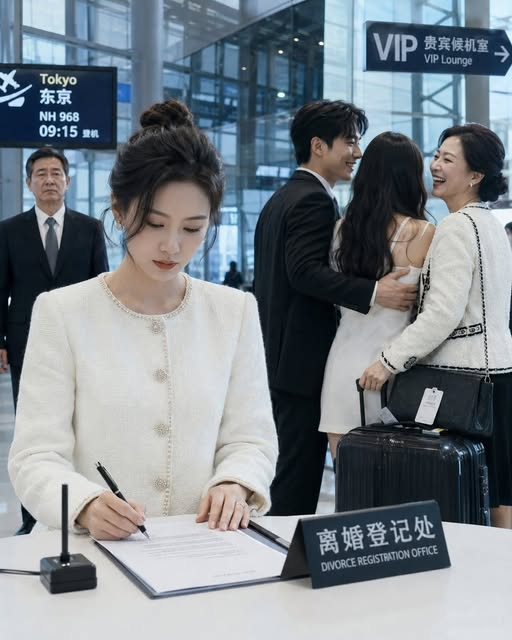
“And today your family went to Tokyo to celebrate getting rid of me.”
Chu Uyen Thanh finally spoke.
“You already agreed to divorce. Why punish the company?”
Dad answered before I could.
“Nobody is punishing Luc Thi.”
He pushed a document across the table.
“We are simply no longer taking risks for people who are not family.”
Canh Dien opened it.
His face turned pale.
The financing had never been guaranteed indefinitely.
Renewals depended on investment committee approval.
Now Luc Thi would have to refinance at market terms.
No more invisible protection.
No more favorable grace periods.
No more assuming money would appear.
Canh Dien looked at me.
“Did you know about this?”
“No.”
That answer seemed to hurt him more.
Because it meant I had not married him with a financial trap prepared.
I really had loved him.
The next six months were difficult for Luc Thi.
But the company did not collapse.
Dad refused to destroy it merely because my marriage had ended.
Luc Canh Dien sold two speculative projects.
Reduced debt.
Canceled unnecessary expansion.
His family sold several luxury assets.
The Tokyo celebration never happened.
Neither did his wedding to Chu Uyen Thanh.
Not because I interfered.
Pressure simply revealed what romance had hidden.
Her family had expected Luc Thi to keep expanding.
When the balance sheet weakened, negotiations over marriage became negotiations over money.
They separated before the year ended.
I felt nothing when I heard.
By then I had returned to Thanh Viet Capital.
Not as “Chairman To’s daughter.”
I started in the investment review division.
Dad gave me no ceremonial position.
“If you want the company,” he said, “learn why every number matters.”
So I did.
For the first time in years, nobody introduced me as Luc Canh Dien’s wife.
I became To Niem again.
Two years later, Luc Canh Dien came to see me.
He looked older.
More restrained.
“I used to think you had nothing.”
I closed the report in front of me.
“I know.”
He gave a bitter smile.
“The worst part is that even if that had been true, I still had no right to treat you the way I did.”
That was the first intelligent thing he had said about our marriage.
I nodded.
“Yes.”
He looked at me for a long time.
“If I had known who you were…”
I interrupted him.
“Then I’m glad you didn’t.”
His face froze.
“Why?”
“Because I got the answer I wanted.”
Three years earlier, I had hidden my surname to discover whether he could love a woman without status.
The answer had cost me a marriage.
But it had saved the rest of my life.
On April 8, 2025, Luc Canh Dien walked out of the Civil Affairs Department believing he had discarded an ordinary wife who brought nothing to his family.
Minutes later, my father withdrew thirty billion yuan of support.
But the money was never the real punishment.
The real consequence was much simpler.
The Luc family had spent three years judging my value by what they thought I owned.
And when they finally discovered who my father was, it was already too late.
Because by then, I had discovered something more important too:
A family that only respects you after learning your price never respected you at all.
