My father replied less than a minute later.
“Confirmed. Flight departs at 9:20 a.m. the day after tomorrow. London.”
I stared at the message until the letters blurred.
London.
A city I had only seen in photographs.
A university foundation program specializing in visual arts.
A life where Daniel Jiang and Camila Lin didn’t exist at the center of every decision I made.
For the first time that day, I smiled.
When I arrived at University A, registration was almost finished.
Daniel called twice.
Camila sent six messages.
I ignored all of them.
I went directly to the administration building.
The woman behind the counter looked surprised when I placed my admission notice in front of her.
—You want to withdraw before enrolling?
—Yes.
—Are you certain?
I thought about the art university application I had crossed out months earlier.
About Daniel saying the three of us should stay together.
About Camila holding my hand and begging me not to leave her alone.
Then I remembered the station.
They hadn’t been afraid of being without me.
They had simply been afraid that I might choose something without them.
—I’m certain.
I signed.
Twenty minutes later, my place at University A disappeared from the system.
Outside the administration building, I finally saw them.
Daniel was carrying Camila’s suitcase.
Camila held two cups of milk tea.
They looked exactly like the photo from the train.
Like a couple who had forgotten they were supposed to be part of a trio.
Camila saw me first.
—Star!
She ran toward me.
—Why didn’t you answer? We saved you a bed in our dorm area.
I looked at her.
—I’m not staying.
Daniel frowned.
—What does that mean?
—I withdrew.
Both of them froze.
Camila laughed uncertainly.
—Stop joking.
—I’m not joking.
Daniel’s face darkened.
—You’re withdrawing because we left earlier?
There it was.
Not an apology.
Not even embarrassment.
Just irritation that my reaction had become inconvenient.
—No.
I adjusted the strap of my bag.
—I’m withdrawing because I don’t want to study here.
—But you chose University A.
I looked straight at him.
—No, Daniel. You chose University A. Camila chose University A. I followed you.
For the first time, he had nothing to say.
Camila’s smile disappeared.
—Then where are you going?
—I haven’t decided what I want to tell people yet.
Her eyes widened.
—We’re not “people.” We’re your best friends.
Something inside me became strangely calm.
—Are you?
Daniel stepped forward.
—Star, you’re being childish.
That word would have destroyed me once.
I would have immediately wondered whether I was overreacting.
Whether I was too sensitive.
Whether I should apologize simply to restore peace.
That day, I only nodded.
—Maybe.
Then I walked past them.
Daniel caught my wrist.
—Where are you going?
I looked down at his hand.
—Let go.
His fingers loosened immediately.
Perhaps it was my tone.
Perhaps it was because, for the first time in eighteen years, I wasn’t asking him to understand me.
I was simply leaving.
That evening, Camila flooded our group chat.
“Star, we’re sorry, okay?”
“We didn’t intentionally abandon you.”
“Daniel thought I told you.”
“I thought Daniel told you.”
“Why are you making this such a big deal?”
Then:
“Are you really throwing away eighteen years over one train?”
I read that message twice.
Then I finally answered.
“No.”
Daniel immediately appeared online.
Camila started typing.
I added:
“I’m leaving because it was never just one train.”
I exited the group.
Then I deleted it.
The next day, my father helped me pack.
He didn’t ask many questions.
While folding my clothes, he found an old sketchbook beneath my bed.
Inside were drawings I had made during high school.
Buildings.
Faces.
Train stations.
Illustrations.
Designs for imaginary book covers.
He sat on the edge of my bed and flipped through them quietly.
—You stopped drawing.
I looked away.
—I didn’t have time.
My father closed the sketchbook.
—No.
His voice was gentle.
—You stopped because you were building your life around other people’s plans.
That hurt because it was true.
He handed the book back to me.
—Take it.
So I did.
At seven the next morning, I arrived at the airport.
I hadn’t told Daniel or Camila.
My phone rang while I was checking my suitcase.
Daniel.
I declined it.
Again.
Declined.
Then Camila.
Declined.
Finally, a message arrived.
“Your mother told my mother you’re going abroad. Is that true?”
Another followed immediately.
“Star, answer me.”
Then Daniel:
“Where are you?”
I put my phone into airplane mode.
At 9:20 a.m., the plane left the runway.
I watched the city become smaller beneath the clouds.
And eighteen years ended without a dramatic goodbye.
No screaming.
No confrontation.
Just distance.
Three months later, I was studying illustration in London.
Six months later, I transferred permanently into the university’s visual communication program.
One year later, one of my poster designs won a student competition.
Two years later, a children’s publisher hired me to illustrate a book.
And somehow, without realizing it, I became happy.
Not the kind of happiness where someone constantly reassures you that you belong.
The quieter kind.
The kind where you stop questioning whether you’re wanted because you’re too busy living.
Daniel and Camila still sent messages occasionally.
At first, they were angry.
“You could have told us.”
“You disappeared like we meant nothing.”
Then nostalgic.
“Remember our middle school festival?”
“We found that restaurant you used to like.”
Then confused.
“Why won’t you come home during summer?”
I answered politely when necessary.
But I never returned to the old relationship.
Three years passed.
Then I went home for my father’s birthday.
At the airport, someone called my childhood nickname.
—Star.
I turned.
Daniel stood several meters away.
He looked older.
More serious.
Beside him was Camila.
But they were no longer standing close together.
Daniel approached first.
—I heard you were coming back.
I smiled politely.
—For ten days.
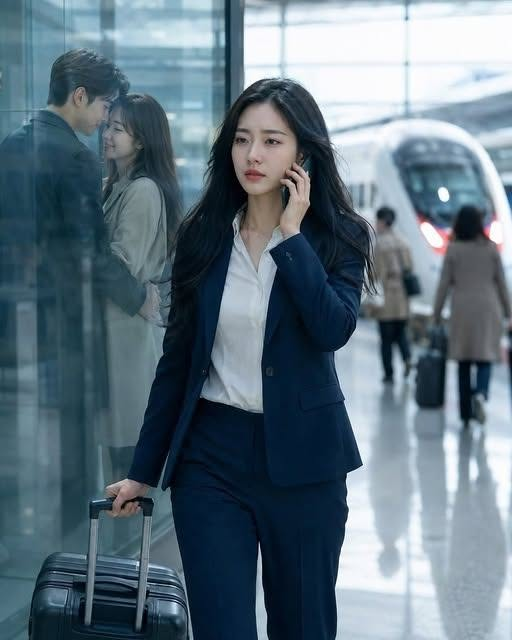
Camila looked at the portfolio case beside my suitcase.
—We saw your exhibition online.
—Thank you.
Silence stretched between us.
Finally Daniel said:
—Can we talk?
We sat in a café near the arrivals hall.
For several minutes, nobody knew where to begin.
Then Camila whispered:
—We broke up.
I blinked.
—You were together?
Daniel laughed bitterly.
—Eventually.
Of course.
The revelation didn’t hurt.
That surprised me most.
Camila stared into her coffee.
—After you left, we started dating during the first semester.
I nodded.
—That makes sense.
She looked up quickly.
—You’re not angry?
—Why would I be?
Her eyes reddened.
—Because maybe we were already acting like a couple before we admitted it.
I said nothing.
Daniel looked at me.
—We treated you badly.
Three years ago, I had waited desperately for that sentence.
Now it arrived when I no longer needed it.
He continued:
—The station wasn’t an accident.
Camila closed her eyes.
Daniel swallowed.
—I knew you were waiting.
I stared at him.
He looked ashamed.
—Camila wanted to travel alone with me. She asked me not to tell you we changed trains. I agreed.
Camila whispered:
—Daniel—
—She deserves the truth.
He looked back at me.
—We thought you’d be upset for a day and then forgive us like always.
There it was.
The entire eighteen-year friendship summarized in one sentence.
They hurt me because they trusted my forgiveness more than they respected my feelings.
Camila began crying.
—I was jealous of you.
That surprised me.
—Of me?
—Daniel always listened when you spoke. Teachers liked you. Your father supported everything you wanted. You never seemed to need anyone.
I almost laughed.
—I changed my university choice because you said you needed me.
Her face crumpled.
—I know.
Daniel rubbed his hands together.
—After you left, everything changed.
Apparently, without me absorbing every disagreement, Daniel and Camila began fighting constantly.
Without me organizing birthdays, resolving misunderstandings, remembering deadlines and smoothing over hurt feelings, their supposedly effortless closeness became exhausting.
They lasted less than two years.
Daniel looked at me.
—Sometimes I think losing you was the first consequence we ever had.
I considered his words.
Then I smiled.
—Maybe.
Camila reached across the table.
—Can we start over?
I looked at her hand.
Then at Daniel.
Two people I had once believed would remain in my life forever.
I didn’t hate them.
That was the strange part.
I had simply grown beyond the version of myself who needed them.
—I forgive you.
Camila’s face brightened.
Then I continued:
—But forgiveness isn’t the same as returning.
Her hand slowly withdrew.
Daniel nodded as though he understood before she did.
—You’re not coming back to us.
—I already came back.
I looked toward the airport windows.
—Just not to the person I used to be.
Ten days later, I returned to London.
Before boarding, I opened my old sketchbook.
On the first page was a drawing made three years earlier.
Three children standing together.
Daniel in the center.
Camila beside him.
Me at the edge.
Half outside the frame.
I turned the page.
Then I took out a pencil.
I drew a new picture.
One woman standing alone at a train station, suitcase beside her.
Ahead of her were tracks disappearing toward the horizon.
But this time, being alone didn’t look lonely.
It looked like possibility.
Underneath, I wrote one sentence:
“The day they left me behind was the day I finally stopped leaving myself behind.”
Then my flight was called.
I closed the sketchbook.
Picked up my suitcase.
And walked toward the gate without waiting for anyone.
