I stared at the price on the screen.
890 yuan.
That was all my ticket would have cost.
Less than the fifteen thousand yuan Chu Khai had handed his younger brother for “pocket money.”
Less than what my mother-in-law had spent on duty-free cosmetics during previous trips.
Less than one family dinner at the restaurant Chu Khai liked.
So it had never been about money.
I simply wasn’t worth including.
That realization hurt.
But it also made everything suddenly simple.
I opened the banking app.
For seven years, Chu Khai had transferred a fixed household allowance to me every month.
Groceries.
Utilities.
His parents’ medicine.
Our son’s tuition.
His brother’s daily expenses whenever he stayed with us.
Everything came from that amount.
People thought I was being supported.
Nobody knew how often I used the savings I had accumulated before marriage when the household budget ran short.
I opened my old account.
Balance:
312,640 yuan.
My money.
Earned before I quit my job.
I had barely touched it except to fill holes in the life Chu Khai called “resting at home.”
I called my university friend, Lin Yue.
She answered immediately.
—Hue Man?
—I need a lawyer.
Silence.
Then:
—Finally?
I froze.
—What do you mean, finally?
She sighed.
—I’ve been waiting seven years for you to say that.
Three hours later, I was sitting in a law office with a stack of documents.
Marriage certificate.
Property records.
Bank statements.
School expenses.
Receipts.
The lawyer listened carefully.
Then asked:
—What do you want?
I thought about it.
Not revenge.
Not every yuan Chu Khai had ever earned.
Not the house.
I wanted something I had not had in years.
Time.
—A clean divorce.
—I want my premarital savings protected.
—I want a fair division of marital assets.
—I want shared responsibility for our son.
Then I added:
—And I want to go back to work.
That afternoon, I made another call.
Before marriage, I had worked in hotel operations.
Not glamorous.
But I had been good at it.
My former manager now ran a boutique hospitality company.
When I asked whether there were any openings, she laughed.
—Hue Man, I offered you a position three years ago.
—I know.
—And you told me your family needed you.
I looked at the empty apartment.
—They don’t anymore.
She became quiet.
—Come Monday.
That night, my mother-in-law posted another photo.
Six people seated at a seafood restaurant in Phuket.
My husband sat in the middle.
Our son was holding a giant lobster.
Caption:
“Family vacation. Happiness is everyone together.”
I looked at the photo for a long time.
Then left the family chat.
Nobody noticed.
Not that night.
Not the next day.
On day three, Chu Khai sent me one message.
Did you remember to pay the property fee?
I replied:
No. Pay it yourself.
He answered almost immediately.
What are you angry about now?
I didn’t respond.
Day four.
My mother-in-law called.
—Hue Man, transfer me another five thousand. Tieu Hao wants to buy something.
I said:
—Ask Chu Khai.
She sounded irritated.
—His card has a daily limit. You can transfer it first.
—No.
Silence.
—What did you say?
—I said no.
For seven years, perhaps that was the first time she had heard the word from me.
She immediately raised her voice.
—You stay home doing nothing and now you’re counting money with your own family?
I smiled.
—You’re right.
—So from now on, everyone can pay for themselves.
Then I ended the call.
By the sixth day, almost all my belongings were packed.
Not the furniture.
Not the appliances.
Only what was truly mine.
Clothes.
Books.
Certificates.
My laptop.
The old hotel management manuals I had kept inside a storage box for years.
I rented a small two-bedroom apartment near my new office.
One room for me.
One for my son when he stayed with me.
At the entrance to the old house, I placed the divorce agreement on the table.
Beside it were seven envelopes.
One for each year of marriage.
Inside were summaries of the household expenses I had managed.
Groceries.
Tuition.
Medical appointments.
Utility payments.
Family gifts.
Transfers to his parents.
Money spent on his brother.
Seven years of invisible work turned into numbers.
The final page contained one sentence:
“You said the family deserved a vacation after working hard all year. Here is the work you never counted.”
On day seven, they returned.
I knew because my son called.
—Mom, where are you?
I closed my office laptop.
—At work.
There was a pause.
—Work?
—Yes.
I heard Chu Khai in the background.
—Give me the phone.
Then his voice came through.
—Hue Man, what are you doing?
—I’m working.
—Why is the refrigerator empty?
I almost laughed.
—Buy groceries.
—And where are your clothes?
—At my apartment.
Silence.
Long enough for him to understand.
—What apartment?
—Mine.
His voice hardened.
—Stop making trouble and come home.
—No.
—We just got back from a seven-day trip and you choose now to throw a tantrum?
I looked at the clock.
My shift ended in thirty minutes.
—I didn’t throw anything.
—I left you the divorce papers.
The phone went completely silent.
Then:
—Divorce?
For the first time, he sounded afraid.
That evening he appeared outside my new apartment.
His mother came too.
The moment the door opened, she started shouting.
—You want to destroy your family because of one plane ticket?
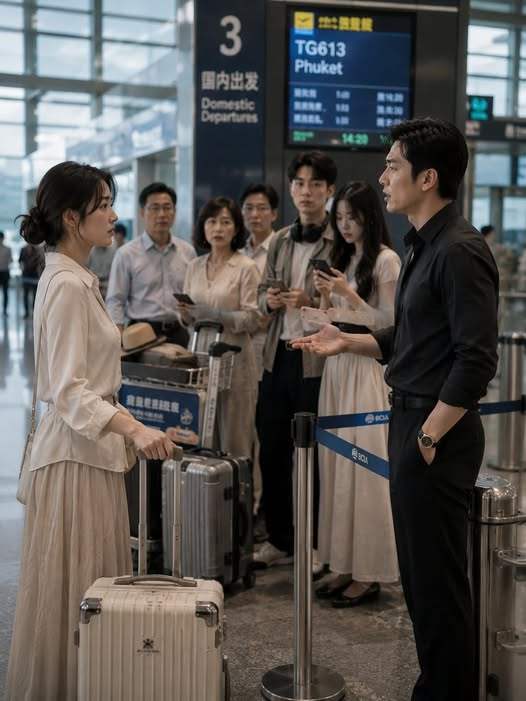
I looked at her.
—No.
—The ticket simply showed me my position in it.
Chu Khai pushed past her.
—Hue Man, we can buy another trip.
—I’ll take you anywhere you want.
—Europe.
—Japan.
—Maldives.
I shook my head.
—Still don’t understand.
He stared at me.
—Then explain it!
So I did.
—You didn’t forget my ticket.
—You deliberately didn’t buy one.
—You stood at the airport with our son and your entire family and told me I was an unnecessary expense.
His face stiffened.
I continued:
—Then you said I rest every day because you never considered cooking, cleaning, caring for your parents and raising our child to be work.
His mother interrupted:
—Those are a wife’s responsibilities!
I turned toward her.
—Then your son can marry someone who agrees.
She fell silent.
Chu Khai lowered his voice.
—What about our son?
—He has two parents.
—I’ll take care of him during my custody time.
—You take care of him during yours.
He frowned as if I had proposed something impossible.
And that expression told me exactly how our marriage had survived seven years.
He had never imagined responsibility reaching him.
The divorce took five months.
Chu Khai resisted at first.
Then reality became tiring.
His mother refused to cook every day.
His younger brother moved back to campus once nobody washed his clothes.
The house became messy.
Our son started arriving late to school on Chu Khai’s mornings.
For the first time, he had to remember vaccinations, parent meetings, homework, uniforms and lunch boxes.
One evening, when he dropped our son at my apartment, he looked exhausted.
—How did you do all this every day?
I smiled.
—Apparently I was resting.
He lowered his eyes.
That was the closest thing to an apology he could manage at the time.
A year later, I became operations manager of a new hotel.
My salary was not extraordinary.
But when I received the first payment, I stared at the screen for a long time.
Money earned under my own name again.
My son adjusted well.
He eventually stopped asking why we didn’t live together.
Instead, he learned something better.
At my house, he helped set the table.
At his father’s, he learned to put his own clothes in the laundry basket.
One day, he asked:
—Mom, are you tired after work?
—Sometimes.
He thought seriously.
—Then I can wash my own shoes.
I almost cried.
Because a seven-year-old had learned something the adults around me had refused to understand for years:
Love does not mean making someone else’s labor invisible.
Two years after the divorce, Chu Khai called before the winter holiday.
—I’m taking our son to Singapore for four days.
—Okay.
Then he hesitated.
—Do you want to come?
I smiled.
—No, thank you.
—You sure?
—Very.
There was no bitterness anymore.
Just boundaries.
Before hanging up, he said quietly:
—That day at the airport…
I waited.
—I was wrong.
I didn’t rescue him from the discomfort.
He continued:
—I thought because you stayed home, your time had no value.
—I know.
—I know now that the house only looked easy because you were doing everything.
I looked around my small apartment.
Sunlight filled the living room.
On the table was my employee badge.
My son’s drawings.
A passport with a new ticket tucked inside.
I had booked a vacation for myself.
Alone.
—Good —I said.—Then don’t forget it again.
The first time my husband left for Phuket without me, he told me to stay home and guard the house.
I thought that was the moment my family excluded me.
Later, I understood it differently.
They didn’t leave me behind.
They gave me seven uninterrupted days to discover that the door had never been locked.
And when Chu Khai finally came home expecting his wife to still be waiting there,
the house was exactly where he had left it.
I was the one who had finally gone somewhere.
