The plane landed shortly after sunset.
When I walked out of the airport, there was no one waiting for me.
I had expected that.
A university shuttle stood outside with a sign bearing the school’s name.
I dragged my old suitcase onto the bus and chose a window seat.
Around me, other freshmen were calling their parents.
—Mom, I’ve arrived.
—Dad, don’t worry.
—Yes, the school sent a bus.
My phone remained silent.
Until almost midnight.
An An sent me a message.
“Sister, did you remember my dress?”
I stared at it for several seconds.
Then replied:
“No.”
Three dots appeared immediately.
“What?”
“I told you it was on the balcony!”
I answered:
“I’m not home.”
She sent a voice message.
—Where else could you be?
I didn’t listen twice.
I switched off my phone.
The next morning, orientation began.
For the first time in my life, no one introduced me as An An’s older sister.
No one asked me to tutor someone else.
No one told me that the money spent on me was taking something away from her.
When the instructor called:
—Jiang Tich Nguyet.
I answered:
—Present.
Just my name.
That was enough.
Three days later, my family was still in France.
Their group chat was filled with photographs.
The Eiffel Tower.
The Louvre.
Pastries.
Shopping bags.
My mother sent:
“An An loves Paris so much. Maybe she should do her postgraduate studies here someday.”
My father replied:
“Whatever she wants.”
I looked at the message.
Then looked at the form in front of me.
The university’s full scholarship confirmation.
Tuition.
Accommodation.
Meals.
Everything covered.
I had not asked my parents for a single yuan.
I muted the group permanently.
Nine days later, they returned home.
My father was the first person to notice something was wrong.
Not because he missed me.
Because my room was empty.
My desk had been cleared.
My books were gone.
The old suitcase was gone.
Even the certificate from the provincial Physics competition that had been hidden inside my diary was gone.
Mom called me.
I was in class.
When I finished, there were twenty-three missed calls.
I returned the call.
She answered immediately.
—Tich Nguyet! Where are you?
—At school.
—What school?
I was silent.
Then she snapped:
—Don’t play games. We just came home and your room is empty.
—I’m at the university I told you about.
Silence.
My mother seemed to search her memory.
—That… national something?
—National University of Defense Technology.
Another silence.
Then my father’s voice appeared in the background.
—Give me the phone.
He took it.
—When did you leave?
—The day you went to Europe.
—Why didn’t you tell us?
That question nearly made me laugh.
—I did.
—When?
—At An An’s celebration dinner.
I could hear them trying to remember.
Nobody could.
My father became angry.
—Even if you got into university, how could you leave without telling your family properly?
I looked across the campus.
—Dad, you signed my background-check form.
He went silent.
Then he remembered.
That afternoon.
The form he had signed without reading because he was paying An An’s training invoice.
His voice softened slightly.
—Why didn’t you explain what it was?
I answered:
—Would you have listened?
He didn’t answer.
My mother took the phone again.
—Okay, enough. Send us the address. Your father will arrange a return ticket this weekend. You can study somewhere closer.
I frowned.
—Why would I return?
—Because you’re eighteen!
—And?
—Because we’re your parents!
For eighteen years, I had wanted those words to mean something.
Now they sounded almost absurd.
I said:
—My household registration has already been transferred.
Silence.
My mother whispered:
—Transferred?
—Yes.
—Without asking us?
I looked at the official stamp on the copy inside my folder.
—The documents had your signatures.
Another thing they had never bothered to read.
My father became furious.
—Jiang Tich Nguyet, don’t think getting into one university means you can ignore your family!
I asked quietly:
—What university did I get into?
He stopped.
I waited.
Nothing.
He genuinely still didn’t know.
I smiled.
—Exactly.
Then I ended the call.
For the next month, they changed tactics.
My mother sent long messages.
“Your sister cries every day because you aren’t speaking to her.”
My father wrote:
“Family members shouldn’t hold grudges.”
An An sent:
“I already apologized about the plane ticket. Why are you making everyone uncomfortable?”
Even To Vien contacted me.
His message was the most ridiculous.
“Enough. Come back and apologize to your parents. Uncle and Aunt spent eighteen years raising you.”
I stared at it.
Then replied:
“Do you know where I study?”
He answered:
“Some defense college.”
I blocked him.
Life became quiet after that.
And I discovered something remarkable.
I was not actually difficult to love.
My roommates remembered my birthday after knowing me four months.
My instructor noticed when I had a fever and told me to rest.
When our team won an academic modeling competition, the others pushed me to the center of the photograph because I had written most of the solution.
I almost stepped backward automatically.
One girl grabbed my sleeve.
—Why are you hiding? You did the most work.
I froze.
No one had ever said that to me before.
During winter break, I did not return home.
I joined a university research program instead.
My mother called.
—Everyone else is coming home.
—I’m busy.
—An An bought you a gift from Paris.
—She can keep it.
My mother suddenly became quiet.
Then:
—Tich Nguyet, what exactly do you want us to do?
That question arrived eighteen years too late.
I answered honestly.
—Nothing.
She seemed more hurt by that than if I had screamed.
Two years passed.
I went home only once, for my grandmother’s funeral.
The moment I entered the hall, relatives surrounded me.
An aunt stared at my uniform.
—Tich Nguyet, your father said you’re studying at a military university.
My father immediately smiled.
—Yes. She has always been very independent.
I looked at him.
Independent.
What a beautiful word for a child nobody had paid attention to.
An An stood nearby.
She looked different.
Less confident.
University had not gone as smoothly as she expected.
Without my notes, reminders and constant help, she had failed several courses during her first year.
My parents had hired tutors again.
To Vien still hovered beside her.
He looked me up and down.
—So you’re really studying there.
I said:
—Apparently.
His face reddened.
He remembered calling it third-rate.
That evening, my father tried to speak to me alone.
—Your mother misses you.
—I know.
—Your sister too.
I said nothing.
Then he sighed.
—We may have favored An An a little.
A little.
I almost smiled.
—Dad, do you remember my provincial Physics prize?
His brow furrowed.
—You won one?
That was my answer.
I stood.
He grabbed my sleeve.
—Tich Nguyet.
I looked back.
His eyes were finally unsettled.
—Did we really treat you that badly?
For years, I had imagined this conversation.
I thought I would list everything.
The English class.
The Olympiad fee.
The cake.
The airport.
The train of forgotten birthdays and invisible achievements.
But standing there, I suddenly didn’t need him to understand every detail.
I said:
—You treated me like someone who would always understand why everyone else mattered more.
His hand slowly fell.
—I eventually understood something different.
—What?
—That I mattered too.
I walked away.
By my final year, I had been selected for a competitive postgraduate research program.
The university published a short profile about several outstanding students.
My photograph appeared online.
That was when my family suddenly began receiving congratulations.
Neighbors called.
Relatives sent messages.
My father’s colleagues asked:
—Your daughter is Jiang Tich Nguyet?
For the first time, my parents searched my university properly.
My mother called that night crying.
—I didn’t know.
I closed my eyes.
—You could have.
She cried harder.
—Why didn’t you tell us how difficult it was to get in?
I answered:
—Because I wanted one thing in my life that didn’t need to become a comparison with An An.
She had no response.
Several months later, graduation arrived.
Families filled the campus.
Parents carried flowers.
My roommates took photographs with their mothers and fathers.
I had told nobody to come.
Yet when I walked out after the ceremony, I saw my family standing beyond the crowd.
My father.
My mother.
An An.
Even To Vien.
My mother held flowers.
She looked nervous.
—Tich Nguyet.
I stopped.
My father said:
—We didn’t know whether you’d let us come.
—You already came.
He lowered his eyes.
—Yes.
For once, nobody demanded anything.
Nobody asked me to help An An.
Nobody told me to forgive them because we were family.
My mother simply handed me the flowers.
—Congratulations.
I accepted them.
—Thank you.
An An stepped forward.
She looked at me for a long time.
Then said:
—I used to think you didn’t need anything.
I answered:
—I needed the same things you did.
Her eyes reddened.
—I know now.
I believed her.
But understanding after eighteen years did not erase eighteen years.
We took one photograph together.
Then I left with my classmates.
My father called:
—Aren’t you coming home with us?
I turned.
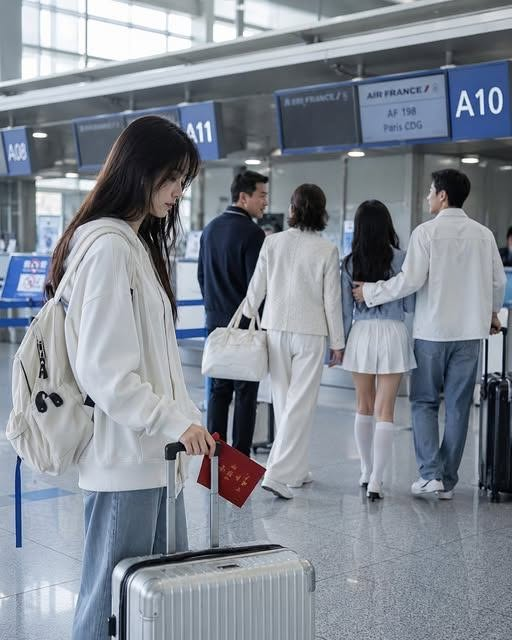
For a moment, he looked exactly as I had at the airport years earlier.
Standing still.
Watching the people he expected to leave with walk in another direction.
I said:
—I have somewhere else to go.
He nodded slowly.
This time, he didn’t tell me to follow.
Years later, my relationship with my family became polite.
Occasionally warm.
Never what it could have been.
An An and I learned to speak as adults rather than twins forced into roles.
My parents learned that calling me required asking about my life instead of immediately mentioning hers.
And I learned that forgiveness did not require moving back into the place where I had spent eighteen years feeling invisible.
The day they forgot my plane ticket, they thought they had left one daughter at the airport while taking the other to Europe.
They didn’t realize that I was also leaving.
Not for one holiday.
Not out of anger.
I was leaving the version of myself that waited quietly to be remembered.
They flew west toward Paris.
I flew three thousand miles in the opposite direction.
And for the first time, I wasn’t standing half outside someone else’s photograph.
I finally walked into a life where I belonged in the center of my own.
