Alexander called me thirty-seven times that afternoon.
I counted because my phone kept lighting up beside the crib.
I answered none of them.
At six seventeen, a message appeared.
Where are you?
Then:
Clara, this is not funny.
Then:
Bring my daughter home.
That last sentence made me look at the screen for a long time.
My daughter.
Not our daughter.
His daughter.
As if I had packed up one of his possessions.
I placed the phone face down.
My baby stirred against the mattress.
I touched her tiny hand.
—Sleep, Mia.
The new house was quiet.
No servants.
No marble floors.
No rooms large enough to echo.
Just two bedrooms, a kitchen, a small garden and sunlight that entered the living room every morning.
It was the first place I had chosen entirely for myself.
At eight, Alexander finally called my attorney.
Mr. Hart answered.
According to him, Alexander did not bother with greetings.
—Tell my wife to come home.
Mr. Hart corrected him.
—Mrs. Song has filed for divorce.
—She left a piece of paper on my nightstand. That does not mean I agreed.
—You do not need to agree to receive a divorce petition.
Silence.
Then Alexander asked:
—Where is my daughter?
—Safe with her mother.
—Give me the address.
—No.
That was apparently when he lost his temper.
But anger did not produce my address.
Money did not produce it either.
The house had been purchased years before through a small inheritance my grandmother left me.
Alexander knew the inheritance existed.
He simply never cared enough to ask what I did with it.
For years, I had kept the money untouched.
Then, while pregnant, I quietly bought the house.
At the time I told myself it was an investment.
Maybe some part of me already knew I would need an exit.
The next morning, Emily Su called.
I stared at her name.
Then answered.
Her voice was soft.
—Clara.
—What?
—I think there has been a misunderstanding.
I almost laughed.
—About which part?
—Paris was for work.
—Of course.
—Alexander was helping me because I had just returned to the company and the project was difficult.
I looked at Mia sleeping beside me.
—Then congratulations on the successful project.
Emily became quiet.
—He came back because he was worried about you.
—He came back because the trip ended.
She inhaled sharply.
—You always assume the worst about us.
That sentence told me everything.
Not because it admitted an affair.
Because Emily still believed there was an “us” I was required to understand.
I said:
—Emily, I’m divorcing him.
Silence.
Then, strangely:
—Really?
There was something almost like relief in her voice.
I smiled.
—You sound happy.
—No. I just think maybe everyone can stop suffering.
—Good.
I paused.
—Then enjoy whatever comes next.
I ended the call.
Whatever relationship Alexander had with Emily was no longer my investigation.
I had spent too much of my marriage examining every photograph, every trip, every delayed meeting, every look that lasted one second too long.
I was done being a detective in my own home.
Three days later, Alexander found me anyway.
Not through private investigators.
Through Mrs. Miller.
She called me first, crying.
—Madam, I’m sorry. He kept asking whether the baby was safe. I told him only the neighborhood.
I sighed.
—It’s okay.
He appeared that evening.
I saw him through the front window.
Still wearing expensive clothes.
Still looking like the man everyone trusted immediately.
But he was holding no flowers.
For once, he had come empty-handed.
I opened the door but did not invite him inside.
His eyes moved past me.
—Where is Mia?
—Sleeping.
His shoulders visibly loosened.
Then he looked at me.
—You left without saying a word.
I almost smiled.
—You left two days after I gave birth.
—It was fifteen days.
—Exactly.
His face tightened.
—I told you it was work.
—And Emily?
He said nothing.
That was enough.
I continued:
—I had a fever one night.
—Mia cried almost four hours.
—I called you.
—You declined the call.
His eyes changed.
—I was in a meeting.
—At eleven thirty at night?
Silence.
I nodded.
—Right.
He stepped closer.
—Clara, come home.
—No.
—We can fix this.
—No.
His jaw tightened.
—You can’t simply take my daughter and disappear.
—And you can’t simply disappear with another woman for fifteen days and return expecting the house to reset itself.
—I did not abandon you.
I looked at him.
—You left a woman who had just given birth and your newborn child because Emily needed you in Paris.
—Call it whatever helps you sleep.
For the first time, Alexander looked tired rather than angry.
—Did you hate me the whole time?
I thought about that.
—No.
That seemed to surprise him.
—I loved you for most of it.
—That’s why it took so long to leave.
The divorce process began formally the following week.
Alexander fought hardest over Mia.
Not because he wanted to take her from me.
Because he could not tolerate having scheduled access to a daughter he had previously assumed would always be waiting in his house.
Eventually, we agreed on a parenting arrangement appropriate for her age.
Visits first.
More time later.
No sudden trips.
No using Mia to force contact with me.
Alexander resisted the last condition.
Then my lawyer asked:
—Are you asking for time with your daughter or access to your former wife?
He stopped arguing.
Emily lasted another four months.
I only learned because Alexander himself told me.
We were sitting in a family mediation room after discussing Mia’s schedule.
He suddenly said:
—Emily transferred to Singapore.
I looked at him.
—Okay.
—We’re not together.
—I didn’t ask.
His face hardened slightly.
—You really don’t care?
I thought about it.
Then answered honestly.
—Not anymore.
That hurt him more than anger.
I could see it.
For years, Alexander had been accustomed to my jealousy.
My questions.
My waiting.
Even my pain had reassured him that he mattered.
Indifference gave him nothing.
I returned to work when Mia was eight months old.
Before marriage, I had worked in hospitality development.
I did not become a CEO overnight.
I did not inherit an empire.
I started as a project consultant for a small hotel group.
Three days a week.
Then four.
I learned again how to speak in meetings without glancing at the clock every ten minutes.
I learned that my judgment still had value.
That I could solve problems unrelated to Alexander.
That being needed by a child and being consumed by a marriage were not the same thing.
Two years later, I became development manager.
I moved Mia and me into a slightly larger house near a park.
I sold the little house with the sunny fireplace to a young couple expecting their first baby.
When I handed them the keys, the woman said:
—It feels peaceful here.
I smiled.
—It is.
Alexander changed too.
Slowly.
He learned to care for Mia without calling me every hour.
He learned which stuffed rabbit she needed to sleep.
Which foods she refused.
How to recognize when she was getting tired before the crying started.
One evening he brought her home with her hair tied into two terrible uneven pigtails.
I stared.
—Did you do that?
He looked offended.
—It took twenty minutes.
I laughed.
For the first time since our divorce, we both laughed at the same thing.
Not because we were getting back together.
Because we had finally become two people capable of raising a child without pretending the marriage still existed.
Years later, Alexander asked me a question while waiting outside Mia’s school performance.
—If I had stayed home after she was born, would you have forgiven everything else?
I looked toward the auditorium doors.
—Probably.
His face tightened.
Then I added:
—And that would have been another mistake.
He looked at me.
—I had spent years accepting being second whenever Emily appeared.
—Paris was just the first time you did it when our daughter needed you too.
He nodded slowly.
No excuse.
No defense.
That was perhaps the most mature thing he ever gave me.
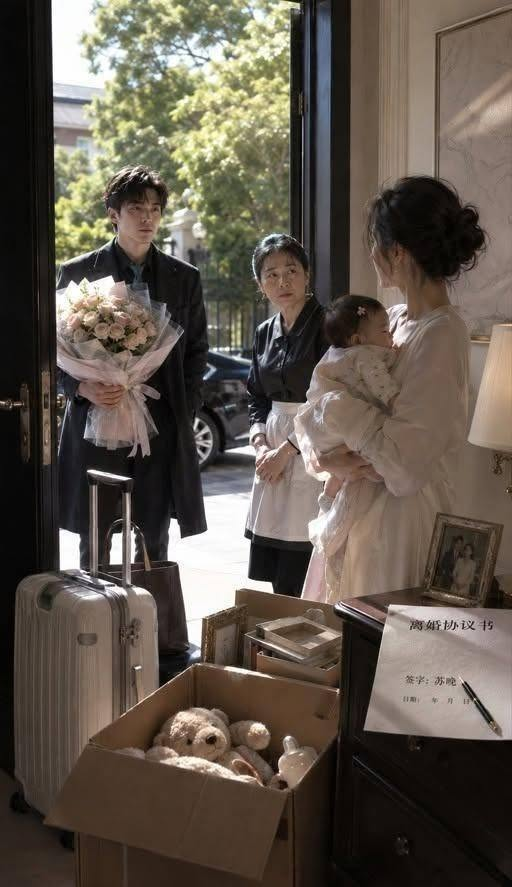
The day Alexander returned from Paris, he expected champagne roses to restore the life he had left behind.
Instead, he found an empty nursery, an empty closet and divorce papers beside his bed.
For a long time, he believed those thirteen days were when he lost me.
He was wrong.
He had been losing me little by little every time he taught me that Emily’s needs were urgent and mine could wait.
Paris was simply the moment I stopped waiting too.
And when Alexander finally learned how to come home properly, there was still a place for him in Mia’s life.
There just wasn’t one left in mine.
