Adrián stared at his secretary.
—Repeat that.
The man swallowed.
—Mrs. Fu revoked the power of attorney over the shares inherited from her grandmother.
—That’s impossible.
—The legal department confirmed it ten minutes ago.
Adrián’s face slowly lost color.
For three years, my 18.7 percent stake had been represented by him at board meetings.
I had never interfered.
Never questioned how he voted.
Whenever documents required my signature, Adrián simply placed them in front of me and said:
—Trust me.
And I had.
That trust was worth more than he realized.
Combined with his own holdings, my voting rights had given him effective control of Fu Group.
Without them, his uncle and two institutional investors could remove him as chairman the next morning.
Adrián grabbed his phone.
—Call Elena’s lawyer.
—We already did.
—And?
—He said all communication regarding Mrs. Fu’s assets must now go through him.
Adrián’s jaw tightened.
—She’s my wife.
The secretary hesitated.
—Sir… her attorney also filed a separation petition this morning.
Silence.
Adrián looked toward the wedding ring still lying on my desk.
Only then did he finally understand.
I hadn’t gone to Toronto because I was angry.
I had left him.
Completely.
When I landed, Toronto was raining.
Cold wind hit my face as I stepped outside the airport.
Three years earlier, I would have immediately called Adrián and complained that I was freezing.
That day, I simply wrapped my coat tighter.
My program coordinator, Professor Margaret Clarke, was waiting for me.
When she saw the suitcases and camera cases, she smiled.
—Elena Fu?
I hesitated.
Then corrected her.
—Elena Navarro.
My maiden name.
She nodded as if that were the most natural thing in the world.
—Welcome to Toronto, Elena Navarro.
Those words almost made me cry.
Not because they were dramatic.
Because no one had called me that in three years.
The next morning, Adrián called from an unknown number.
I answered only because I thought it might be the university.
—Elena.
I closed my eyes.
—How did you get this number?
—Does that matter?
—Yes.
—Come home.
I laughed softly.
—No.
His breathing changed.
—You’re angry. I understand that.
—No, Adrián. You don’t.
—I shouldn’t have pushed you.
—Correct.
—And Sofía shouldn’t have entered your study.
—Also correct.
—Then I’ll make her apologize.
There it was.
He still thought this was about an apology.
—Do you remember the first year of our marriage when she crashed my car?
Silence.
I continued:
—You told me she was young.
—She was nineteen.
—When she wore my mother’s necklace without asking and lost it?
—Elena—
—You bought me another one.
My voice remained calm.
—You never understood that replacing something isn’t the same as respecting it.
He said nothing.
—When she insulted me at your mother’s birthday, you asked me to leave because Sofía was crying.
—She was going through a difficult time.
I smiled bitterly.
—Exactly.
Every cruelty had an explanation.
Every disrespect had context.
Every wound she caused me became something I was supposed to understand.
Then I finally said:
—Adrián, I spent three years competing with your sister for the right to matter in my own marriage.
—That’s ridiculous. She’s my family.
—And what was I?
Silence.
That silence answered for him.
I ended the call.
The Fu board meeting took place six hours later.
Adrián survived.
Barely.
His uncle failed to remove him by two votes.
But the message was obvious.
He was no longer untouchable.
That afternoon, my lawyer received an offer.
Adrián wanted to buy my shares at twenty percent above market value.
I declined.
The next offer was thirty percent.
Then forty.
I declined again.
Finally, he sent a personal message.
Are you trying to destroy me?
I replied for the first time.
No. I’m simply taking back what was always mine.
He didn’t answer.
Three weeks later, Sofía called.
I almost ignored it.
Then I answered.
Her voice sounded strange.
Smaller.
—Sister-in-law…
—Don’t call me that.
She went quiet.
—Elena.
—What do you want?
—I wanted to apologize.
I waited.
—For the vase.
I nearly laughed.
—Only the vase?
Silence.
Then she began crying.
—My brother hasn’t spoken to me properly since you left.
Of course.
Even her apology was about what she had lost.
—Sofía, listen carefully.
My voice was calm.
—I don’t hate you.
She sniffed.
—Then come back.
—No.
—I’ll never enter your study again.
—That’s not enough.
—I said I’m sorry!
For the first time, impatience returned to her voice.
There she was.
The real Sofía.
I smiled.
—And now you understand why your apologies never meant much.
I hung up.
Four months passed.
I became busy.
Beautifully busy.
I spent mornings in archives photographing nineteenth-century manuscripts.
Afternoons restoring damaged negatives.
Weekends traveling with classmates to museums and historical sites.
I made friends.
I learned to cook for one person.
Then, gradually, I stopped cooking for one because friends began filling my apartment.
Life expanded.
Adrián’s calls became less frequent.
Then stopped.
I thought perhaps he had finally accepted it.
I was wrong.
One snowy evening, I walked out of the conservation laboratory and saw him standing across the street.
Black coat.
Hands in his pockets.
Snow collecting on his shoulders.
For a second, my heart betrayed me.
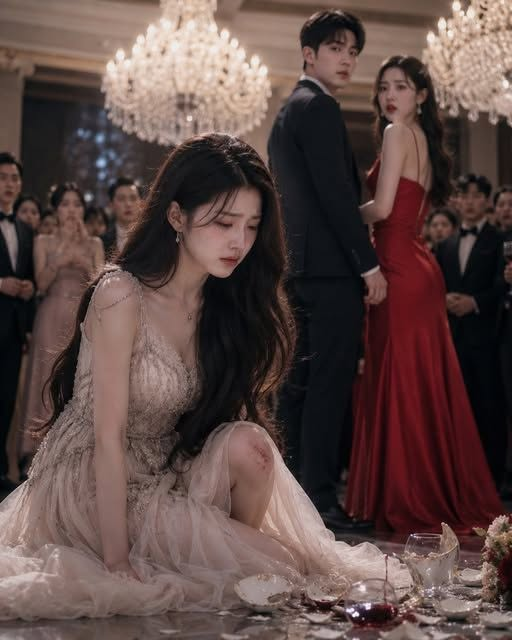
Then I remembered the red wine soaking my wedding dress.
The broken porcelain.
His hand pushing me away.
I kept walking.
Adrián crossed the street.
—Elena.
—Why are you here?
—I had meetings in New York.
—Toronto isn’t New York.
—No.
At least he didn’t lie.
He looked thinner.
—Can we talk?
—Five minutes.
We sat in a café.
He placed something on the table.
A blue-and-white porcelain vase.
I stared at it.
—What is this?
—I spent three months finding the artisan who restored your grandmother’s vase.
My fingers froze.
I looked closer.
The cracks were still visible.
Thin golden lines connected the broken pieces.
—They used kintsugi.
I looked at him.
—That’s Japanese. The vase is Chinese.
A faint, embarrassed smile appeared.
—I know.
—Then why?
—Because the conservator told me hiding the cracks would erase part of the object’s history.
His voice lowered.
—That sounded familiar.
For the first time, Adrián wasn’t trying to pretend nothing had happened.
He pushed the vase toward me.
—I know restoring it doesn’t fix what I did.
I said nothing.
—I also know apologizing doesn’t give back the opportunities you rejected because of me.
His eyes reddened.
—So I’m not asking you to come home.
That surprised me.
—What are you asking?
He swallowed.
—Nothing.
He stood.
—I just wanted to return something I should have protected.
Before leaving, he paused.
—The divorce papers arrived yesterday.
My heart tightened.
—And?
—I’ll sign them.
He looked at me for a long moment.
—You shouldn’t have to fight me for permission to leave.
Then he walked away.
Our divorce became final seven months later.
I kept my shares.
I eventually appointed an independent representative to vote them.
Not Adrián.
Not his uncle.
Someone whose only responsibility was protecting my financial interests.
Fu Group survived.
So did Adrián.
Without my automatic support, he became a better chairman.
Apparently accountability improved him.
Sofía moved out of the family estate.
For the first time in her life, Adrián stopped solving every problem she created.
Perhaps that was good for both of them.
Three years later, I completed the Toronto program.
At my graduation exhibition, my central photograph showed a restored blue-and-white vase under soft morning light.
Its cracks were visible.
I titled it:
What Survives Breaking.
Professor Clarke stood beside me.
—Is this about your marriage?
I smiled.
—No.
I looked at the photograph.
—It’s about me.
Because the vase had never been the thing that ended my marriage.
Neither was Sofía.
Not even the push.
Those were only moments that finally forced me to see the truth.
For years, I had mistaken being remembered for being valued.
Adrián knew my favorite cake.
My medicine.
The temperature I liked the bedroom.
But when respect required him to disappoint someone else, I was always the easiest person to sacrifice.
The morning I flew to Toronto, I thought I was losing a husband.
Instead, I regained a career.
My name.
My inheritance.
My voice.
And most importantly, the ability to walk away before love demanded that I disappear completely.
Some broken things should be repaired.
Others should simply teach you never to hand someone the power to break you twice.
