Three years ago, during those terrible months in Geneva, I had failed one hundred and forty-two experiments in a row.
Investors withdrew.
My laboratory almost closed.
I lived on bread and instant noodles and became so thin that Ha Mien once threatened to drag me to the hospital herself.
The only thing I refused to sell was the purple sandalwood bracelet on my wrist.
My father had given it to me before he died.
He had said:
—Tong Chieu, when you don’t know where home is, remember that you can build one yourself.
That sentence carried me through experiment number one hundred and forty-three.
It worked.
Six months later, our medical-material project received international certification.
A year later, I founded my own laboratory in Zurich.
Two years later, the technology was licensed in eleven countries.
And now the city government was welcoming me because the research center I represented was negotiating a joint biomedical project worth several billion.
None of that had anything to do with Luc Tram.
Which was precisely why returning no longer frightened me.
The following morning, I went to the funeral home.
My father’s grave had to be relocated because the old cemetery was being incorporated into a protected development area.
I had just finished discussing the transfer documents when someone behind me said:
—Tong Chieu.
My hand stopped over the page.
I knew that voice.
Even after three years.
I turned.
Luc Tram stood several meters away.
Up close, he looked more exhausted than he had at the airport.
His eyes were red.
—You saw me yesterday.
It wasn’t a question.
I signed the final page.
—Yes.
His jaw tightened.
—Then why didn’t you come over?
I handed the pen back to the employee.
—Why would I?
For a moment, Luc Tram looked genuinely lost.
Maybe the old Tong Chieu would have run toward him.
The girl who spent eight years inventing excuses to see him certainly would have.
But she no longer existed.
He followed me outside.
—I’ve been looking for you for three years.
—I know.
He stopped.
—You know?
—Ninety-three messages the day I left.
I looked at him.
—Then emails. Letters. Calls through mutual friends.
His voice became hoarse.
—And you never answered.
—I didn’t have anything to say.
He stared at me as if those words were more painful than hatred.
Finally, he whispered:
—What happened at the wedding wasn’t what you thought.
I laughed softly.
—You married my sister.
—No.
That one word made me stop.
Luc Tram stepped closer.
—The wedding never happened.
I looked at him.
He continued quickly:
—Nhuoc Ninh left before the ceremony ended.
—Why?
His eyes remained fixed on me.
—Because she realized I was waiting for you.
For several seconds, I said nothing.
Then I almost smiled.
—That’s supposed to make things better?
His expression froze.
Three years earlier, the day before their wedding, I had learned the whole truth.
Nhuoc Ninh had found me in my room wearing the wedding bracelet our mother had left behind.
She told me Luc Tram had finally agreed to marry her.
Then she said:
—Sister, you’ve chased him for eight years. Haven’t you realized yet? A man doesn’t reject love. He only rejects the woman he doesn’t want.
That sentence destroyed the last piece of dignity I still had.
So I smiled.
I congratulated her.
And the next morning, I left.
What I didn’t know was that Luc Tram had arrived at the wedding venue and asked where I was before asking where the bride was.
Nhuoc Ninh heard him.
They fought.
She demanded:
—If you love me, marry me now.
And Luc Tram apparently remained silent.
She removed the veil herself.
The ceremony ended before it began.
I listened to all of this without feeling the satisfaction he seemed to expect.
—Why did you agree to marry her? —I asked.
His face darkened.
—Your father asked me to take care of her before he died.
I stared at him.
—So you married her out of responsibility?
—At first, I thought so.
—And while I spent eight years loving you?
He lowered his eyes.
—I thought what you felt was dependence.
I laughed.
—How convenient.
—Tong Chieu—
—You rejected me because you were certain I’d always be there.
He went silent.
That was the truth.
He had never needed to choose me because I had already chosen him enough for both of us.
I stepped past him.
He grabbed my wrist.
—I’m choosing you now.
I looked down at his hand.
He immediately released me.
—Three years too late.
That evening, the city hosted a reception for the international research delegation.
Luc Tram appeared again.
This time, he wasn’t waiting outside.
He was part of the local military medical cooperation committee.
When Deputy Mayor Lam introduced me, the entire room applauded.
—Dr. Tong Chieu, founder of Helix Regenerative Research and lead developer of the Qing-7 biomaterial platform.
Luc Tram’s expression changed.
I could almost see him remembering the girl he once told to “stop thinking about nonsense and focus on studying.”
Ha Mien stood beside me afterward and whispered:
—He looks like someone just informed him that the moon belongs to you.
I nearly laughed.
Then another man approached.
Dr. Elias Zhou.
My co-founder.
He handed me a glass of sparkling water.
—Your father’s cemetery arrangements are finished?
—Almost.
Luc Tram saw the ease between us.
His face tightened immediately.
Later, he cornered me on the terrace.
—Who is he?
I raised an eyebrow.
—My colleague.
—Only colleague?
I finally understood.
The man who rejected me dozens of times was jealous.
The irony was almost beautiful.
—Does it matter?
—Yes.
—Why?
His voice cracked.
—Because I love you.
Eight years.
I had waited eight years to hear those words.
I thought they would change my entire world.
Instead, I felt only sadness for the girl who had needed them so badly.
I looked at Luc Tram calmly.
—You know what the cruelest part is?
He said nothing.
—If you’d told me that three years ago, I would have abandoned everything and come back.
His eyes filled with hope.
Then I continued:
—But you didn’t.
The hope disappeared.
Five days later, I finished moving my father’s grave.
I was leaving for Zurich that afternoon.
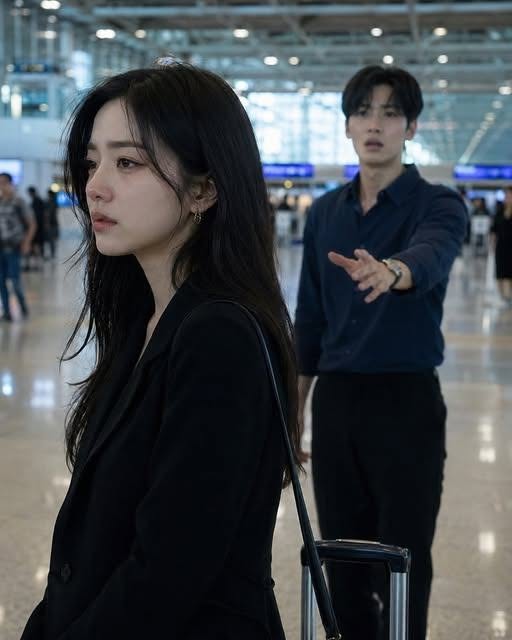
Luc Tram came to the airport.
This time, he found the correct entrance.
He stood in front of me holding nothing.
No flowers.
No ring.
Just exhaustion.
—If I ask you to stay?
I smiled.
—You already asked.
—Once.
—Exactly.
I picked up my suitcase.
—I begged you for eight years, Luc Tram.
His eyes reddened.
—Do you really hate me that much?
I shook my head.
—I don’t hate you at all.
That seemed to hurt him even more.
—Then why can’t we try again?
I looked through the glass toward the aircraft waiting outside.
—Because while you were learning to regret losing me, I was learning how peaceful life could be without chasing anyone.
The boarding announcement sounded.
I took one step away.
Luc Tram whispered:
—Tong Chieu.
I turned.
—If there were another chance…
I smiled faintly.
—There was.
—For eight years.
Then I walked through security.
Three years earlier, I left that airport believing I had lost the man I loved most.
This time, I understood the truth.
Luc Tram had not lost me when I boarded the plane.
He had lost me during every one of those eight years when I stood in front of him with my heart open… and he believed I would always be there to offer it again.
