The visitor badge hit the security officer’s hand.
For a few seconds, nobody moved.
My husband stood there breathing heavily, waiting.
Waiting for me to panic.
Waiting for me to apologize.
Waiting for me to do what I had done for years.
Fix the situation.
But I didn’t.
The security officer looked at him.
“Sir, you need to leave the floor.”
My husband laughed.
“You don’t understand. She’s my wife.”
The nurse answered before I could.
“She is also a patient.”
That sentence stayed with me.
Because for years, I had forgotten that.
I was always his wife first.
The person who adjusted.
The person who explained.
The person who apologized.
But lying there with bruises, stitches, and a body that was still trying to recover, I finally understood something.
Being someone’s wife did not mean giving them ownership over me.
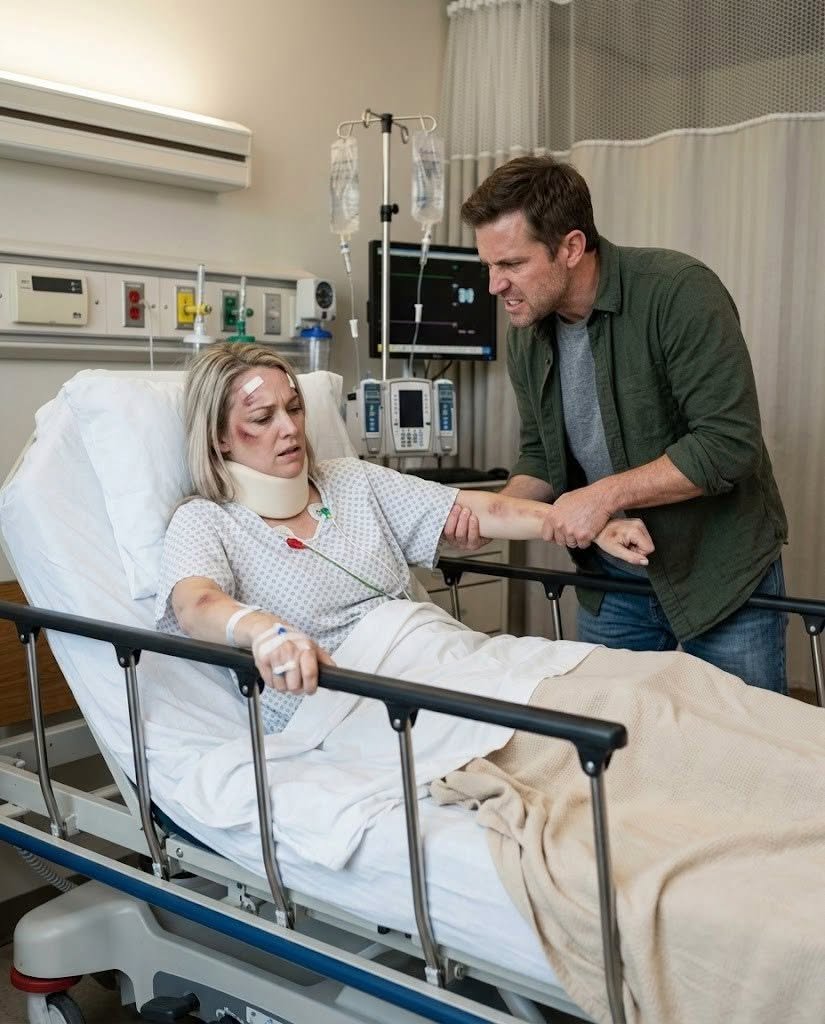
My husband pointed at me.
“She’ll regret this.”
The nurse looked at him calmly.
“That is her choice.”
He stared at me.
“After everything I’ve done for you?”
There it was.
The sentence underneath every argument.
Every bill.
Every complaint.
Every time he reminded me what things cost.
A debt.
A list.
A calculation.
I looked at him.
“What have you done for me?”
The question surprised him.
“What?”
“You paid bills.”
“Yes.”
“You bought groceries.”
“Yes.”
“You helped with the house.”
“Exactly.”
I nodded.
“And every time you did, you made sure I knew I owed you.”
His face changed.
Because he knew.
He had never given support.
He had created a contract.
One where love was something I had to repay.
The security officer escorted him away.
This time, I didn’t call him back.
I didn’t ask him to understand.
I didn’t worry about what he would tell people.
I just closed my eyes.
And for the first time since the accident…
I felt safe.
The next morning, the hospital social worker visited me.
She asked careful questions.
Not about my marriage.
About my safety.
About what happened.
About whether I had somewhere to go after discharge.
At first, I wanted to say everything was fine.
Because that was my automatic answer.
But then I remembered his hand on my arm.
His anger.
His threat.
The way he believed money gave him permission.
So I told the truth.
Not all at once.
But enough.
When the social worker left, she gave me a folder.
Inside were resources.
Legal information.
Housing assistance.
Support options.
Not because I was helpless.
Because I deserved choices.
Three days later, my husband came back.
But this time he didn’t enter.
He stood outside the room.
The nurse checked with me first.
“Do you want to see him?”
I thought about it.
Then nodded.
“Yes.”
He walked in slowly.
Different from before.
Less angry.
More careful.
“I overreacted.”
I said nothing.
“I was stressed.”
Still nothing.
“I was scared about the bills.”
I looked at him.
“That doesn’t excuse what you did.”
He looked away.
“I know.”
“No.”
My voice was quiet.
“You know now because someone stopped you.”
He didn’t answer.
“If that nurse wasn’t there, would you have stopped?”
Silence.
That was the answer.
He sat down.
“I love you.”
I looked at him.
“Then why did I feel most alone when I needed you most?”
His eyes became red.
“I made mistakes.”
I nodded.
“You did.”
A long silence followed.
Then he asked:
“What happens now?”
For years, I had been afraid of that question.
Because I thought losing him meant losing everything.
But now…
I realized I had already lost the version of him I believed in.
“I don’t know.”
He looked surprised.
I continued:
“But I know one thing.”
“What?”
“I am not going back to the way things were.”
Two weeks later, I left the hospital.
Not to go back home.
I went to a small apartment arranged through the support program.
It wasn’t large.
It wasn’t perfect.
But every decision inside it was mine.
The first night there, I made tea.
I sat by the window.
No one questioned the cost.
No one asked why I needed it.
No one made me feel guilty for existing.
A month later, my husband sent me a message.
“I finally understand.”
I read it.
Then another message arrived.
“I should have protected you.”
I looked at the words for a long time.
Because he was right.
He should have.
But understanding something after destroying it doesn’t bring it back.
I replied:
“I hope you become a better person.”
“Just not at my expense.”
Then I put my phone down.
The accident had broken my body.
But it also broke something else.
The fear that had kept me in place for years.
And when I finally stood again…
I wasn’t standing up to return to him.
I was standing up to return to myself.
