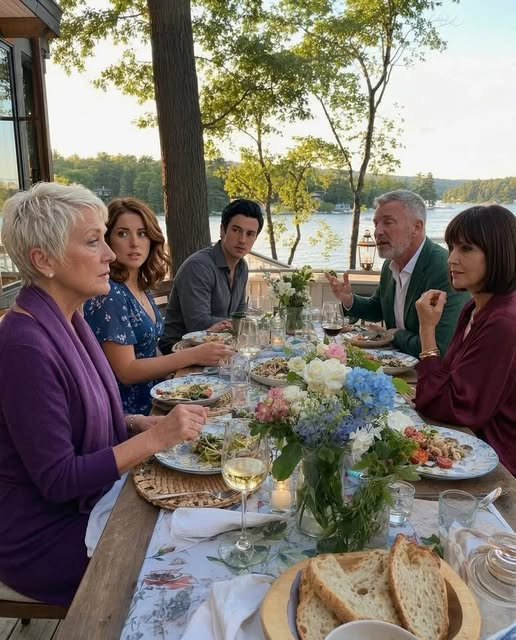
I looked directly at Philippe.
For a few seconds, nobody moved.
The conversation stopped.
The sound of the lake outside seemed louder than before.
Then I spoke in French.
“Before you decide what kind of life someone has lived, perhaps you should ask them about it first.”
The color disappeared from Philippe’s face.
Hélène froze with her glass halfway to her lips.
Claire looked at me.
Not because she understood every word.
But because she recognized something she had never seen before.
Confidence.
Luca immediately looked between his parents and me.
“Margaret…”
I smiled gently.
“It’s okay, Luca.”
Then I continued in French.
“I have listened politely for the entire evening while you discussed my daughter, my family, and my life as if I were not sitting at this table.”
Nobody spoke.
“So let me correct a few things.”
I placed my hands calmly on the table.
“You called Claire simple.”
I looked at my daughter.
“Claire is one of the most creative people I have ever known. She built a career from nothing but her own talent. She doesn’t need to pretend to be impressive because she already is.”
Claire’s eyes widened.
She had never heard me defend myself.
Let alone defend her this way.
I turned back toward Hélène.
“You said I lived an ordinary life.”
A small smile crossed my face.
“That is interesting.”
“I spent eight years in Lyon.”
Philippe blinked.
“I arrived there at twenty-two with one suitcase and barely enough money to survive.”
I continued.
“I learned a new language. I worked jobs where nobody cared who I was. I made friends who became family. I built a life without my parents, without connections, and without anyone opening doors for me.”
The room remained silent.
“Then I returned to America, became a teacher, raised my daughter, and spent decades helping young people believe they could become more than their circumstances.”
I looked at Philippe.
“So yes.”
“My life was ordinary.”
“But it was mine.”
Luca finally spoke.
“Mother. Father.”
His voice was calm.
But disappointed.
“I told you Claire’s family mattered to me.”
Hélène lowered her eyes.
“We didn’t mean to offend.”
I nodded.
“I believe you.”
That surprised them.
“People often don’t realize they are being cruel when they have spent their entire lives believing they are superior.”
Philippe looked uncomfortable.
For the first time all evening, he had nothing to say.
Claire reached for my hand beneath the table.
Her fingers squeezed mine.
After dinner, she followed me onto the deck.
The lake was dark now.
Only small lights reflected on the water.
“Mom.”
I turned.
She looked emotional.
“Why didn’t you ever tell me?”
“Tell you what?”
“That you were like this.”
I laughed softly.
“Like what?”
“Strong.”
The word stayed between us.
Because for most of my life, people had called me many things.
Kind.
Patient.
Reliable.
Helpful.
But rarely strong.
I looked at my daughter.
“I used to be.”
She frowned.
“What do you mean?”
“I think I forgot.”
Claire was quiet.
Then she said:
“I always thought you were quiet because you had nothing to say.”
Those words hurt.
Not because she meant to hurt me.
Because they were true.
I had spent so many years making myself smaller that even my own daughter never knew how much space I had once occupied.
“I’m sorry,” she whispered.
I shook my head.
“No.”
“You don’t apologize for not knowing a story I never told.”
The next morning, breakfast was different.
Not uncomfortable.
Just honest.
Philippe approached me while I was making coffee.
“I owe you an apology.”
I looked at him.
He seemed uncomfortable saying it.
Good.
Some apologies should be uncomfortable.
“I judged you without knowing you.”
“Yes.”
He nodded.
“I was wrong.”
I accepted the apology.
But I didn’t rush to make him feel better.
Because forgiveness didn’t mean pretending nothing happened.
Later that afternoon, Luca and Claire announced their wedding plans.
But something had changed.
Not between them.
Between all of us.
The families were no longer being compared.
No one was trying to prove who was more important.
Because everyone had finally learned something.
A person’s value was not measured by their accent.
Their money.
Their education.
Or the family name attached to them.
Months later, at Claire’s wedding, Luca’s parents stood beside me.
Not above me.
Not judging me.
Beside me.
During the reception, Philippe raised his glass.
“To Margaret Doyle.”
Everyone turned.
“To the woman who reminded me that the quietest person in the room may have the most stories to tell.”
I smiled.
Then I looked at my daughter.
She was laughing.
Happy.
Exactly as she deserved to be.
For years, I thought staying silent was how I kept peace.
I was wrong.
Sometimes silence protects others from your truth.
But sometimes, the most powerful thing you can do…
is finally let yourself be heard.
