I expected Adrian Kane to be angry.
That was the only logical reaction.
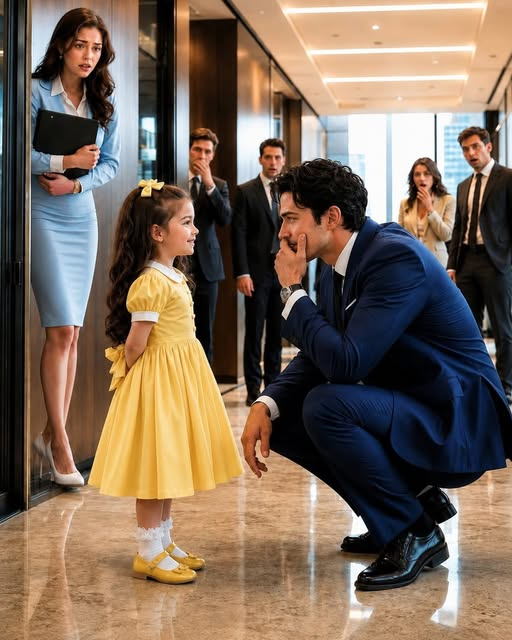
A six-year-old child had wandered into the executive wing of Manhattan’s most intimidating billionaire, interrupted his morning, and announced in front of half the company that he should become her father.
My career should have been over before lunch.
Instead, Adrian looked at Mia like she had just asked him the most interesting question he had heard in years.
“Why exactly do you think your mother needs me to be your daddy?” he repeated softly.
Every person standing nearby suddenly found something fascinating about the floor, the walls, or their phones.
I wanted to disappear.
“Mia,” I said quickly, stepping forward. “We don’t say things like that to people we just meet.”
“But I know him,” she replied.
I froze.
“You know him?”
She nodded seriously.
Adrian raised an eyebrow.
Mia pointed at him.
“He’s the man who makes Mommy come home late but still checks her work because he wants it to be perfect.”
My face burned.
Several executives looked away, pretending they had not heard.
Adrian’s expression changed slightly.
Not anger.
Curiosity.
“You know who I am?” he asked her.
“You’re Mr. Kane.”
“And what else?”
Mia looked at him for a moment.
“You’re lonely.”
The hallway went silent.
I felt my stomach drop.
“Mia.”
But Adrian didn’t interrupt her.
For the first time since I had worked for him, I saw something I never expected.
He looked uncertain.
A billionaire who negotiated million-dollar deals without hesitation suddenly had no answer for a six-year-old girl.
“Why do you think I’m lonely?” he asked.
Mia shrugged.
“Because everyone here is scared of you.”
Nobody breathed.
She continued.
“People who have friends don’t make everyone scared.”
I closed my eyes.
That was it.
I was definitely fired.
But then Adrian did something impossible.
He laughed again.
Quietly this time.
Not because she was funny.
Because somehow, she had said something nobody else dared to say.
“She’s honest,” he said.
“I’m sorry,” I whispered. “I have no idea where she gets this from.”
“I do.”
I looked at him.
Adrian looked down at Mia.
“She gets it from observing people.”
That answer surprised me.
Before I could respond, my assistant appeared from the other side of the hallway.
“Mr. Kane, the board members are waiting.”
Adrian nodded.
Then he looked at me.
“Bring her.”
I blinked.
“Excuse me?”
“Mia.”
My daughter smiled.
“The board meeting?”
“Yes.”
“Can I come?”
“No,” I answered immediately.
Adrian looked amused.
“She already seems to have stronger opinions than most people in that room.”
“Mr. Kane—”
“Five minutes.”
His voice was calm, but it wasn’t a command.
It was an offer.
I hesitated.
Then Mia grabbed Gerald the stuffed elephant and whispered, “Don’t worry. I’ll behave.”
That was exactly the sentence children said before causing chaos.
And somehow, I followed them.
Conference Room A had always felt like a courtroom.
Twenty executives.
Glass walls.
Perfect suits.
Perfect silence.
Adrian sat at the head of the table while I took the seat farthest away, hoping Mia would stay occupied.
She lasted three minutes.
Then one of the executives presented a campaign concept.
Mia looked at the screen.
“Why does the woman look sad?”
Everyone stopped.
The executive turned.
“What?”
“The picture.”
She pointed.
“She’s supposed to sell expensive perfume, but she looks like she wants to leave.”
I covered my face.
“Mia…”
But Adrian lifted a hand.
“Let her speak.”
The room became silent again.
The executive looked uncomfortable.
“It’s a luxury emotional campaign.”
Mia tilted her head.
“Then why does she look like she’s pretending?”
Nobody answered.
I expected Adrian to shut it down.
Instead, he leaned back.
“What do you think she should look like?”
Mia looked at the image.
“She should look like she chose that life.”
The room changed.
Not dramatically.
Not magically.
But enough.
Because everyone heard the same thing.
A child had identified the exact weakness in a campaign that three departments had spent weeks creating.
Adrian looked at the screen for a long moment.
Then he looked at me.
“Your daughter has better instincts than some of our consultants.”
I smiled nervously.
“She also thinks crackers count as lunch.”
“Still a work in progress.”
For the rest of the meeting, something strange happened.
Adrian became different.
Not softer exactly.
Just less distant.
He asked questions.
He listened.
And every time Mia made a small comment, he actually considered it.
By the time the meeting ended, the entire executive team was looking at my daughter differently.
Especially Adrian.
I expected him to walk away.
Instead, he stopped beside her.
“Mia.”
“Yes?”
“Do you always tell people what you think?”
“Yes.”
“Even when they might not like it?”
She nodded.
“Mom says lying makes your heart heavy.”
Adrian glanced at me.
I had never said those exact words.
But I knew where she got the idea.
He smiled faintly.
“Your mother sounds wise.”
“She is.”
The answer came instantly.
Something about the way Mia said it made Adrian pause.
Then he looked at me.
Not as an employee.
Not as a creative director.
As a person.
“Can I ask you something?”
I straightened.
“Of course.”
“Why have I never heard about your daughter before?”
The question caught me off guard.
Because the answer was complicated.
“I keep my personal life separate from work.”
“That’s usually what people say when they’re protecting something.”
I looked away.
Maybe because he was right.
Maybe because I didn’t want him to know how much I had struggled.
How many nights I had worked after Mia fell asleep.
How many times I had chosen deadlines over dinner.
How much guilt I carried every day.
Adrian noticed.
But he didn’t push.
Instead, he crouched slightly so he was at Mia’s height again.
“You know, Mia, I don’t think your mother needs another daddy.”
My daughter looked disappointed.
I almost laughed.
Adrian continued.
“I think she needs someone who reminds her she doesn’t have to do everything alone.”
My smile faded.
Because those words landed somewhere deeper than I expected.
Mia looked between us.
“So you can still be her friend?”
Adrian looked at me.
For a second, neither of us spoke.
Then he answered.
“Yes.”
My heart skipped.
Not because of the word.
Because of the way he said it.
Like he meant it.
That evening, I thought the strangest part of my day was over.
I was wrong.
At 7:42 p.m., while I was putting Mia to bed, my phone received an email from Adrian Kane.
I expected instructions about the campaign.
Instead, there was only one sentence.
“I need to ask you about Mia’s father.”
I stared at the screen.
Because Adrian Kane had never asked personal questions.
And because Mia’s father was the one subject I had spent six years avoiding.
Then another message appeared.
“I found something in the company records that you need to see.”
My hands went cold.
Because I knew Adrian.
He was careful.
He was precise.
And if something had made him send that message…
It meant the past I had buried was finally coming back.
