I ignored Locke’s order.
Not because I wanted to disobey.
Not because I wanted recognition.
Because six hundred and twenty Marines were still breathing behind me.
And every second we waited, fewer of them would be.
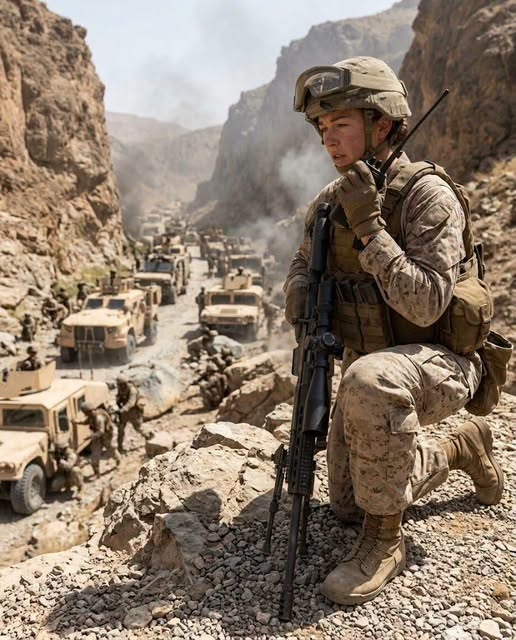
I pressed my cheek against the rifle stock and looked through the scope.
The world became smaller.
The screaming.
The explosions.
The panic.
Everything disappeared.
There was only distance.
Wind.
Movement.
The enemy positions hidden between the rocks.
I counted.
One machine-gun nest.
Two RPG teams.
A spotter directing fire from the upper ridge.
A communications man with a radio pressed against his shoulder.
That was the key.
They weren’t just attacking.
They were controlling.
I whispered into the radio.
“Pierce.”
A second passed.
Then his voice answered.
“Calder?”
“Enemy command element is on the upper ridge. Taking them out will create a gap.”
Silence.
Then:
“You’re in position?”
“Yes.”
Another pause.
“Locke is going to lose his mind.”
I looked through the scope.
“Locke already decided we were lost.”
Nobody answered.
Because everyone heard it.
Everyone remembered.
The moment a commander stopped seeing people and started seeing numbers.
I adjusted my breathing.
The first target moved.
The radio operator.
One shot.
The man dropped.
Immediately, enemy fire shifted.
They were confused.
The second shot hit the spotter.
The third hit the man controlling the machine-gun position.
Within seconds, the rhythm of the attack changed.
Not stopped.
Changed.
And sometimes that was enough.
“Pierce, now.”
His response came instantly.
“Marines! Move!”
The convoy erupted.
Armored vehicles that had been trapped in place began pushing forward.
Smoke grenades filled the road.
Medics dragged wounded Marines behind cover.
The center column that Locke had written off started moving again.
Then Locke’s voice came through the radio.
“Calder, stand down.”
I kept my rifle aimed.
“Negative.”
“That is a direct command.”
I ignored him.
Because another RPG team was preparing to fire.
I watched the launcher rise.
A Marine vehicle was directly in its path.
I fired.
The launcher dropped.
The explosion came from the weapon itself, throwing dust across the ridge.
For the first time all morning, the enemy hesitated.
They had expected the convoy to be trapped.
They had expected everyone to follow orders.
They had not expected someone to move.
Especially not me.
Twenty minutes later, the first reaction force reached the valley.
The firefight slowly disappeared into scattered bursts.
Smoke still covered the road.
Vehicles were damaged.
Marines were wounded.
But they were alive.
All 620 had not been lost.
When I finally walked back toward the convoy, nobody spoke.
They just looked at me.
Some with disbelief.
Some with gratitude.
Some with questions.
Locke stood near the command vehicle.
His face was unreadable.
“You disobeyed a direct order.”
I stopped in front of him.
“Yes, sir.”
“You endangered yourself.”
“Yes, sir.”
“You compromised command authority.”
I looked at the burning vehicles behind him.
“With respect, sir, command authority means nothing if it abandons the people it commands.”
The air became silent.
Nobody moved.
Locke stepped closer.
“You think you know better than everyone else?”
“No.”
I looked directly at him.
“I think the Marines trapped in that valley deserved someone who tried.”
For several seconds, he said nothing.
Then Chief Pierce walked over.
“Sir.”
Locke looked at him.
Pierce removed his helmet.
“Those men are alive because she saw what we didn’t.”
Locke’s jaw tightened.
“She took an unauthorized position.”
Pierce nodded.
“Yes.”
Then he looked at the convoy.
“But it was the right one.”
The investigation started the next morning.
My actions were questioned.
My movement was analyzed.
Every decision I made was reviewed.
And I knew exactly what would happen.
People like me were not supposed to challenge people like Locke.
Especially not publicly.
But then something unexpected happened.
The Marines from the center column started submitting statements.
One after another.
They described what happened.
They described hearing the order to abandon their position.
They described seeing one sniper move when everyone else was told to wait.
A young Marine named Carter wrote something that stayed in the report:
“She didn’t save us because she was ordered to.”
“She saved us because we were still there.”
Three days later, I was called into the command office.
Locke was waiting.
No anger.
No shouting.
Just silence.
On the desk was a folder.
My report.
“You know what bothers me most?” he said.
I waited.
“You were right.”
I said nothing.
He looked away.
“I made a decision based on probability.”
“Six hundred and twenty lives became a calculation.”
His voice lowered.
“And I forgot they were people.”
That was not an apology.
Not exactly.
But it was the first honest thing I had heard from him.
He pushed the folder toward me.
“Your actions saved the battalion.”
I opened it.
Inside was a recommendation.
Not for punishment.
For recognition.
I looked at him.
“Why?”
He answered quietly:
“Because someone needs to be brave enough to remind commanders what they are supposed to protect.”
I left the office carrying that folder.
But I knew the story was not finished.
Because while the official investigation focused on my decision to move…
another question had started spreading among the Marines.
How did the enemy know our exact route?
How did they know the convoy would enter Coral Valley at that exact time?
Someone had given them information.
And when intelligence reviewed the communications logs…
they found something impossible.
The enemy had received our route details…
from a transmission made using our own military frequency.
A frequency only a handful of officers had access to.
Including Commander Adrian Locke.
