“Commander Vance.”
The voice came from behind him.
The SEAL’s smile vanished.
His hand was still gripping my hoodie when Captain Marcus Hale stepped through the glass doors with two senior officers behind him.
Hale stopped.
His eyes dropped to the fist twisted in my clothes.
Then to the spilled coffee.
Then back to the man holding me against the counter.
The silence inside the lounge became absolute.
“Petty Officer,” Hale said quietly. “Remove your hand from Commander Vance.”
The SEAL released me so quickly that he nearly stumbled backward.
“Commander?”
I straightened my hoodie.
Hale’s expression hardened.
“Yes.”
The young airman by the snack counter suddenly became fascinated with the floor.
The SEAL looked at me again, but this time he actually saw me.
Not the jeans.
Not the hoodie.
Me.
“I—I didn’t know, ma’am.”
“That much is obvious.”
“Commander Vance,” Hale continued, “are you injured?”
“No.”
The SEAL seized on the answer.
“Sir, it was a misunderstanding.”
Hale turned toward him.
“You physically assaulted an active-duty officer inside a controlled military lounge.”
“I thought she was a civilian.”
I picked up my bag.
“And that would make it acceptable?”
His mouth opened.
Nothing came out.
Hale asked for his name.
“Petty Officer First Class Derek Shaw.”
Something about the name sounded familiar.
I pulled out my phone and opened the movement roster.
Then I found it.
SHAW, DEREK M.
Attached element.
Naval Special Warfare.
My eyes stayed on the screen for another second.
Interesting.
Hale noticed.
“What is it?”
I turned the phone toward him.
Derek’s face changed before Hale even finished reading.
He understood.
Captain Hale almost looked sympathetic.
Almost.
“You’re attached to Vance’s task group.”
Derek swallowed.
“Yes, sir.”
I finally looked directly at him.
“0920 movement?”
His voice had lost every trace of arrogance.
“Yes, ma’am.”
“What time is it?”
He checked his watch.
“0857.”
“Good.”
I picked up my ruined coffee cup and dropped it into the trash.
“You have twenty-three minutes to decide whether the man who walked into this lounge is the same man you intend to bring onto my team.”
Derek straightened.
“Ma’am, I apologize.”
“You’re apologizing because you learned my rank.”
“No, ma’am.”
“Then what are you apologizing for?”
He hesitated.
That hesitation told me everything.
Hale ordered airport security to preserve the lounge footage and collect witness statements.
I didn’t interfere.
Derek seemed surprised by that too.
Perhaps he expected me to use my position to destroy him on the spot.
That wasn’t how command worked.
Anger made poor evidence.
The cameras did not.
At 0918, I reached the restricted departure gate.
Derek was already there.
So were eleven other operators.
The moment I approached, conversations stopped.
Some recognized me.
Others recognized Hale walking beside me.
Derek stood rigidly at the end of the line.
I removed my hoodie.
Underneath it was a plain black shirt.
No dramatic uniform reveal.
No medals.
I didn’t need decorations to establish authority.
“Listen carefully,” I said.
“I’m Commander Elena Vance. For the next phase of your assignment, operational authority runs through me.”
Several expressions changed.
Derek stared straight ahead.
“Our work requires discipline when nobody is watching, judgment when information is incomplete, and restraint when your ego wants something else.”
Nobody moved.
I stopped in front of Derek.
“Petty Officer Shaw demonstrated a failure in all three areas this morning.”
His jaw tightened.
I continued.
“This will not become public entertainment. Nobody here will mock him. Nobody will turn it into a story for the barracks.”
A few operators immediately straightened.
“Because humiliation is not accountability.”
I looked at Derek.
“But accountability is coming.”
The flight departed without him.
Hale removed Derek from movement pending review of the airport incident.
Three days later, I received the preliminary findings.
Security footage confirmed the confrontation.
Witness accounts matched.
But buried beneath the incident report was something more concerning.
Derek had two earlier complaints.
Neither involved physical violence.
Both involved junior personnel.
Both described the same behavior.
Intimidation.
Status-based insults.
Aggressive confrontations followed by claims that he had merely been “testing” people.
The complaints had gone nowhere.
Derek’s performance record was exceptional.
So someone had repeatedly decided his results mattered more than his conduct.
I closed the file.
That was the real problem.
The airport had not created Derek Shaw.
It had simply placed him in front of someone he couldn’t intimidate without consequences.
Two weeks later, he appeared before the review panel.
I attended but did not control the proceedings.
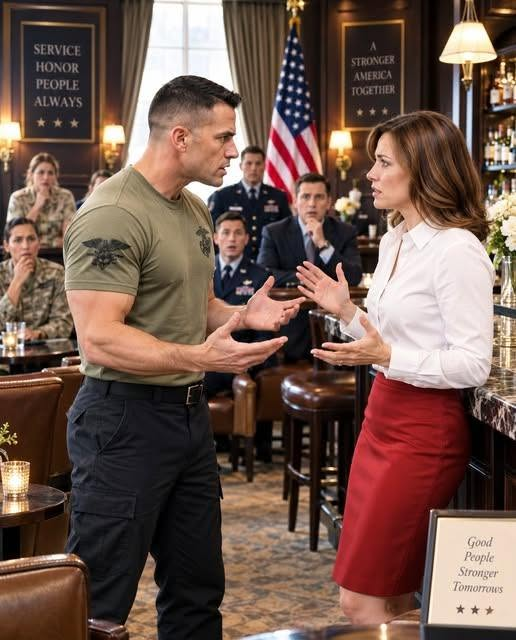
Derek entered in uniform.
The arrogance was gone.
He looked exhausted.
When asked why he had confronted me, he initially repeated the same explanation.
He thought I didn’t belong there.
Then one panel member asked:
“Based on what?”
Derek went silent.
There had been no access violation.
No security alert.
No request from lounge personnel.
Nothing except his assumption.
Finally, he said:
“Based on how she looked.”
That sentence mattered more than any apology.
Because it was the truth.
When my turn came, I described what happened without exaggeration.
Derek listened.
Then the panel asked whether I believed he should remain attached to my command.
I chose my words carefully.
“That is not a decision that should be based on whether he offended me personally.”
Derek looked up.
“My concern is whether his conduct reflects a pattern that could endanger team cohesion, civilian interactions, or junior personnel.”
Afterward, Derek caught me in the corridor.
“Commander.”
I stopped.
He remained several feet away.
Good.
“I owe you an apology that has nothing to do with your rank.”
I waited.
“I saw someone I thought couldn’t do anything to me.”
His voice was quieter now.
“And I treated you differently because of it.”
For the first time, he had identified the actual failure.
“I’m sorry.”
I studied him.
“An apology isn’t rehabilitation, Shaw.”
“I know.”
“It’s the beginning of responsibility.”
He nodded.
Months passed.
Derek lost his place on our deployment and entered a formal corrective process.
I assumed that would be the last time I saw him.
I was wrong.
Almost eleven months later, I walked into a training facility in Virginia and saw him helping a young sailor gather equipment scattered across the floor.
The sailor looked embarrassed.
Derek didn’t yell.
Didn’t ridicule him.
He simply crouched down and helped.
Then he noticed me.
He stood.
“Commander.”
“Shaw.”
There was no fear in his face this time.
No arrogance either.
Just recognition.
“I heard you completed the remediation program.”
“Yes, ma’am.”
“And?”
He glanced toward the younger sailor.
“I discovered I wasn’t nearly as impressive as I thought I was.”
I almost smiled.
“That’s useful information.”
“Yes, ma’am.”
I started walking away.
Then he called after me.
“Commander?”
I turned.
“I never thanked you.”
“For what?”
“For not putting me through that counter.”
I raised an eyebrow.
Apparently someone had finally told him enough about my background to understand what could have happened.
“You were lucky.”
He nodded.
“I know.”
“No, Shaw.”
I looked him directly in the eyes.
“You were lucky because I had nothing to prove.”
He understood.
Years earlier, I had learned that the most dangerous people in our profession were rarely those who knew what they could do.
They were the ones desperate to make everyone else know it.
Seventeen years of covert operations had taught me to disappear into crowds, survive hostile environments, and recognize threats before they fully formed.
But that morning at Sea-Tac reminded me of something simpler.
Character reveals itself most clearly when someone believes the person standing in front of them has no power.
Derek Shaw thought I was nobody.
That was why he showed me exactly who he was.
And ultimately, that—not my rank, my record, or the command waiting for me—was what nearly ended his career.
