On the morning I left, my mother did not notice my suitcase.
She was standing in front of Beatriz, adjusting the ribbon on her dress.
“Turn around. Let me see.”
Beatriz spun happily.
Then she noticed me near the door.
“Where are you going?”
“University.”
My mother didn’t even turn around.
“Come back early. We’re having dinner with your sister’s professors tonight.”
I looked at her back.
For twenty-two years, some part of me had always waited for her to turn around.
That morning, she didn’t.
So I left.
At the National Research Institute, they took my phone, identification documents and personal belongings.
A researcher placed the final agreement before me.
“Once you sign, your participation becomes classified. Your former identity will be administratively suspended for the duration of the project.”
“Ten years?”
“Ten years.”
“No contact with family?”
“None.”
I signed.
Then I gave them the folder containing the forged residency waiver.
“Before my identity is suspended, I want this submitted for legal review.”
The researcher looked through it.
“Your signature was forged?”
“Yes.”
“Do you want to file a formal complaint?”
I thought of my mother buying mango cakes.
I thought of Iceland.
I thought of eighteen unanswered calls while I lay feverish in a freezing warehouse.
“Yes.”
For once, I wasn’t protecting her.
Three hours later, Bao Suyin ceased to exist publicly.
And inside my mother’s apartment, nobody knew.
Not yet.
That evening, she sent me a message.
“Buy soy sauce before coming home.”
An hour later:
“Where are you?”
Then:
“Your sister’s professors are here. Stop embarrassing us.”
At midnight:
“Answer me immediately.”
The following morning, anger became panic.
My room was almost empty.
My documents were gone.
My university confirmed that I had completed the necessary withdrawal procedures.
My employer said I had resigned.
My bank account had been closed.
My phone was disconnected.
Only then did my mother understand.
The daughter who never complained had left without asking permission.
She reported me missing.
The police eventually told her only that I was an adult and there was no evidence I had been harmed.
Then another problem arrived.
The forged document.
My mother was summoned for questioning.
She initially denied everything.
Then officials showed her the original.
She claimed she had only wanted to simplify the household registration.
But the signature analysis contradicted her.
More records followed.
My residency transfer had deliberately been blocked.
Documents had been submitted in my name.
And the false information had directly affected my eligibility for the Institute’s ordinary admission process.
For the first time, what my mother called “family arrangements” had consequences outside our home.
Beatriz’s admission was also reviewed.
She had not forged my documents herself, but questions emerged about whether residency advantages and family information in her application were accurate.
Her celebration disappeared overnight.
The irony was almost perfect.
My mother had erased one daughter to make another daughter’s future brighter.
Instead, she placed a shadow over both.
I knew none of this while it happened.
Inside the classified project, the outside world became irrelevant.
The first year was brutal.
I worked sixteen-hour days.
I failed experiments.
I cried alone in bathrooms.
Sometimes I woke from dreams hearing my mother call Beatriz’s name.
But slowly, something changed.
People began remembering mine.
Not because I carried groceries.
Not because I washed dishes.
Not because I surrendered something so another person could have more.
They remembered me because my work mattered.
By the fourth year, I led a small research group.
By the seventh, our team achieved the breakthrough that had justified the entire isolation program.
By the tenth, I was no longer the girl who had arrived carrying one suitcase.
I was Dr. Su Wen.
The name was part of the new administrative identity offered to participants after completion.
When officials asked whether I wanted to restore my old identity, I looked at the form for a long time.
Bao Suyin.
The forgotten twin.
The daughter without a household.
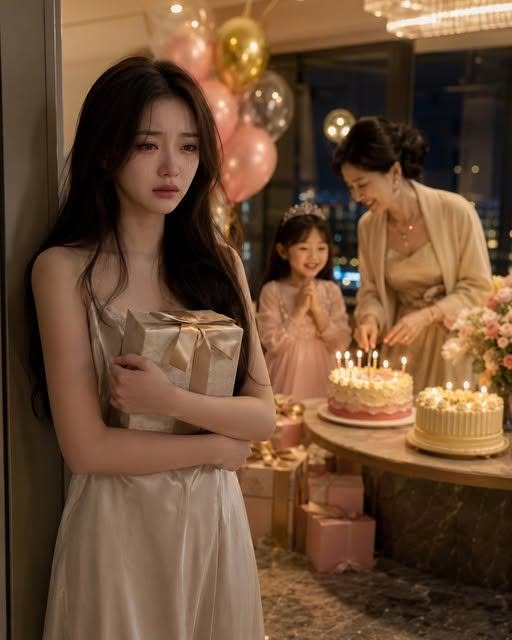
The girl who had spent her life waiting for one cake with her own name.
“No,” I said.
“I’ll keep the new one.”
Ten years after disappearing, I walked out of the Institute.
I was thirty-two.
My work had been declassified enough for the government to announce the research team publicly.
My photograph appeared in the national news.
“Dr. Su Wen, principal scientist in the decade-long Horizon Project.”
That evening, my mother saw my face on television.
According to Beatriz, she dropped her bowl.
Three days later, she appeared outside my research center.
I recognized her immediately.
She had aged.
Her hair was gray.
Her shoulders seemed smaller.
But the moment she saw me, she cried my old name.
“Suyin!”
I stopped.
She ran toward me.
“Where have you been?”
I almost smiled at the absurdity.
“You know where I wasn’t.”
She froze.
“At home.”
Her lips trembled.
“I looked for you for ten years.”
“You had twenty-two years to see me before that.”
She began crying.
“I made mistakes.”
“No.”
I shook my head.
“Forgetting my favorite food is a mistake. Forgetting a birthday is a mistake.”
I looked directly into her eyes.
“You forged my signature.”
Her face collapsed.
“I only wanted your sister to have better opportunities.”
“So did I.”
“I thought you were stronger.”
There it was.
The sentence people use when they want to make neglect sound like praise.
I had heard versions of it my entire childhood.
You’re sensible.
You’re independent.
You don’t need as much.
I answered quietly.
“Being able to survive without love doesn’t mean I didn’t need it.”
She covered her mouth.
Then another voice came from behind her.
“Sister.”
Beatriz.
For ten years I had imagined how I might feel seeing my twin again.
Anger?
Jealousy?
Grief?
Instead, I felt almost nothing.
She looked strangely fragile.
“I’m sorry,” she said.
I waited.
“I knew about the registration.”
“I know.”
“I didn’t know Mom forged your signature.”
“But you knew I was excluded.”
She lowered her eyes.
“Yes.”
“And you enjoyed pretending to be an only child.”
Her silence answered.
I nodded.
At least she didn’t lie.
Then Beatriz said something unexpected.
“My Institute admission was revoked.”
I looked at her.
“The investigation found inconsistencies. I tried applying elsewhere afterward, but everything fell apart.”
My mother immediately grabbed her arm.
“Don’t tell her that.”
“Why not?”
Beatriz pulled away.
“For ten years you blamed her!”
I frowned.
My mother went pale.
Beatriz laughed bitterly.
“She told everyone you ruined my future because you reported the documents.”
“I reported a forged signature.”
“I know that now.”
She looked at our mother.
“But for years she told me you did it because you were jealous.”
My mother whispered:
“I was angry.”
“No,” Beatriz replied. “You needed someone to blame.”
Something unexpected happened then.
For the first time in our lives, Beatriz and I were standing on the same side of the truth.
Not necessarily as sisters.
But no longer as rivals.
My mother reached for my hand.
I stepped back.
“Suyin, come home.”
I looked at her.
“What home?”
“Your room is still there.”
I almost laughed.
“My room?”
The warehouse for Beatriz’s costumes?
The place where half the space never belonged to me?
She started crying harder.
“I changed it.”
Ten years too late.
“I bought you a bed you would like. I kept your awards. Every birthday I bought you a cake.”
That hurt more than I expected.
“What flavor?”
She hesitated.
One second.
Two.
“Mango.”
I smiled.
There was my answer.
After ten years, she still didn’t know.
“I hate mango.”
Her face went blank.
Beatriz closed her eyes.
I turned toward the research building.
My mother called after me.
“Are you really never going to forgive me?”
I stopped.
“I don’t know.”
She stared at me.
“But whether I forgive you has nothing to do with whether I return.”
That was the difference the old me never understood.
Forgiveness did not require surrender.
Blood did not create unlimited rights.
And being someone’s daughter did not mean spending an entire life begging to be treated like one.
Before leaving, Beatriz called my new name.
“Dr. Su.”
I turned.
She gave me a small smile.
“Congratulations.”
For the first time, she congratulated me for something without our mother immediately comparing us.
“Thank you.”
Then I walked inside.
Months later, my research team held a small birthday dinner.
I expected nothing special.
When the lights went out, my colleagues entered carrying a cake.
Chocolate and strawberry.
My favorite.
My name was written across the top.
Not Beatriz’s.
Not “the twins.”
Mine.
Dr. Su Wen.
I stared at it so long that everyone became confused.
“Aren’t you going to make a wish?” someone asked.
I closed my eyes.
At twenty-two, I had wished for my mother to remember me.
At thirty-two, I finally understood that I no longer needed that wish.
I had spent ten years building a life in which I did not have to disappear so someone else could shine.
So when I opened my eyes, I blew out the candles.
And for the first time in my life, the cake in front of me belonged entirely to me.
