I placed my boots beside the folding chair.
Then I folded my flannel shirt over the backrest.
Blake Haron laughed.
—Seriously?
A few parents raised their phones higher.
They thought they were about to watch a fight.
They were wrong.
I stepped onto the mat in my socks and stopped several feet from Blake.
—You said full contact.
—Unless you’ve changed your mind.
—I haven’t.
His grin widened.
Then I pointed toward the security camera above the entrance.
—But before we start, say the rules again.
Blake frowned.
—What?
—For the recording.
The room became quieter.
His assistant shifted uncomfortably.
Blake recovered quickly.
—No point system. We continue until one person gives up.
I nodded.
—And you’re voluntarily challenging a forty-two-year-old parent because I asked you to apologize for what happened to my thirteen-year-old son?
His smile weakened.
—Your kid was sparring.
—Answer the question.
Several parents lowered their phones.
They were beginning to understand.
This wasn’t about whether I could beat Blake.
It was about whether Blake should have been teaching children at all.
He stepped closer.
—Are you fighting or talking?
I raised my hands.
Not aggressively.
Just ready.
Blake moved first.
Fast.
Much faster than most people in that room expected.
His opening punch came straight toward my face.
I shifted my head a few inches.
Nothing more.
His fist passed beside me.
Blake stumbled half a step, surprised that he hadn’t connected.
From the bleachers came a sharp intake of breath.
I glanced toward the sound.
An older man wearing a Navy veteran cap was staring at me.
His face had changed.
He whispered something to the woman beside him.
I couldn’t hear everything.
Only two words.
—Team Six.
My stomach tightened.
I hadn’t heard those words attached to my name in nine years.
Blake attacked again.
I stepped away.
He tried to corner me.
I moved.
He accelerated.
I moved again.
Thirty seconds passed.
Then forty.
I never threw a punch.
Blake’s face grew red.
—Fight me!
—I am.
—You’re running!
—No.
I looked directly at him.
—I’m controlling distance.
That made him furious.
He rushed forward again.
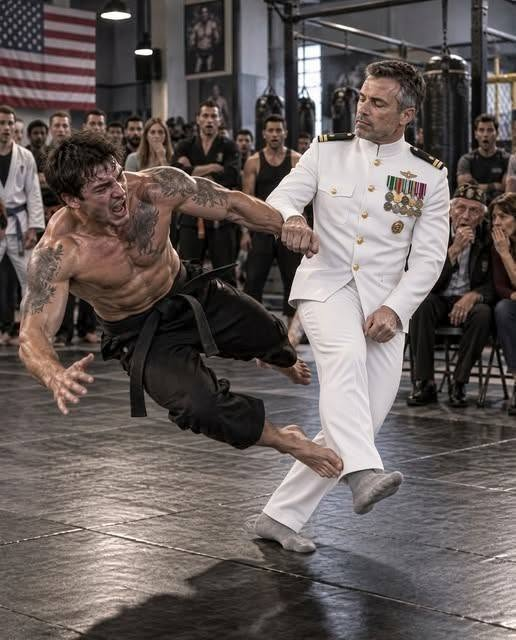
This time I redirected his arm, stepped aside and let his own momentum carry him safely onto the padded mat.
No dramatic strike.
No revenge.
Just control.
Blake jumped up.
The room had gone silent.
I lowered my hands.
—We’re done.
His eyes widened.
—You’re quitting?
—No.
I turned toward the parents.
—I’ve already proved what I came here to prove.
Blake laughed bitterly.
—You haven’t done anything.
—Exactly.
I looked at him.
—A trained adult doesn’t need to hurt someone weaker to demonstrate skill.
Nobody laughed now.
I continued:
—My son came here to learn discipline. You used him to entertain a room.
Blake’s expression changed.
—He agreed to spar.
—He’s thirteen.
One mother stood.
—My daughter came home crying last month.
Another parent looked at her.
—Why?
She hesitated.
—Blake put her against an advanced student because she said she wanted to stop competing.
A father near the wall slowly raised his hand.
—My son was told not to complain because champions don’t complain.
Blake stared around the room.
—This is ridiculous.
Then the older veteran stood.
He was probably in his late sixties.
He walked toward the mat and studied me.
—Damon Reed?
I wished he hadn’t said my last name.
Blake looked between us.
—You know him?
The veteran gave a humorless smile.
—I know what kind of training he had.
I shook my head slightly.
That was enough.
He understood.
No details.
No stories.
The life I’d left behind belonged in the past.
Blake, however, suddenly looked uncertain.
—What training?
I bent down and picked up my shirt.
—Training that taught me the difference between capability and character.
Then the front doors opened.
Two people entered.
One was the recreation center director.
The other carried a clipboard and identified herself as a representative from the regional martial arts association.
Blake’s face changed.
—What’s going on?
I looked toward the mother whose daughter had been afraid to return.
She held up her phone.
—I called them while you were challenging Evan’s father.
Apparently, I hadn’t been the only parent who’d had enough.
Within twenty minutes, the class was suspended pending review.
Parents were asked to submit recordings.
Blake protested.
He said everyone was overreacting.
He said martial arts were supposed to be tough.
He said Evan needed confidence.
That last sentence nearly made me lose mine.
But I didn’t.
Because Evan was waiting outside.
And what happened next mattered more than Blake.
I put my boots back on and walked to my truck.
Evan was sitting in the passenger seat.
He looked at me nervously.
—Did you beat him?
I opened the driver’s door.
—No.
His face fell.
—Oh.
I sat beside him.
—And that’s the lesson.
He looked confused.
—I could have fought him because I was angry.
I started the engine.
—But being able to hurt someone doesn’t mean you should.
Evan stared through the windshield.
After a while, he asked:
—Were you scared?
I thought about it.
—Yes.
He looked at me in disbelief.
—Of him?
—Of becoming the kind of man I don’t want you to become.
That answer stayed with him.
Three days later, the center refunded every family’s membership.
Two weeks later, Blake was removed from youth instruction while the complaints were reviewed.
I thought that was the end.
It wasn’t.
One Saturday morning, the veteran from the bleachers appeared outside my house.
His name was Thomas Mercer.
I remembered him now.
Not from my old unit.
From much earlier.
He’d been one of the instructors who taught young sailors that staying calm mattered more than looking dangerous.
Evan opened the door.
—Dad! There’s some Navy guy here!
Mercer laughed.
—Some Navy guy?
I came outside.
—What do you want, Mercer?
He handed me an envelope.
—You disappeared pretty thoroughly.
—That was intentional.
—I know.
He looked toward Evan.
—Good kid.
I nodded.
—Best thing I’ve ever done.
Mercer’s expression became serious.
—That’s actually why I’m here.
He handed me the envelope.
Inside was a photograph.
It showed Blake standing beside three men at a martial arts tournament.
I recognized one of them.
And suddenly the quiet life I’d built in Cedar Falls didn’t feel quite so separate from my old one.
—Where did you get this?
—One of the parents sent it after the gym incident went online.
I looked closer.
The man beside Blake was older now.
Gray hair.
Different glasses.
But I knew him.
—That’s impossible.
Mercer shook his head.
—Apparently not.
Evan stepped onto the porch.
—Dad?
I immediately lowered the photograph.
—Go inside for a minute, buddy.
He hesitated, then obeyed.
Once the door closed, Mercer spoke quietly.
—Nine years ago, you left everything behind and came here.
—I know what I did.
—Then you should also remember why.
I stared at the photograph.
The man beside Blake had been connected to the final chapter of my military career.
A chapter I’d never told Evan about.
—Does Blake know who I am?
Mercer didn’t answer immediately.
That was answer enough.
My stomach tightened.
—The challenge at the gym…
—I don’t think it was planned.
—But?
Mercer pointed to the photograph.
—Blake made several calls after you stepped onto that mat.
I looked toward my house.
Toward the window where Evan was pretending not to watch us.
—Calls to whom?
Mercer handed me a second page.
A name.
A phone number.
And a timestamp from twelve minutes after the confrontation.
I recognized the number.
I hadn’t seen it in almost a decade.
Mercer lowered his voice.
—Damon, Blake wasn’t frightened because you embarrassed him in front of his students.
I looked up.
—Then why?
—Because the moment you moved, he recognized the same thing I did.
A cold feeling settled in my chest.
Mercer looked at the house behind me.
—And somebody from your old life now knows exactly where you and your son live.