The recording wasn’t for Margaret’s birthday.
It was for my lawyer.
For three months, I had been collecting evidence.
Bank statements.
Messages.
Property documents.
And conversations the Hale family never imagined I would preserve.
The birthday dinner had simply given me the last piece.
Twenty minutes after I drove away, Andrew called.
I ignored him.
Then Emma.
Then Margaret.
Finally, a message arrived from Andrew.
“Come back before Mom gets more upset. I’ll order food. You just need to apologize.”
I read it twice.
Even now, I was the one expected to apologize.
I forwarded the message to my lawyer, Rachel Morgan.
Her reply came immediately.
“Don’t return tonight. I’ll see you tomorrow.”
I drove to a hotel.
For the first time in five years, nobody asked me where the clean towels were.
Nobody complained that dinner was late.
Nobody reminded me that Margaret preferred her soup without scallions.
I took a shower.
Ordered noodles.
And slept for nine hours.
The next morning, Rachel listened to the birthday recording.
Margaret’s voice filled her office.
“Do it again.”
Then Andrew:
“If Mom says she didn’t like it, go and prepare something simple.”
Rachel stopped the audio.
—This proves the household environment, but it’s not the most important evidence.
She opened another folder.
The important evidence involved Hale Catering Group.
The company Andrew’s family had spent five years telling everyone belonged entirely to them.
Before marrying Andrew, I had worked as a food-development consultant.
Margaret’s restaurant business had been struggling.
I redesigned recipes.
Standardized suppliers.
Created menus.
Negotiated delivery contracts.
Then, when Andrew proposed, I stopped charging consulting fees.
“We’re family now,” he’d said.
I believed him.
Within three years, Hale Catering expanded from four restaurants to thirty-two.
Margaret told everyone her son had saved the company.
My name disappeared.
But my work hadn’t.
Rachel placed copies of my original contracts on the table.
—You retained ownership of seventeen proprietary recipes and two process manuals.
I nodded.
I’d discovered that only months earlier.
Andrew had repeatedly asked me to sign updated intellectual-property paperwork.
I never did.
Mostly because he kept forgetting to bring the final documents home.
For once, his carelessness had protected me.
—Can they continue using them?
—That’s what we’re going to determine properly.
I wasn’t trying to destroy thirty-two restaurants because my mother-in-law threw away dinner.
This wasn’t revenge.
It was separation.
If the Hales wanted my work, they could negotiate for it like everyone else.
At 10:17 that morning, Andrew entered Rachel’s office without an appointment.
—Clara.
He looked terrible.
—We need to talk.
—My lawyer is here.
—About last night—
—No.
I slid another folder across the table.
Divorce petition.
His face changed.
—You’re divorcing me?
—Yes.
He actually laughed.
—Because Mom threw away some food?
Rachel looked at me.
I looked at Andrew.
—Do you know what happened on my birthday last year?
He frowned.
—We had dinner.
—Your mother called because her kitchen sink was leaking. You left before the cake arrived.
He said nothing.
—Our fourth anniversary?
—Clara—
—Emma needed someone to pick up her dog.
His jaw tightened.
—My promotion dinner?
Silence.
—Margaret didn’t like the restaurant, so we left.
I leaned back.
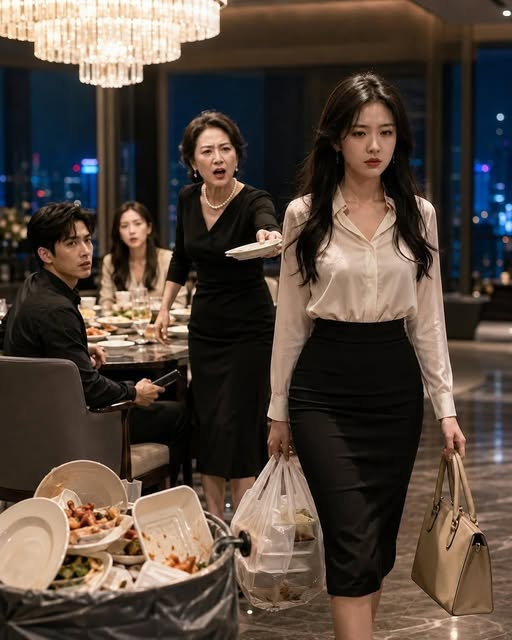
—The nine dishes weren’t the reason.
—They were simply the first time I watched my work being thrown into the trash and realized it looked exactly like my marriage.
Andrew stared at me.
For once, he had no answer.
Then Rachel placed another document before him.
—We also need to discuss Hale Catering’s continued use of Mrs. Hale’s protected materials.
His face drained.
—What?
That afternoon, Margaret called.
This time, I answered.
—Clara, what did you tell the company lawyers?
—The truth.
—Those recipes belong to the Hale family!
—Then show me the assignment agreement.
Silence.
—You’re Andrew’s wife!
—Not for much longer.
Her voice rose.
—You ate our food, lived in our house—
I almost laughed.
The apartment Andrew and I lived in had been rented.
I paid half.
The groceries?
Mostly mine.
The vacations?
Split.
Even the car Margaret liked telling people her son had bought me was registered under a loan I paid myself.
The Hale family’s generosity existed mostly in their own stories.
—Margaret, I said calmly, you told me last night that I wasn’t even allowed to sit down and eat unless I cooked your dinner again.
—Now you’re claiming I owe your family everything?
She hung up.
Three days later, the company offered to purchase my recipe rights.
The first offer was insulting.
I rejected it.
The second was better.
I rejected that too.
The third came through independent lawyers and included licensing terms rather than permanent transfer.
I accepted negotiations.
Not because Andrew asked.
Because hundreds of employees had nothing to do with our marriage.
That distinction mattered to me.
Then the audit uncovered something I hadn’t expected.
Hale Catering had been paying a company called CFM Holdings for “culinary development services.”
Nearly $1.8 million over four years.
I had never heard of CFM Holdings.
Rachel investigated.
The owner was Emma.
My sister-in-law.
I stared at the records.
—Emma doesn’t cook.
Rachel almost smiled.
—Apparently that didn’t stop her from invoicing the company for developing your menus.
Every recipe I had created had been internally attributed to CFM Holdings.
Emma had been collecting fees for my work.
Did Andrew know?
I wanted evidence.
We found it.
An email from four years earlier.
Emma had written:
“Clara keeps everything on her laptop. What if she realizes the recipes are still legally hers?”
Andrew replied:
“She won’t. She thinks we’re building this together.”
I read that sentence once.
Then again.
The strange thing was that I didn’t cry.
The divorce stopped feeling sad.
It became administrative.
Andrew came to see me that evening.
This time, he didn’t argue.
—I can explain the email.
—Please don’t.
—Emma needed income.
I stared at him.
—So you gave her mine?
—It wasn’t like that.
—It was exactly like that.
He rubbed his face.
—Clara, I was going to fix everything later.
—When?
He couldn’t answer.
Then I asked:
—Did Margaret know?
His silence told me enough.
The birthday recording suddenly had another meaning.
Margaret hadn’t thrown away the food because it was bad.
She had spent years benefiting from my work while making sure I never believed that work had value.
If I remained the grateful daughter-in-law who couldn’t even cook a birthday dinner correctly, I would never ask why thirty-two restaurants were serving variations of dishes I had developed.
Two weeks later, Emma’s company was suspended from receiving further payments while Hale Catering conducted an internal review.
Margaret blamed me.
Andrew blamed Emma.
Emma blamed Margaret.
I blamed none of them.
I simply provided documents.
Let them explain themselves.
Then my father-in-law, Robert Hale, requested a private meeting.
I agreed with Rachel present.
Robert placed an old contract on the table.
—There’s something you should know.
The document was dated seven years before I met Andrew.
Hale Catering had nearly collapsed then.
A private investor provided the money that saved it.
The investor’s name was hidden behind a company:
Northbridge Food Ventures.
—What does this have to do with me?
Robert pushed a photograph across the table.
My father stood beside him.
I stopped breathing.
My father had died when I was twenty-two.
He’d owned a small food-processing business.
Nothing remotely comparable to the Hale family’s company.
At least, that’s what I’d believed.
—Your father funded us, Robert said.
I looked at Rachel.
—How much?
—Enough to keep the company alive.
My father’s investment agreement granted Northbridge twelve percent of Hale Catering plus royalties on several processing systems.
After he died, Robert claimed, Margaret told him the investment had been repaid.
—Was it?
Robert lowered his eyes.
—I believed her.
Rachel immediately requested the records.
It took three weeks.
The investment had never been repaid.
Worse, Northbridge hadn’t disappeared.
Its ownership had transferred through my father’s estate.
To me.
I sat in Rachel’s office staring at the document.
I didn’t suddenly own the Hale family company.
I didn’t control it.
But I had inherited a legitimate twelve-percent interest nobody had disclosed to me.
And according to the original agreement, certain unpaid royalties had accumulated for years.
Andrew came to the next legal meeting.
He looked stunned.
—You own part of Hale Catering?
—Apparently.
Margaret slammed her folder shut.
—This is ridiculous. Her father abandoned the investment.
Rachel calmly placed the original contract beside her.
—Then your attorneys can demonstrate that.
Margaret went silent.
For the first time since I’d known her, she couldn’t order the problem out of the room.
An independent forensic review began.
And then something unexpected happened.
Robert called me.
—Clara, the twelve percent isn’t what Margaret is afraid of.
I frowned.
—What is she afraid of?
—Your father’s original partnership agreement.
Another document arrived.
My father hadn’t merely invested money.
He and Robert had planned a separate packaged-food division.
My father contributed processing methods.
Robert contributed distribution.
Margaret opposed the project.
After my father’s death, the division was quietly absorbed into Hale Catering.
One clause had survived.
If my father’s heir ever worked directly in product development for Hale Catering without receiving contractual compensation, ownership of those specific product rights reverted automatically to the heir.
Me.
Suddenly the fake CFM invoices made sense.
They hadn’t only been paying Emma.
They had been creating a paper trail suggesting someone else developed the products.
Margaret hadn’t been trying to convince me I was a bad cook.
She had been trying to make sure the company records never admitted I was the cook at all.
The divorce was finalized five months after her birthday.
Andrew asked me once whether we could start again.
I said no.
He accepted it.
That was perhaps the first decision of mine he’d respected without an argument.
I negotiated a fair commercial license for the recipes the restaurants were already using.
The company could continue operating.
Employees kept their jobs.
My work finally carried my name.
Emma’s consulting payments remained under review.
And Margaret stopped calling me.
I thought that was the end.
Until Victoria, my father’s former accountant, contacted me.
She was seventy-three and living in Vancouver.
She had seen my name in an industry article about the Hale dispute.
Her first words were:
—Your father told me this day might come.
A week later, a package arrived.
Inside was a handwritten recipe notebook.
I recognized my father’s handwriting immediately.
The first half contained formulas and processing notes.
The second half was financial.
On the final page was a list of nine dishes.
Exactly nine.
Braised pork.
Steamed fish.
Chicken soup.
The vegetables.
Even the dessert Margaret had thrown away.
My hands went cold.
Those weren’t recipes I’d created from nothing.
They were dishes my father had taught me when I was young.
Recipes I had gradually adapted without realizing where their foundations came from.
Beside the list, my father had written:
“Margaret requested these for the Hale family private menu. Do not license them.”
I stared at the date.
Twenty-four years earlier.
Margaret had known those dishes before I ever married Andrew.
She had recognized them.
That night, I reopened the birthday recording.
This time I listened past the moment I walked out.
My phone had remained on the dining-room sideboard for another seven minutes before I’d returned quietly through the kitchen entrance to retrieve it.
I had never listened to that part.
Andrew’s voice came first.
—Mom, why did you do that?
Margaret answered sharply:
—Because she cooked them exactly like him.
Silence.
Then Robert:
—Margaret, stop.
But she continued.
—Twenty-four years, and she walks into my house serving his food on my birthday?
Andrew sounded confused.
—Whose food?
A chair scraped.
Then my father-in-law said something so quietly I had to replay it.
—Clara’s father.
Andrew asked:
—What did Clara’s father have to do with Mom?
Nobody answered for several seconds.
Then Margaret said:
—Everything.
The recording continued.
And finally Robert asked the question nobody had ever asked me.
—Does Clara know why her father really left Northbridge?
Margaret’s answer was almost a whisper.
—No.
Then came the sentence that changed the entire story.
—And she can never find out that I was supposed to marry him before I married you.
I stopped the recording.
My father.
Margaret.
Twenty-four years ago.
Nine dishes she recognized immediately.
A company rescued with money she later pretended had never existed.
And a partnership agreement someone had spent decades hiding.
The birthday dinner hadn’t made Margaret hate my cooking.
It had frightened her.
Because when I placed those nine dishes on her table, I had unknowingly brought my father back into a house that had spent twenty-four years erasing his name.
