Seven days before I disappeared, Ngo Quan Ky came home earlier than usual.
I had just finished preparing dinner when he walked into the bedroom.
He looked around for a moment before saying casually:
—Trang Ha, move your things to the guest room.
My hand stopped on the drawer.
—Why?
—Lan Anh is coming back.
That name finally appeared.
The woman he had hidden in his heart for years.
Quan Ky avoided my eyes.
—She isn’t used to unfamiliar places. The master bedroom gets better sunlight, and her health hasn’t been good.
I understood immediately.
Our wedding room.
The room I had cleaned, decorated and slept in beside him for years.
He wanted me to give it to another woman.
Strangely, I wasn’t angry.
Perhaps when someone has already decided to leave, even humiliation becomes light.
—Alright.
Quan Ky frowned.
—That’s it?
—What else should I say?
He stared at me as though my obedience somehow disturbed him.
That night, I packed my clothes into two suitcases.
But I didn’t take them to the guest room.
Most of them went into donation boxes.
After all, in seven days, Trang Ha would officially cease to exist.
Six days remained.
At breakfast, Quan Ky sent me a message from the military base.
“Tomorrow Lan Anh returns. Prepare the house.”
A second message followed.
“She doesn’t eat spicy food.”
I stared at those words.
For years, Quan Ky had never remembered that I was allergic to peanuts.
Yet he remembered exactly what another woman disliked.
I replied with one word.
“Okay.”
The following afternoon, military vehicles entered the compound.
Lan Anh returned wearing a decorated uniform.
Only then did I learn the truth.
Years earlier, during an overseas operation, she had saved several members of Quan Ky’s unit and suffered serious injuries.
She had spent years recovering abroad.
Now she was returning as a national hero.
People surrounded her with flowers and applause.
Quan Ky stood at the front.
The expression in his eyes was one I had never seen when he looked at me.
Pride.
Relief.
And tenderness.
Lan Anh smiled at him.
—Major Ngo, you still came to welcome me.
He answered quietly:
—I promised I would.
Nobody noticed me standing behind the crowd.
I turned around and went home.
Five days remained.
That evening, Quan Ky unexpectedly asked:
—Do you want to see a movie?
I almost laughed.
During our marriage, he had taken me to the cinema only twice.
Yet because I was leaving, I agreed.
The movie was about soldiers sent on a mission from which some would never return.
Near the ending, a soldier said goodbye to his pregnant wife.
She stood beneath the rain, unable to chase after him.
Quan Ky suddenly spoke beside me.
—If you were her, could you accept it?
I watched the screen.
—Yes.
He turned toward me.
—Really?
—If someone has chosen where he belongs, keeping him beside you only makes everyone miserable.
His eyes remained on me for several seconds.
He didn’t know I wasn’t talking about the movie.
Four days remained.
Lan Anh moved into our house.
She looked surprised when she saw me carrying the final box from the master bedroom.
—Sister Trang, you don’t have to do this.
Before I could answer, Quan Ky spoke.
—She already agreed.
Lan Anh lowered her eyes.
—I’m sorry.
I smiled.
—There’s nothing to apologize for.
Because soon none of this would belong to me anyway.
That night, I heard them talking downstairs.
Lan Anh asked:
—Does your wife know?
A long silence followed.
Then Quan Ky answered:
—There’s no reason to tell her.
My hand froze against the railing.
Lan Anh whispered:
—But you’ve waited for me for so many years.
I didn’t stay to hear the rest.
For the first time, I realized there was no need.
Three days remained.
I began erasing myself from the house.
I removed my books from the study.
Deleted my recipes from the kitchen tablet.
Returned the spare keys to the drawer.
Canceled the subscriptions under my name.
The framed wedding photograph remained.
I looked at it for a long time.
Then I placed it face down.
That evening, Quan Ky noticed.
—Why did you move our photograph?
—It was dusty.
He picked it up and carefully returned it to its original position.
—Then clean it. Don’t put it away.
I almost asked him why he cared.
But I didn’t.
Two days remained.
A sealed envelope arrived.
Inside was my final authorization.
SECURITY CLASSIFICATION: HIGHEST LEVEL.
IDENTITY TERMINATION: APPROVED.
From midnight on the seventh day, all ordinary civil records connected to Trang Ha would be sealed under the national program.
I burned the envelope after memorizing the instructions.
That night, Quan Ky knocked on the guest-room door.
—Are you asleep?
—Not yet.
He entered.
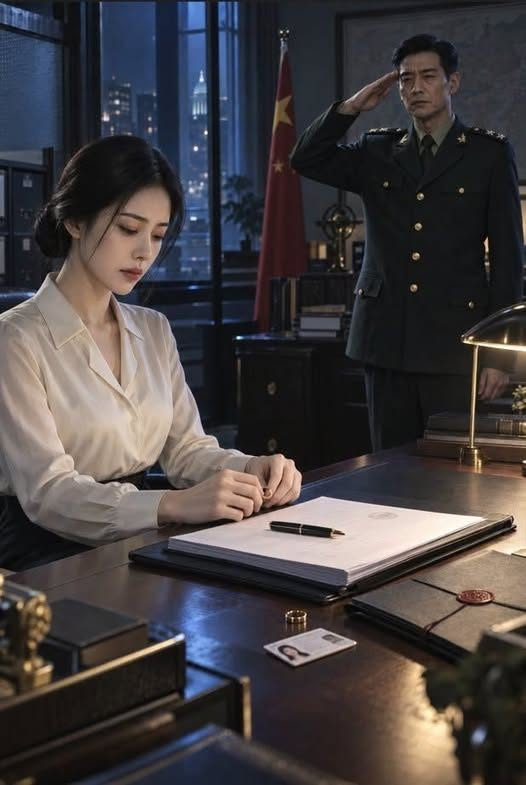
For once, he wasn’t wearing his uniform.
He looked strangely tired.
—Lan Anh will receive another commendation tomorrow.
—I know.
—Come with me.
I looked at him.
—Why?
His answer surprised me.
—Because you’re my wife.
For several seconds, neither of us spoke.
Then I smiled.
—Alright.
He couldn’t know those words would only remain true for one more day.
The final morning arrived.
I woke before sunrise.
I cooked his favorite breakfast.
Ironed his uniform.
Repaired the loose button near his collar.
And placed his military watch beside his gloves.
Quan Ky came downstairs and stared at the table.
—Why did you prepare so much?
—Because I probably won’t have another chance.
He frowned.
—What does that mean?
I calmly poured his tea.
—Nothing.
He received a call from Lan Anh before he could ask again.
As always, he left.
At eleven, a black government vehicle stopped two streets away.
I carried only one small bag.
No photographs.
No wedding ring.
No evidence that I had once been Mrs. Ngo.
Before closing the door, I looked back at the house.
Then I placed my ring on the entrance cabinet.
And left.
At midnight, Trang Ha disappeared.
Three days later, Quan Ky finally noticed something was wrong.
At first he thought I had gone to my parents.
Then he discovered my phone number had been disconnected.
My workplace had no employment record under my name.
My bank account was inaccessible.
Even the neighborhood database showed nothing.
He called the police.
Within hours, his rank turned an ordinary missing-person report into a citywide search.
Then an officer entered the room carrying a computer.
—Major Ngo, there’s a problem.
—What problem?
The officer hesitated.
—The woman you’re asking us to find doesn’t exist.
Quan Ky stared at him.
—She’s my wife.
The officer turned the screen around.
—According to the civil database, you have never been married.
Quan Ky’s face went white.
—Check again.
—We already did.
He slammed his hand against the desk.
—Her name is Trang Ha!
The officer answered quietly:
—There is no citizen registered under that identity.
Quan Ky rushed home.
He searched every room.
My clothes were gone.
My documents were gone.
My belongings were gone.
Only the wedding ring remained.
He picked it up with trembling fingers.
For the first time since I had known him, Major Ngo Quan Ky panicked.
Then he noticed something beneath the ring.
A folded piece of paper.
There was only one sentence written on it.
“You once chose the person you couldn’t forget. Now I’ve chosen the place where I’m needed.”
His phone rang.
It was his commanding officer.
Quan Ky answered immediately.
—Sir, my wife has disappeared.
Silence came from the other end.
Then the commander said:
—Major Ngo, from this moment forward, stop searching for Trang Ha.
Quan Ky froze.
—Why?
The commander’s voice became severe.
—That’s an order.
—Where is she?
—You don’t have clearance to know.
Quan Ky’s fingers tightened around the phone.
Then came the sentence that completely shattered his composure.
—And Major… you should have known who your wife really was before she chose to disappear.
Hundreds of kilometers away, beneath a classified research facility, I stood before a steel door.
My old identity had already been erased.
A new identification card was placed in my hand.
The director looked at me solemnly.
—Welcome back, Professor.
I stared at the title.
A title I hadn’t heard since giving up my research career for marriage.
Then the steel doors opened.
Dozens of researchers stood waiting.
But the man standing at the center made me stop.
He was wearing the uniform of a senior military officer.
And I recognized him immediately.
He was the supposedly dead commander whose photograph had hung for years in Ngo Quan Ky’s military base.
He looked at me and said:
—Professor Trang, we’ve been waiting five years for you.
Then he placed a classified file on the table.
On its cover was a photograph of my husband.
And beneath Ngo Quan Ky’s name were four words:
“SUBJECT OF INTERNAL INVESTIGATION.”
