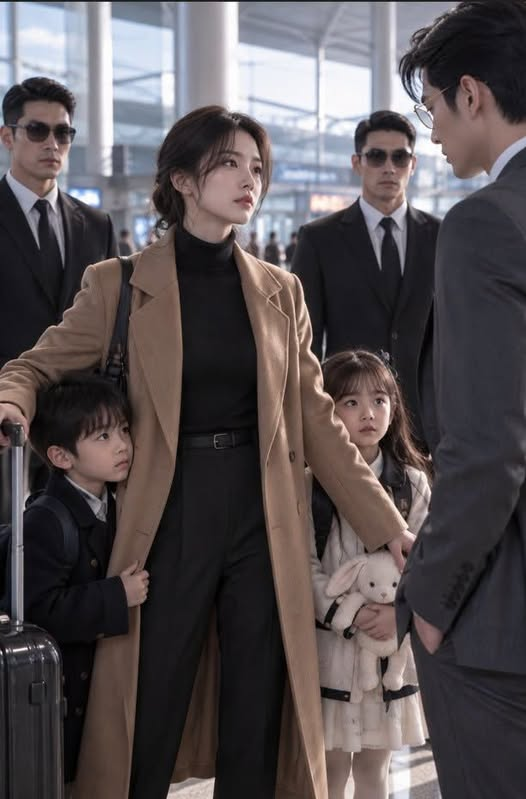
Lam An looked up at me and asked quietly in English:
“Mom, is that man our father?”
The airport suddenly seemed too quiet.
Truong Hang’s expression changed.
I tightened my grip on my son’s hand.
“Why would you ask that?”
Lam An glanced at the men in black.
“Because they keep looking at me like they already know me.”
My daughter Lam Uc immediately touched her own face.
“Do we look like him?”
Before I could answer, a cold male voice came from behind the bodyguards.
“Very much.”
My entire body stiffened.
The two men stepped aside.
And after six years, I saw Co Tram Chu again.
He wore a black suit without a tie. His features were sharper than I remembered, his expression calmer, colder.
Time had changed him.
But not enough.
I still recognized the man who had once placed divorce papers in front of me and said:
“Sign them. Thanh Nhu is back.”
No explanation.
No hesitation.
Just one sentence ending our marriage.
Now his eyes weren’t on me.
They were fixed on Lam An.
Then Lam Uc.
His face remained expressionless, but the hand beside his body slowly clenched.
He walked toward us.
“How old are they?”
I stepped between him and the children.
“That doesn’t concern you.”
His gaze finally met mine.
“Lam Uyen Ninh.”
Six years.
He still said my name the same way.
Like he had a right to it.
“Answer me.”
I smiled.
“You lost the right to demand answers from me the day we divorced.”
Truong Hang quietly signaled the bodyguards to move away.
Tram Chu ignored him.
“Six years old?”
I said nothing.
His eyes returned to Lam An.
My son had inherited almost everything from him.
The same dark eyes.
The same straight nose.
Even the small habit of pressing his lips together when thinking.
Six years ago, I had prayed my children would look like me.
Apparently genetics had found that funny.
Tram Chu crouched.
Lam An immediately stepped backward.
That tiny movement stopped him.
For the first time, something resembling pain crossed his face.
“What is your name?”
Lam An looked at me first.
I nodded.
“Lam An.”
“And your sister?”
“Lam Uc.”
Tram Chu repeated the names softly.
Then Lam An asked:
“Are you our father?”
Nobody moved.
Truong Hang lowered his eyes.
My daughter stared curiously at the stranger.
And Co Tram Chu—the man who could silence an entire boardroom with one look—couldn’t answer an eight-year-old’s simple question.
Finally, he looked at me.
“Are they?”
I replied calmly:
“They are my children.”
His jaw tightened.
“I asked whether I’m their father.”
“And I answered what matters.”
He stood.
“We’re doing a paternity test.”
I laughed.
“No.”
“This isn’t negotiable.”
“It absolutely is.”
I pulled out my phone.
“And if your people prevent me from leaving this airport again, my lawyer will handle the rest.”
Truong Hang frowned.
“Dr. Lam, there’s no need to make this ugly.”
“It became ugly when three men surrounded a woman traveling with two children.”
Tram Chu’s eyes hardened.
Then something unexpected happened.
He stepped aside.
“Let them go.”
Truong Hang looked startled.
“President Co—”
“I said let them go.”
The path opened.
I took the children’s hands.
But as I passed him, Tram Chu spoke.
“I’ll find out.”
I stopped.
He continued:
“If they’re mine, six years won’t disappear because you changed their surname.”
I turned.
“And becoming their biological father won’t magically make you their parent.”
Then I walked away.
That night, we stayed at my mother’s old apartment.
I had barely finished putting the children to bed when someone knocked.
Not Tram Chu.
A lawyer.
He handed me an envelope.
Inside was a petition requesting formal confirmation of paternity and temporary restrictions preventing the children from being taken out of the country until the dispute was resolved.
I read every page.
Then I called my attorney.
By midnight, Harvard’s legal liaison had also been notified.
By morning, the Co family discovered something they hadn’t expected.
I wasn’t the woman who had left Van Thanh six years earlier with one suitcase and no money.
I had my own legal team.
My own career.
My own resources.
And most importantly, six years of records proving who had raised those children.
Every medical appointment.
Every school registration.
Every emergency contact.
Every birthday.
Every parent-teacher conference.
Every signature.
Mine.
Co Tram Chu’s name appeared nowhere.
Three days later, the paternity test happened under court supervision.
I didn’t fight it.
There was no reason.
I already knew the result.
99.99%.
Biological father: Co Tram Chu.
He stared at that page for a long time.
Then he asked:
“When did you know?”
“Shortly after arriving in America.”
His head snapped up.
“You knew for six years?”
“Yes.”
“Why didn’t you tell me?”
I looked at him.
“Do you remember what you said when I signed our divorce?”
He remained silent.
I remembered every word.
“You said, ‘Take whatever belongs to you. Leave everything belonging to the Co family behind.’”
His face slowly changed.
I continued:
“I left with nothing.”
I placed the DNA report between us.
“And when I discovered I was pregnant, I decided my children would never grow up somewhere they could be discarded the moment another woman returned.”
His voice dropped.
“I didn’t know.”
“You didn’t ask.”
“You disappeared.”
“You divorced me.”
“I thought you would contact me.”
“For what?”
He couldn’t answer.
Then he said:
“I want custody.”
I almost smiled.
“Of course you do.”
“They’re my children.”
“They don’t know your favorite food.”
His expression froze.
“They don’t know whether you’re afraid of thunderstorms. They don’t know what you sound like when you laugh. They don’t know your birthday.”
I leaned forward.
“And you don’t know theirs.”
His fingers tightened around the DNA report.
“I can learn.”
That answer surprised me.
Not I have money.
Not I’m their father.
Not The Co family won’t allow its bloodline to live outside.
Just:
“I can learn.”
But six years couldn’t be repaired with one sentence.
“Then learn,” I said.
His eyes lifted.
“But don’t confuse learning about them with owning them.”
For the next month, Tram Chu stopped using bodyguards.
He stopped sending lawyers to my door.
Instead, he requested supervised visits.
The first lasted forty minutes.
Lam Uc asked him seventeen questions.
“Why are you so serious?”
“Why do you wear black every day?”
“Are you rich?”
“Can you cook?”
That last one defeated him.
“No.”
She frowned.
“Mom says adults who can’t cook should at least know how to wash dishes.”
For the first time in six years, I saw Co Tram Chu laugh.
Lam An was different.
He remained cautious.
At the fourth visit, Tram Chu brought him an expensive limited-edition watch.
Lam An looked at it.
Then asked:
“Did you know I don’t wear watches?”
Tram Chu went silent.
My son continued:
“You don’t know what I like.”
“No.”
“Then why did you buy something expensive?”
Another silence.
Finally Tram Chu said:
“Because buying things is easier than admitting I don’t know you.”
Lam An stared at him.
Then pushed the box back.
“Next time, just ask.”
Something shifted after that.
Slowly.
Not forgiveness.
Not yet.
But possibility.
Then Thanh Nhu returned.
The woman for whom my marriage had ended appeared at a medical research banquet where I was scheduled to present my work.
She approached me during the reception.
Six years hadn’t changed her smile.
“Uyen Ninh.”
I turned.
“It’s been a long time.”
“I heard you brought Tram Chu’s children back.”
There was something strange in her tone.
I looked at her.
“You seem well informed.”
She smiled.
“You know how Van Thanh is.”
Then she leaned closer.
“You should take the children back to America.”
I almost laughed.
“Is that advice?”
“A warning.”
Before I could respond, Tram Chu appeared behind her.
“Warning about what?”
Thanh Nhu went pale.
He looked from her to me.
She recovered quickly.
“Nothing. We were just talking.”
“No.”
I picked up my glass.
“She was telling me to take your children out of the country.”
His expression turned cold.
“Why?”
Thanh Nhu’s smile disappeared.
“Because this is getting ridiculous. Your family has already started discussing inheritance. Your mother wants DNA reports distributed to the board. Everyone is talking as if those children appeared from nowhere and suddenly own half the Co family.”
I stared at her.
There it was.
Not love.
Money.
Power.
Inheritance.
Tram Chu said quietly:
“Leave.”
“Tram Chu—”
“Now.”
She walked away.
But before disappearing into the crowd, she looked back at me.
And that look made me uneasy.
The next morning, my attorney called.
“Dr. Lam, we found something strange in your old divorce records.”
“What?”
“The original settlement file was altered.”
I sat up.
“Altered how?”
“There was a medical attachment.”
My heart began beating faster.
“What medical attachment?”
“A hospital laboratory report dated three days before your divorce.”
I stopped breathing.
That was impossible.
I hadn’t known I was pregnant until weeks later in America.
“What did it say?”
My attorney hesitated.
Then answered:
“It recorded elevated pregnancy markers.”
The room tilted.
Someone had known.
Before I left.
Before I boarded the plane.
Before I even knew myself.
“Who accessed the report?”
“We’re tracing it.”
I immediately called Tram Chu.
He arrived within twenty minutes.
I threw the copy onto the table.
“Did you know?”
He read it.
His face went blank.
“Where did you get this?”
“Answer me.”
“No.”
“Don’t lie.”
“I didn’t know.”
For once, I believed him.
Because the shock on his face wasn’t guilt.
It was horror.
He turned to the final page.
There was an internal signature confirming receipt of the report.
His hand suddenly stopped.
I saw the name at the same moment he did.
Not Thanh Nhu.
Not his mother.
Truong Hang.
His special assistant.
The man who had been beside him for more than a decade.
The man who had blocked me at the airport.
The man who knew exactly when I returned with two children.
Tram Chu immediately called him.
No answer.
Again.
Nothing.
Then my phone vibrated.
A message from Lam An.
Mom, Uncle Truong came to school.
My blood went cold.
Another message appeared.
He says Dad sent him to pick us up.
I stood so quickly my chair fell backward.
Tram Chu read the screen over my shoulder.
For the first time since I had known him, all color disappeared from his face.
“I didn’t send him.”
My fingers started trembling.
Then a third message arrived.
This one wasn’t from my son.
It came from an unknown number.
There was only a photograph.
Lam An and Lam Uc were standing beside a black car.
And underneath it, one sentence:
Six years ago, you escaped with the Co family’s secret. This time, neither you nor the twins will leave Van Thanh.
