The doctor looked from Adrián to me.
“Mrs. Vega, do you want the father present?”
Adrián seemed to stop breathing.
The answer belonged entirely to me.
“No.”
His face tightened.
But he didn’t argue.
“Understood,” the doctor said.
The door closed between us.
For the next twenty minutes, I concentrated on the small screen beside the examination table.
The doctor checked the pregnancy carefully.
Everything looked normal.
Only when she told me the baby was developing well did the knot inside my chest loosen.
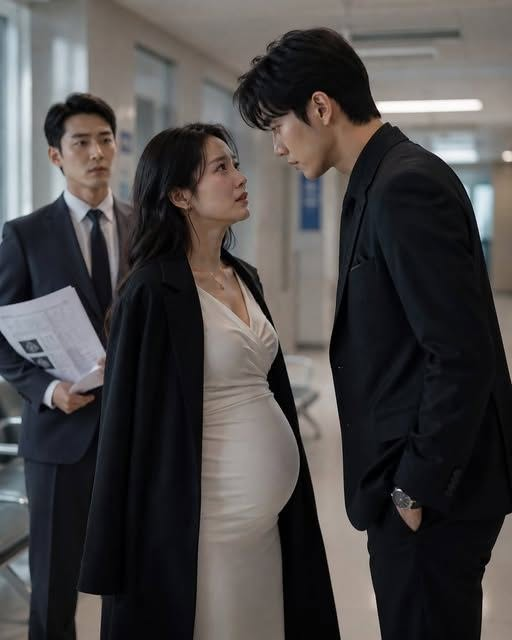
When I left, Adrián was still there.
So was Marcos.
And so was the elderly specialist Adrián had been speaking to earlier.
The specialist approached me.
“Mrs. Vega?”
“It’s Vega. We’re divorced.”
He glanced at Adrián.
“Of course.”
Then he introduced himself.
“Dr. Esteban Lozano. Hematology.”
Hematology?
I looked at Adrián.
“What is this?”
His expression became unreadable again.
“Not here.”
“I have nothing to discuss with you.”
“You do.”
“No.”
Then Dr. Lozano said:
“It concerns Irene Serrano.”
I stopped.
Ten minutes later, we were sitting in an empty consultation room.
Adrián remained by the window.
Marcos stood near the door.
Dr. Lozano placed a medical file on the table.
“I can’t disclose Miss Serrano’s private medical information without authorization. She has provided written permission for us to discuss the part that directly concerns you.”
“Concerns me?”
The doctor nodded.
Then he explained.
Months earlier, during a routine medical examination connected to the Salvatierra family’s private foundation, Irene had been diagnosed with a serious blood disorder.
She needed a donor.
Finding a compatible one had been difficult.
Then, by coincidence, an old family medical record revealed something nobody expected.
Irene Serrano was Adrián’s half-sister.
I stared at him.
“What?”
Adrián finally turned around.
“My father had another daughter.”
The room seemed to tilt.
“Irene?”
“Yes.”
“And you knew?”
“Not until five months ago.”
That was when everything in our marriage had changed.
The late meetings.
The secret phone calls.
The medical documents.
The sudden distance.
I had assumed another woman had entered his life.
I had been wrong.
But that didn’t explain the divorce.
“Why leave me?”
Nobody answered immediately.
My stomach tightened.
Then Dr. Lozano continued carefully.
“Further genetic testing raised questions concerning hereditary risks within the Salvatierra family.”
Adrián interrupted him.
“Enough. I’ll tell her.”
He sat opposite me.
For the first time, the man who had always seemed impossible to shake looked frightened.
“My father carried a hereditary mutation.”
I stared at him.
“I was tested.”
My hand instinctively went to my belly.
Adrián noticed.
“I tested positive.”
Everything inside me went cold.
“What does that mean for the baby?”
“We don’t know that the baby inherited anything,” Dr. Lozano said quickly. “And a genetic finding is not automatically a diagnosis. It means there may be additional considerations that can be discussed with the appropriate specialists.”
I barely heard him.
I was looking at Adrián.
“You knew before our divorce.”
“Yes.”
“How long?”
“Three weeks.”
“And instead of telling me, you divorced me?”
His eyes reddened.
“I thought I was protecting you.”
I laughed.
It sounded terrible.
“From what?”
“From me.”
The room became silent.
Adrián leaned forward.
“My father died young. Other relatives had serious complications. Then Irene appeared, already ill. When my results came back…”
He stopped.
“I panicked.”
“So you decided for me.”
“Yes.”
The honesty stunned me.
“I thought if I told you, you’d stay.”
“Maybe I would have.”
“Exactly.”
His voice broke.
“You loved me.”
I stared at him.
“That was your excuse?”
“I couldn’t ask you to spend your life worrying about me.”
“So instead you made me believe you had stopped loving me.”
He lowered his eyes.
“Yes.”
I stood.
“Natalia—”
“No.”
He stopped.
“You don’t get to turn this into sacrifice.”
His face went pale.
“You didn’t protect me, Adrián.”
I pointed toward the door.
“You took away my choice.”
I left the hospital alone.
He didn’t follow.
For once, he respected the word no.
That evening, however, an email arrived.
Not from Adrián.
From Marcos.
It contained only one sentence:
Mr. Salvatierra asked me to send this only if you requested the full truth.
I almost deleted it.
Instead, I replied:
Send it.
There were documents.
Dates.
Medical appointments.
Adrián’s test results.
And one draft email he had never sent me.
Natalia,
I have spent three days trying to tell you.
Every time I look at you, I imagine you saying you don’t care and that we’ll face it together.
And that is exactly what terrifies me.
I stopped reading.
Because suddenly I understood him.
Understanding, unfortunately, was not the same as forgiving.
The next weeks were consumed by appointments.
This time, I made the decisions.
I spoke to specialists.
I asked questions.
I refused to let fear make choices for me.
Adrián attended only the appointments I explicitly invited him to.
At the first one, he sat three chairs away.
At the second, two.
He never tried to touch me.
Never called me his wife.
Never asked me to return.
He simply showed up for his child.
That mattered.
But it did not erase anything.
One afternoon, after an appointment, he asked:
“Can I buy you lunch?”
“No.”
“All right.”
He turned to leave.
I called him back.
“Coffee.”
He looked at me.
“Coffee is fine.”
That was how we began learning to speak again.
Not as husband and wife.
As two people who were going to become parents.
Irene contacted me a month later.
I agreed to meet her.
She was thinner than I expected.
She looked nervous.
“I suppose you hate me.”
“No.”
She blinked.
“I barely know you.”
A faint smile appeared.
“Adrián said you would say something like that.”
That irritated me more than it should have.
She noticed.
“Sorry.”
I stirred my tea.
“Did you tell him to divorce me?”
“No.”
Her answer was immediate.
“I told him he was an idiot.”
That surprised a laugh out of me.
Irene continued:
“When he learned about the genetic issue, he became obsessed with controlling every possible consequence.”
“That sounds like him.”
“He thought losing you deliberately would hurt less than watching you choose him and possibly suffer later.”
I looked at her.
“He was wrong.”
“I know.”
“So does he.”
My son was born months later.
Healthy.
Loud.
Furious at the world.
I named him Leo Vega.
Adrián didn’t object to the surname.
He stood beside the hospital bed holding him with trembling hands.
For a man who controlled corporations without blinking, he looked terrified of a three-kilogram baby.
“Support his head,” I said.
“I am.”
“You look like you’re holding an explosive.”
“I’ve held explosives.”
I stared at him.
“That is not reassuring.”
For the first time in almost a year, we laughed together.
Then Leo opened his eyes.
Adrián’s expression changed.
He kissed our son’s forehead.
And silently cried.
I looked away.
Some moments belonged to fathers too.
Even imperfect ones.
Adrián never asked me to cancel the divorce.
It was already final.
Instead, he became dependable.
Appointments.
Midnight fevers.
Diapers.
Pediatric checkups.
If he said he would arrive at six, he arrived at five fifty-five.
He never used Leo as an excuse to enter my life.
That was probably the first real proof that he had changed.
A year after Leo’s birth, Adrián came to my apartment for our son’s birthday.
After everyone left, he stayed to help clean.
I found him removing paper decorations from the wall.
“You can leave those.”
He smiled.
“I know.”
That sentence made me pause.
I know.
Not: I’m doing this for you.
Not: You need me.
Not: I know what’s best.
Just:
I know.
He had finally learned that helping did not give him ownership.
Two years later, Irene’s condition had stabilized enough for her to build a life that did not revolve around hospitals.
She and I were never close.
But Leo knew her as Aunt Irene.
Life became surprisingly ordinary.
Then, one evening, Adrián and I stood outside my building after he dropped Leo home.
He handed me our son’s backpack.
“Natalia.”
“Yes?”
“I owe you one more apology.”
“You’ve given me many.”
“Not this one.”
He looked directly at me.
“I used to tell myself I divorced you because I loved you.”
I remained silent.
“That was arrogant.”
My throat tightened.
“I divorced you because I was afraid.”
He continued.
“I was afraid you’d choose a difficult life with me, and I didn’t trust you enough to make your own decision.”
There it was.
The truth without decoration.
“I loved you,” he said. “But I treated your love like something I had the right to manage.”
I nodded.
“Yes.”
“I won’t do that again.”
Then he left.
He didn’t ask for forgiveness.
Didn’t ask me to come back.
And perhaps that was why, for the first time, I truly forgave him.
Another year passed before anything changed between us.
Slowly.
Coffee became dinner.
Dinner became walks after Leo fell asleep at my mother’s house.
There was no dramatic reconciliation.
No grand proposal.
No assumption that history entitled us to another marriage.
Then one spring evening, Adrián asked:
“Would you go on a date with me?”
I stared at him.
“We’ve been divorced for four years.”
“I know.”
“We have a three-year-old son.”
“I know.”
“You already know almost everything about me.”
He smiled.
“Apparently I didn’t know the most important thing.”
“What?”
“That loving you doesn’t give me the right to choose for you.”
I looked at him for a long moment.
Then I smiled.
“One date.”
His eyes brightened.
“One.”
“And if you’re unbearable, there won’t be another.”
“Understood.”
There was another.
And another.
A year later, when Adrián proposed again, he did it in our kitchen while Leo was building a crooked tower from wooden blocks.
No photographers.
No family.
No Salvatierra mansion.
Adrián placed the ring on the table instead of on my finger.
“You don’t have to answer today.”
I looked at the ring.
Then at him.
Five years earlier, he had ended our marriage because he believed loving me gave him permission to decide my future.
This time, he didn’t even push the ring toward me.
He waited.
So I picked it up myself.
“Yes.”
Adrián closed his eyes.
Leo knocked over his tower and shouted:
“Papa!”
Adrián laughed and lifted him.
I watched them together.
Our second marriage wasn’t a continuation of the first.
That marriage had ended in a hospital hallway when the truth finally came out.
This was something new.
Built by two people who had learned that protecting someone doesn’t mean deciding what they are allowed to know, endure or choose.
Adrián had once destroyed our marriage because he was terrified I would choose him despite the truth.
Years later, when he finally gave me the whole truth and stopped trying to control the answer…
I chose him anyway.
