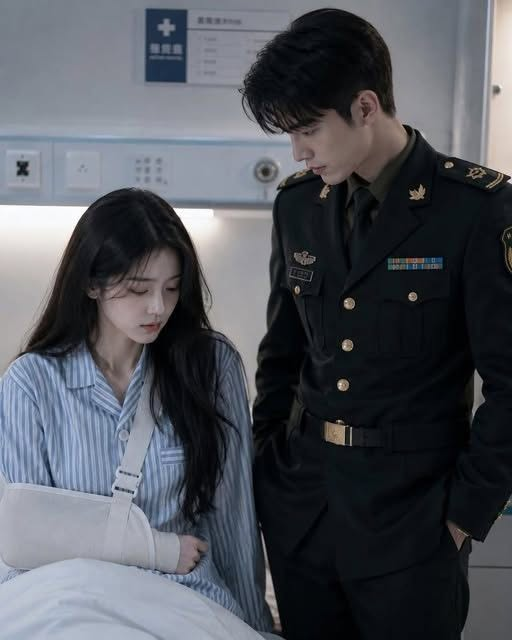
Adrian returned to my hospital room at 6:20 the next morning.
By then I was already dressed.
My injured arm was secured in a sling, and the discharge papers were folded inside my bag.
He stopped at the door.
“You’re leaving?”
“Yes.”
“Why didn’t you wait for me?”
I looked at him.
“For what?”
The question silenced him.
Before, I would have demanded an explanation.
Where had he been all night?
Why had taking Olivia upstairs required hours?
Why had he forgotten the wife with a fractured arm?
But I no longer wanted answers.
That frightened him more than anger ever had.
“Mara.”
He reached for my bag.
“I’ll take you home.”
“No need.”
“We live in the same house.”
“For another week.”
He frowned.
“What does that mean?”
“Nothing.”
I walked past him.
He stood there watching me leave.
Six days remained.
The divorce papers reached Adrian two days later.
He was in a command meeting when his assistant entered and whispered something.
Adrian’s expression changed.
He left the room immediately.
Twenty minutes later, he appeared at our house.
I was sorting Noah’s belongings.
Not throwing them away.
Never that.
His drawings were going into one box.
School photographs into another.
His favorite blue sweater was folded carefully on top.
Adrian entered holding the divorce petition.
“What is this?”
I didn’t look up.
“You can read.”
“You filed for divorce?”
“Yes.”
“Why?”
That finally made me stop.
I looked at him.
Adrian seemed genuinely confused.
And somehow that hurt more than if he had been angry.
“You really need me to explain?”
“Mara, we’ve been struggling. I know that. But we’re grieving.”
“No.”
My voice remained calm.
“I was grieving.”
His face tightened.
“And you kept asking me to grieve more conveniently.”
“I never said that.”
“You told me to stop blaming Olivia.”
“She didn’t intend—”
“There.”
He stopped.
I nodded.
“You did it again.”
Adrian rubbed his forehead.
“Olivia made a terrible mistake. But destroying her won’t bring Noah back.”
“I never asked you to destroy her.”
“Then what did you want?”
“My husband to admit that our son’s safety mattered more than protecting Olivia from consequences.”
He stared at me.
“I wanted you to stand beside me once.”
“I was beside you.”
“No, Adrian.”
I closed Noah’s box.
“You were standing between me and her.”
He didn’t sign.
For the next four days, Adrian behaved like a man who had suddenly discovered a fire after ignoring the smoke for months.
He came home early.
He cooked.
Badly.
He canceled meetings.
He even moved Olivia’s belongings out of the guest quarters she sometimes used at the military residence.
None of it mattered.
On the fifth night, he entered my room and found my closet empty.
His face went pale.
“Where are your uniforms?”
“Transferred.”
“To where?”
“Classified.”
He stared at me.
“What transfer?”
I didn’t answer.
“Mara, I’m your husband.”
“For two more days.”
His jaw tightened.
“You can’t disappear because we’re having problems.”
I almost laughed.
“Having problems?”
Our six-year-old son was gone.
Our marriage had become a room where only one person was allowed to say his name without being told to move on.
Those weren’t “problems.”
That was an ending.
Adrian stepped closer.
“Cancel the transfer.”
“No.”
“I can speak to command.”
“No, you can’t.”
His expression changed.
That was when he finally understood this wasn’t an ordinary posting.
“What did you volunteer for?”
I picked up my bag.
“Something important.”
“For how long?”
I looked at him.
“Goodbye, Adrian.”
The divorce became final the following morning.
At 4:30 p.m., I surrendered my personal phone.
At 5:10, I received new identification documents.
At 6:00, Commander Mara Bennett officially disappeared into Project Zorro.
By midnight, I was on a military aircraft heading out of the country.
Adrian learned I was gone at 7:15.
He called my number.
Disconnected.
He called my unit.
Transferred.
He contacted headquarters.
Classified.
Finally he called Rachel.
“Where is my wife?”
Rachel answered:
“You don’t have one.”
That was how our marriage ended.
Not with screaming.
Not with betrayal exposed at a crowded party.
With silence.
The same silence Adrian had spent seven months teaching me.
Three months after I disappeared, Adrian reopened Noah’s case.
Maybe losing me finally forced him to look at everything he had refused to examine before.
Or maybe the questions had always been there and he had simply been afraid of the answers.
Either way, he began with the forty-seven minutes.
Why had Olivia waited?
Her original statement claimed she had searched the area herself because she believed Noah had wandered away.
But surveillance footage showed something different.
For part of that time, Olivia had been inside her car.
On her phone.
The call wasn’t to emergency services.
It was to a number she had never disclosed during the original inquiry.
Adrian requested the full record.
That decision changed everything.
The number belonged to a man connected to a civilian security contractor.
The same contractor whose employees had access to the school event that afternoon.
Adrian stared at the report for a long time.
Then he asked for Olivia to be brought in for formal questioning.
For once, he didn’t go to comfort her.
Olivia cried.
She said she had made a mistake.
Then another.
Then finally the truth began to emerge.
Weeks before Noah disappeared, she had been communicating with someone connected to the contractor.
She had shared information she should never have shared.
Schedules.
Routes.
Details about Adrian’s family.
She claimed she thought the man was interested in her.
She said she never understood what he intended to do with the information.
On the day Noah disappeared, she realized almost immediately that something was wrong.
But instead of calling authorities, she called him first.
She wanted him to explain.
She wanted to protect herself.
Those forty-seven minutes had not been confusion.
They had been fear.
Fear of admitting what she had done.
Adrian sat across from her during the final interview.
Olivia was crying.
“Brother Adrian, I didn’t know.”
He looked at her.
For years, that name had softened him.
Not anymore.
“You knew Noah was missing.”
“I panicked.”
“You called him before you called us.”
“I was scared.”
“So was my son.”
She covered her face.
Adrian stood.
For the first time, he understood what I had been trying to tell him.
Intent was not the only thing that mattered.
Consequences did too.
Olivia faced the formal consequences of her actions through the military and civilian investigative process.
Adrian didn’t intervene.
He didn’t call anyone.
He didn’t ask for leniency.
He also didn’t ask for revenge.
He simply stopped protecting her from the truth.
Then he went home.
Our house had remained almost unchanged since I left.
He entered Noah’s bedroom.
On the shelf was a photograph of the three of us.
Noah was sitting on Adrian’s shoulders.
I was laughing beside them.
Adrian sat on the floor.
And for the first time since our son’s death, he allowed himself to admit something he had spent months avoiding.
I had not left because I stopped loving him.
I had left because loving him had become another place where I was forced to suffer alone.
The years passed.
Project Zorro lasted longer than anyone originally expected.
I worked in countries whose names I could not send home.
I changed identities.
Changed uniforms.
Changed languages.
My arm healed.
The rest took longer.
I kept one photograph of Noah.
Nothing else from my old life.
On his birthday, wherever I was, I found ten quiet minutes.
I never tried to replace him.
I never told myself that someday another child would make the loss disappear.
Noah remained my son.
Always.
But eventually remembering him stopped feeling like drowning.
I could remember his laugh.
His obsession with airplanes.
The way he refused to eat carrots unless I called them “orange rockets.”
Those memories became mine again.
Not evidence in an argument.
Not weapons against Olivia.
Not reasons for Adrian to tell me I needed to move on.
Just memories of my boy.
Adrian never remarried.
I didn’t know that at the time.
I knew almost nothing about him.
But later I learned that he requested reassignment away from Olivia’s case once his personal involvement became inappropriate.
He underwent grief counseling.
He established a child-safety program across several military family communities.
Not in Noah’s name.
He said publicly that turning his son’s name into a monument would have been another way of using him to manage his own guilt.
Instead, he simply did the work.
Quietly.
Year after year.
For the first time in his life, Adrian learned that regret was not something you said.
It was something you carried without demanding that the person you hurt come back and lighten it.
Ten years and three months after I left, Project Zorro ended.
I returned home on a gray November afternoon.
There were no reporters.
No ceremony.
Just my father waiting beside an old car.
He had more gray hair than I remembered.
I stood in front of him.
For a second, neither of us moved.
Then he hugged me.
“Welcome home.”
I closed my eyes.
“I’m home.”
Three days later, I visited Noah.
I brought no flowers.
He had hated flowers.
I brought a small toy airplane.
I sat there for almost an hour.
When I finally stood, someone was waiting far away.
Adrian.
Older.
Silver at his temples.
No longer wearing the insignia I remembered.
He didn’t approach until I nodded.
Then he stopped several steps away.
“Mara.”
“Adrian.”
Ten years.
And somehow his voice still belonged to another lifetime.
“I heard Zorro ended.”
I smiled faintly.
“You still hear too much.”
“Less than I used to.”
Silence settled between us.
Then he said:
“I found out the truth about Olivia.”
“I know.”
His eyes widened.
“Classified projects still receive intelligence.”
He nodded.
Of course.
“I should have believed you.”
“Yes.”
“I should have asked harder questions.”
“Yes.”
“I should never have told you we could have another child.”
My throat tightened.
That sentence had waited ten years.
“No,” I said quietly. “You shouldn’t have.”
His eyes reddened.
“I was trying to escape what happened.”
“I know.”
“And I made you feel like Noah was replaceable.”
“Yes.”
He lowered his head.
“I am sorry.”
I believed him.
That surprised me.
Maybe because he wasn’t asking for anything.
No second chance.
No forgiveness.
No return.
Just the truth.
So I gave him one in return.
“I forgive you.”
His head lifted.
Hope flickered across his face.
I shook mine gently.
“Forgiveness isn’t reconciliation.”
The hope disappeared.
But he nodded.
“I know.”
And that was when I realized he really had changed.
The old Adrian would have argued.
The old Adrian would have explained.
This man simply accepted my answer.
We walked out together.
At the gate, our paths separated.
He stopped.
“Will I see you again?”
“Probably.”
A sad smile appeared.
“That’s more than I deserve.”
“This isn’t about what you deserve.”
I looked back toward Noah’s resting place.
“We’re the only two people in the world who were his parents.”
Adrian’s eyes closed briefly.
When he opened them, I continued:
“That connection doesn’t require us to be husband and wife.”
“No.”
“And it doesn’t require me to hate you.”
“No.”
For the first time, there was peace between us.
Not love.
Not the kind we once had.
Something quieter.
Two people who had survived the same loss in completely different ways and had finally stopped demanding that the other suffer exactly as they did.
I walked toward my father’s car.
Adrian didn’t follow.
Ten years earlier, I had disappeared because silence was the only freedom I had left.
I thought leaving meant erasing everything.
My marriage.
My grief.
The woman I had been.
I was wrong.
Coming home taught me something different.
I didn’t need to erase Adrian to move forward.
I didn’t need another child to replace Noah.
And I didn’t need anger to prove that what happened mattered.
Noah had existed.
He had been loved.
He would always be my son.
Adrian had been my husband.
I had loved him too.
But some people belong to a chapter of your life without belonging to the rest of it.
I got into the car.
My father started the engine.
Through the window, I saw Adrian still standing beneath the gray sky.
He raised one hand.
I did the same.
Then we drove away.
This time I wasn’t disappearing.
I wasn’t running from my husband.
I wasn’t escaping my grief.
After ten years of living under another identity, I was finally doing something much simpler.
I was going home as Mara Bennett.
And for the first time since losing Noah, that name felt like mine again.
