Phuong Dao was waiting outside the station.
The moment she saw me, her expression changed.
She didn’t ask why I was still wearing a wedding dress.
She didn’t ask why one side of my face was swollen.
She simply took off her jacket, placed it around my shoulders and said:
“Let’s go home.”
Those four words almost made me cry.
Not because they were particularly moving.
Because nobody from the Chu family had asked where I would go after walking out.
They only wanted their wedding money back.
At Phuong Dao’s apartment, I showered for nearly an hour.
When I came out, the wedding dress was lying in a plastic bag beside the bathroom door.
“Throw it away?” she asked.
I looked at it.
“No.”
She frowned.
“You want to keep that thing?”
“Evidence.”
Phuong Dao stared at me for two seconds.
Then smiled.
“Good. You’re still the To Van I knew.”
That night, we photographed everything.
The mark on my face.
The damaged dress.
The messages from Chu Han.
The threats.
The demands for money.
And most importantly, the videos already circulating from the wedding.
Someone had uploaded the entire incident.
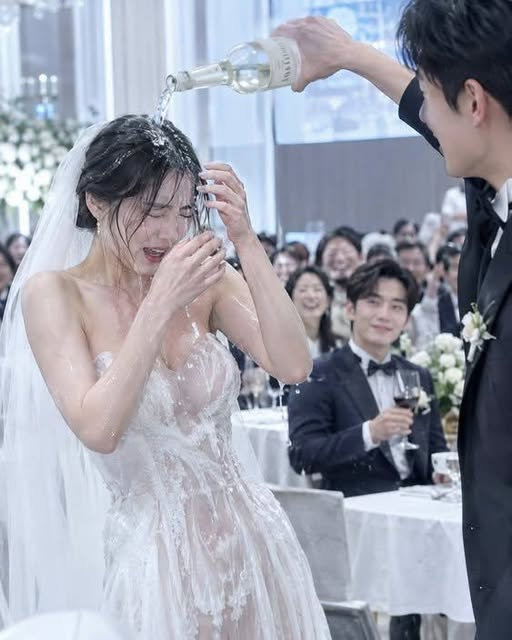
The best man pouring alcohol over me.
The guests laughing.
My father-in-law striking me.
Me throwing away the veil.
The internet had divided into two groups.
Some called me violent because I had retaliated against the best man.
Others asked a much simpler question:
Why had an entire banquet hall treated humiliating a bride as entertainment?
Phuong Dao saved every video before anyone could delete them.
At 1:17 in the morning, Chu Han called from another number.
I answered.
His first sentence was:
“Have you calmed down?”
I nearly laughed.
“No.”
“You embarrassed both families.”
“Your best man poured a bottle over me.”
“It was a joke.”
“Your father hit me.”
“He was angry.”
“And you?”
Silence.
“What did you do, Chu Han?”
“I was trying not to make the situation worse.”
“You sat there.”
“To Van—”
“You watched.”
He became impatient.
“Fine. What do you want? An apology?”
“No.”
“Then what?”
“I want the marriage registration stopped if it hasn’t been finalized, and if anything has already been legally registered, I’ll handle the separation through the proper process.”
His breathing changed.
“You’re serious?”
“Yes.”
“Over one wedding prank?”
“No.”
I looked at the plastic bag containing my wedding dress.
“Over the fact that when thirty tables laughed at me, my husband was table thirty-one.”
He said nothing.
I hung up.
The next morning, I borrowed one of Phuong Dao’s dresses and went to a clinic to document the marks from the incident.
Then I contacted a lawyer.
After that, I did something even more frightening.
I looked for work.
I had resigned from the design institute three months earlier because Chu Han’s mother insisted a married woman shouldn’t spend every day “competing with her husband.”
I had believed I could return later.
I had been wrong.
My former position was already filled.
But my old professor remembered me.
When I called him, he was silent for several seconds.
Then he asked:
“Why did you leave design?”
“I thought marriage required it.”
“And now?”
“I discovered marriage required much less than I gave it.”
He sighed.
“Send me your portfolio.”
Three days later, I was interviewing at a small architectural design company in Giang Thanh.
The salary was lower than my old one.
The office was cramped.
The coffee tasted terrible.
I accepted immediately.
I had 300 yuan when I arrived.
I didn’t have the luxury of pride.
For the first month, I slept on Phuong Dao’s sofa.
For the second, I rented a tiny room near the office.
The window faced a concrete wall.
I loved it.
Nobody could throw me out.
Nobody could tell me the house belonged to their son.
Nobody could remind me how lucky I was to have been accepted.
Then, forty-three days after the wedding, Chu Han appeared downstairs.
He looked thinner.
“To Van.”
I walked past him.
He blocked my path.
“My mother wants to talk.”
“I don’t.”
“She knows she went too far.”
“Your mother didn’t pour the wine.”
“She laughed, yes. She’s apologized.”
“Your father hit me.”
“He lost control.”
“And you watched all of it.”
His face tightened.
“You hit my best man first.”
“Yes.”
I didn’t deny it.
“I shouldn’t have retaliated that way. I’ll accept responsibility for what I did.”
Then I looked directly at him.
“Will your family do the same?”
He had no answer.
That was always the Chu family’s favorite arrangement.
My mistakes required punishment.
Theirs required understanding.
He lowered his voice.
“Come home.”
“I am home.”
He looked at the old apartment building behind me.
“This?”
“Yes.”
His expression almost made me smile.
A room with peeling paint offended him more than his family humiliating his bride.
“To Van, stop proving a point.”
“I’m not proving anything.”
I stepped around him.
“I’m living.”
Three months passed.
Then six.
I became permanent staff.
A year later, I led my first independent project.
It wasn’t glamorous.
A public library renovation.
But when my design was approved, I sat alone at my desk after everyone left and stared at my name printed beneath the drawings.
Lead Designer: To Van.
I ran my finger over those words.
For years, people had introduced me as someone’s daughter.
Then Chu Han’s girlfriend.
Then the future daughter-in-law of the Chu family.
I had almost forgotten how beautiful my own name looked.
Two years later, my firm entered a competition for a major cultural complex.
We won.
That project changed everything.
Trade magazines published our designs.
My salary multiplied.
The company offered me equity.
Phuong Dao framed the first article mentioning my name and hung it in her living room.
Underneath, she wrote:
300 yuan. One wet wedding dress. Start from there.
I laughed when I saw it.
Then one afternoon, I received an invitation.
A hotel redevelopment project.
The address looked familiar.
I checked again.
It was the same hotel where my wedding had taken place.
For several minutes, I simply stared at the screen.
Then I accepted the meeting.
When I entered the hotel lobby three weeks later, almost nothing had changed.
Same chandeliers.
Same marble.
Same enormous staircase.
But I had.
The general manager shook my hand.
“Designer To, we’re honored.”
We entered the conference room.
And I stopped.
Chu Han was sitting inside.
His father was beside him.
The Chu family had invested in part of the hotel’s commercial redevelopment.
Chu Han slowly stood.
“To Van?”
I placed my portfolio on the table.
“Mr. Chu.”
His father stared at me as if he couldn’t connect the woman in front of him with the bride he’d once ordered to kneel.
The meeting lasted ninety minutes.
I discussed floor plans.
Materials.
Traffic flow.
Cost.
Not once did I mention the wedding.
When it ended, Chu Duc Minh finally spoke.
“Miss To.”
I looked at him.
His voice was much quieter than I remembered.
“About what happened years ago…”
I closed my laptop.
“This meeting concerns architecture.”
His face reddened.
Chu Han followed me into the corridor.
“To Van.”
I stopped.
He looked at me for a long time.
Then said:
“You really never came back.”
“You told me not to.”
Pain crossed his face.
“I was angry.”
“I know.”
“I thought you’d return the next morning.”
“I know.”
“My mother said you’d come back when you ran out of money.”
I almost smiled.
“I did run out.”
He stared at me.
“Then why didn’t you?”
Because that was the part he had never understood.
I had been hungry.
Afraid.
Humiliated.
I had counted coins before buying dinner.
But none of it had felt as lonely as sitting beside him.
“I discovered being poor wasn’t the worst thing that could happen to me.”
He lowered his eyes.
“What was?”
“Becoming someone who believed she deserved what happened in that banquet hall.”
I walked away.
A week later, my mother called.
Her voice trembled.
“Van Van, someone came to see me.”
“Who?”
“Chu Han’s mother.”
My hand stopped over the keyboard.
“What did she want?”
“She brought the wedding jewelry.”
I stood.
“What jewelry?”
My mother began crying.
“The jewelry your father left for you.”
Everything inside me went cold.
Before my wedding, my mother had given Ly Ngoc Phan a small locked box for safekeeping during the ceremony.
Inside were pieces my father had purchased over decades.
After I left, my mother told me the box had disappeared in the chaos.
We assumed it had been lost.
It hadn’t.
The Chu family had kept it.
“For more than two years?” I whispered.
My mother didn’t answer.
Then she said something stranger.
“Van Van… there was an envelope inside.”
“What envelope?”
“Your father’s handwriting is on it.”
I couldn’t breathe.
My father had been dead three years before the wedding.
There should have been nothing new from him.
“What does it say?”
“I haven’t opened it.”
“Why?”
My mother’s next words made me grab my coat.
“Because your father wrote on the front that it should only be opened if the Chu family ever tried to take something that belonged to you.”
I froze.
Then my mother whispered:
“Van Van… I think your father knew something about them long before you married Chu Han.”
