I pulled off my flannel shirt, folded it over the chair, and stepped onto the mat in my socks.
Blake laughed.
—Seriously?
A few parents lowered their phones.
Others raised them higher.
I looked toward the door Evan had just walked through.
—One round.
Blake rolled his shoulders.
—Full contact. You agreed.
—No.
I met his eyes.
—I agreed to show you something.
That irritated him.
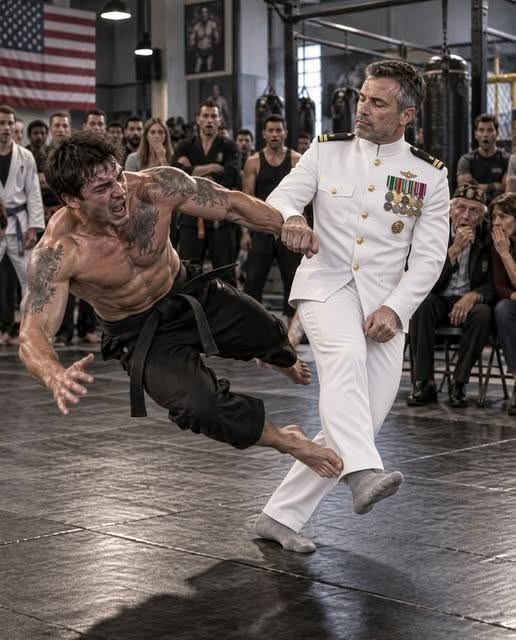
He rushed forward.
His first strike came fast.
I didn’t meet force with force.
I shifted aside.
Blake stumbled past me.
A few people gasped.
He turned, embarrassed.
—Lucky.
His second attempt was harder.
Again, I moved just enough to avoid it.
This time his own momentum carried him off balance.
I caught his arm, redirected him, and released him immediately.
No unnecessary force.
No anger.
Blake stared at me.
The room had gone completely silent.
From the bleachers, an elderly man slowly stood.
He wore a faded veterans cap.
His name was Colonel Thomas Reed.
I hadn’t seen him in eleven years.
He covered his mouth.
Then whispered:
—Damon Cross.
My stomach tightened.
Someone beside him asked:
—You know him?
Thomas kept staring at me.
—He wasn’t trained for trophies.
That was enough.
Blake heard it too.
His smile vanished.
He charged once more, desperate to regain control of the room.
I stepped away and raised one hand.
—Stop.
Something in my voice made him freeze.
—This is finished.
Blake looked around.
—You’re scared to continue?
—No.
I glanced at the parents.
—I’m refusing to turn your gym into the same thing you turned my son’s lesson into.
Nobody spoke.
I picked up my shirt.
Blake shouted behind me:
—Then why step onto the mat at all?
I turned.
—Because Evan needed to see that strength isn’t humiliating someone smaller than you.
I pointed toward the mat.
—And you needed to hear it too.
Thomas walked down from the bleachers.
He stopped several feet away.
—Nine years.
—That’s how long I wanted it to stay buried.
He nodded.
Then his eyes hardened when he looked at Blake.
—You used full-force contact on a thirteen-year-old beginner?
Blake’s face changed.
—It was controlled sparring.
Several parents immediately objected.
One mother held up her phone.
—I recorded everything.
Another parent stood.
—So did I.
That was when Blake finally understood his real problem.
It wasn’t me.
It was evidence.
I collected Evan from the truck and took him for medical evaluation.
Thankfully, he was badly bruised and frightened, but his injuries weren’t more serious.
That evening, Evan sat beside me at our kitchen table.
—Dad?
—Yeah?
—Were you really a SEAL?
I looked at him.
I had spent years hiding that part of my life because I didn’t want him growing up believing violence made a man impressive.
—A long time ago.
His eyes widened.
—Why didn’t you tell me?
—Because being your father matters more.
He thought about that.
—Could you have beaten Coach Blake?
I smiled slightly.
—That wasn’t the lesson.
—What was?
I leaned forward.
—If someone is stronger than you, that doesn’t make them entitled to hurt you.
The following week, the gym’s owners suspended Blake while they reviewed the recordings and complaints.
Several families withdrew their children.
Other parents came forward with stories about humiliating training sessions they’d previously dismissed as “tough coaching.”
Blake’s championship titles suddenly mattered much less than how he’d treated students entrusted to him.
Thomas visited my house two weeks later.
We sat on the porch.
—You disappeared well, Cross.
—I wasn’t hiding.
He smiled.
—You became a maintenance man in Cedar Falls.
—I became a father.
That wiped the smile from his face.
He nodded.
—Fair enough.
Then he handed me an envelope.
Inside was an application for a youth athletic safety program.
They needed instructors.
I pushed it back.
—No.
Thomas didn’t take it.
—Read the second page.
I did.
The program wasn’t looking for fighters.
It was looking for people who could teach discipline, de-escalation, confidence, and safe training practices.
That changed things.
Three months later, I began volunteering every Saturday.
Evan joined too.
At first, he stayed near the back.
Then one afternoon, a smaller kid froze during practice.
Everyone waited.
Evan walked over.
—It’s okay.
He showed the boy where to stand.
—You don’t have to prove anything.
I watched from across the room.
Thomas stood beside me.
—Looks like he learned something.
—So did I.
A year later, Evan competed in his first beginner tournament.
He didn’t win.
He came third.
When he walked off the mat, he was smiling.
—Dad, I lost.
—I noticed.
He laughed.
—But I didn’t panic.
I put my arm around his shoulders.
—Then you didn’t lose everything.
As we left, I saw Blake standing near the entrance.
He looked different.
Quieter.
He had lost his position at the old gym and had spent months rebuilding his coaching credentials.
He approached cautiously.
—Damon.
I waited.
He looked at Evan.
—I owe you an apology.
Evan glanced at me.
I let him decide.
Blake continued:
—What I did wasn’t coaching. I wanted people to think I was powerful, and I used you to prove it.
Evan was silent for a moment.
Then nodded.
—I accept your apology.
Blake thanked him and walked away.
Evan looked up at me.
—Was that okay?
—It was your decision.
We continued toward the truck.
For sixteen years, I’d believed strength meant surviving situations most people would never experience.
Then I spent nine years believing strength meant burying that man completely.
My thirteen-year-old son taught me something better.
Strength wasn’t proving you could hurt someone.
It wasn’t trophies.
It wasn’t fear.
Sometimes strength was simply having the power to escalate a situation—and choosing not to.
And that was the only part of my old life I ever wanted Evan to inherit.
