I ran my fingers through my hair.
A handful came loose.
Professor Wen stared at it, then at my pale face.
—What’s wrong with you?
—Lung cancer.
Her expression froze.
—What stage?
—Late stage.
The USB slipped from her fingers onto the desk.
For several seconds, she couldn’t speak.
Then she suddenly stood.
—Give me your medical records.
—Professor—
—Now.
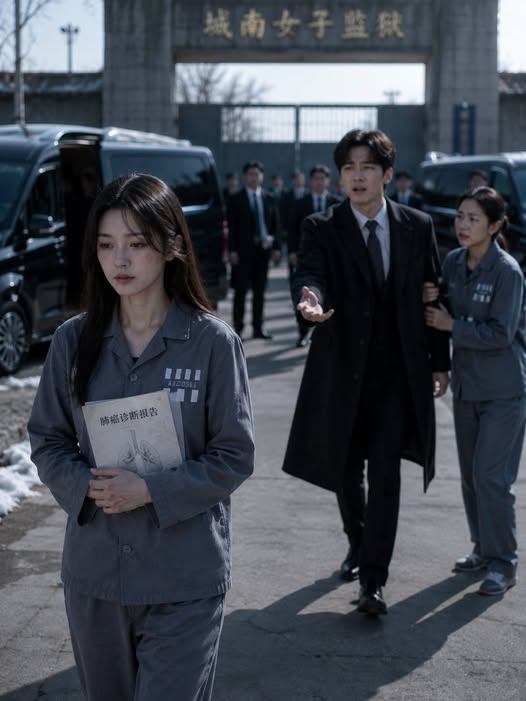
I handed her the envelope from prison.
She read page after page, her face growing darker.
—Why wasn’t this discovered earlier?
I smiled faintly.
—Prison isn’t exactly known for advanced oncology.
Her eyes filled with anger.
—If you had received proper examinations four years ago—
—There’s no point discussing that now.
I pointed toward the computer.
—Please clear Professor Zhao’s name.
That was why I had come.
Four years earlier, Professor Zhao Rong had been accused of falsifying research data in a nationally funded aerospace-materials project.
I was her graduate student.
The night before she planned to submit evidence proving the data had been replaced, she died unexpectedly.
The altered files were found on my computer.
And Song Wanyi testified that she’d seen me entering the laboratory alone.
Everyone believed her.
Including my brother.
Especially my brother.
Professor Wen opened the folders one by one.
Original experiment logs.
Time stamps.
Backups.
Internal correspondence.
Then she found the surveillance archive Professor Zhao had secretly copied.
At 11:43 p.m., Song Wanyi entered the laboratory.
At 12:17 a.m., she left carrying a hard drive.
Professor Wen covered her mouth.
—This proves everything.
I nodded.
—That’s why they wanted the USB.
—Who are “they”?
Before I could answer, someone knocked violently on the door.
Professor Wen opened it.
Jiang Sixing stood outside.
He must have followed me from prison.
His eyes immediately landed on me.
Then on the USB.
—Niansu.
I looked away.
Professor Wen recognized him.
Her expression turned cold.
—Mr. Jiang.
He stepped inside.
—I need to take my sister home.
—She isn’t going anywhere.
Professor Wen placed my medical records on the table.
—Do you know what condition she’s in?
His jaw tightened.
—I know.
—No.
Professor Wen’s voice suddenly rose.
—You know a diagnosis. You don’t know what happened to her.
She pushed the records toward him.
—The earliest abnormalities appeared during her first year in prison. By the second year, the lesion had progressed. Had she received proper specialist care earlier, her situation could have been very different.
Jiang Sixing’s face drained of color.
I stood.
—Professor Wen, I’ll leave the USB with you.
My brother grabbed my wrist.
—Niansu, wait.
I looked down at his hand.
He immediately released me.
Four years ago, I had begged him.
Now he seemed afraid even to touch me.
—What do you want?
His lips trembled.
—A chance to investigate everything again.
I almost laughed.
—Now?
He flinched.
—Four years ago I asked you to investigate.
Snow had covered the steps outside Jiang House that winter.
I had knelt there for three days.
I remembered looking through the glass doors and seeing Song Wanyi sitting beside him.
She cried.
He believed her.
I begged.
He called security.
—Niansu…
—Professor Zhao is dead.
I looked directly at him.
—My career is gone. Four years of my life are gone. And I’m dying.
His eyes reddened.
—What exactly do you want me to give you another chance to fix?
He had no answer.
I walked past him.
That evening, Professor Wen submitted the USB to the university disciplinary committee and police.
Within forty-eight hours, the case exploded.
The original research data matched Professor Zhao’s published methodology.
Digital records showed that the files used against me had been altered.
The laboratory footage placed Song Wanyi at the scene.
Most importantly, investigators recovered an audio recording.
Professor Zhao’s voice.
“If anything happens to me, investigate Song Wanyi and the Shengyuan Research Fund.”
The Shengyuan Research Fund belonged to a subsidiary of Jiang Group.
My brother’s company.
Jiang Sixing came to my rented room that night.
He looked as though he hadn’t slept.
—Did you know?
—Yes.
—Why didn’t you tell me?
I stared at him.
Then I laughed.
It was the first genuine laugh I’d given him since leaving prison.
—I did.
His face froze.
—Four years ago.
Silence.
—I told you the altered data was connected to a Jiang Group subsidiary.
—I told you Professor Zhao was investigating Shengyuan.
—I told you Song Wanyi was lying.
My voice remained calm.
—You said I was jealous of your adopted sister.
His knees seemed to lose strength.
He sat down.
For the first time, Jiang Sixing looked broken.
—I’m sorry.
I picked up my medicine.
—Don’t apologize to me.
—Then what can I do?
—Nothing.
That answer frightened him.
Over the following month, he tried everything anyway.
He contacted specialists.
He offered overseas treatment.
He moved meetings just to sit outside my hospital room.
I accepted treatment because Professor Wen insisted there were options worth trying to improve my condition and comfort.
But I accepted nothing from Jiang Sixing personally.
No house.
No money.
No reconciliation.
Meanwhile, Song Wanyi disappeared.
Police traced her to an airport.
She was stopped before leaving the country.
Her questioning uncovered the rest.
Shengyuan had secretly funded a competing research team.
Professor Zhao’s results threatened patents worth billions.
Song Wanyi had been used to access the laboratory and replace key data.
She had expected Professor Zhao to lose her reputation.
She hadn’t expected the investigation to become much larger.
And she had chosen me as the easiest person to blame.
But one question remained.
Why had Jiang Sixing believed her so completely?
The answer arrived in an old email recovered from his assistant’s archive.
Song Wanyi had sent him photographs supposedly showing me receiving money from Shengyuan.
They were fabricated.
Yet Jiang Sixing had never ordered forensic verification.
He had seen what appeared to be betrayal and immediately believed the worst of me.
That was his real mistake.
Not being deceived.
Choosing not to question a lie when his own sister begged him to.
Three months after my release, the court formally overturned my conviction.
Professor Zhao’s academic reputation was restored.
My name was cleared.
When the judge announced it, Professor Wen cried.
I didn’t.
Outside the courthouse, dozens of reporters waited.
Jiang Sixing stood far behind them.
He didn’t approach.
Perhaps he’d finally learned that remorse didn’t entitle him to forgiveness.
Professor Wen took my arm.
—Where do you want to go?
I thought about it.
Then smiled.
—Professor Zhao’s laboratory.
The university had restored it.
On the desk was an old photograph of Professor Zhao and me.
I was twenty.
Healthy.
Smiling.
Convinced that truth always won quickly.
I touched the frame.
—Professor, I came back.
Professor Wen turned away to hide her tears.
My treatment gave me more time than the prison doctor had predicted.
Not certainty.
Not a miracle.
Time.
And I decided that was enough.
I spent it organizing Professor Zhao’s remaining research so younger students could continue it.
I wrote down everything I knew.
I watched her name return to textbooks and research databases.
Six months became nine.
Nine became fourteen.
One rainy afternoon, Jiang Sixing appeared outside the laboratory.
He had no bodyguards.
No luxury cars.
He held only an umbrella.
—I won’t come in.
He said it before I could stop him.
—I just wanted to give you something.
He placed an envelope on the windowsill.
Inside was the old petition I’d written from detention four years earlier.
“Brother, please investigate once. I didn’t do it.”
At the bottom was a newly added sentence in his handwriting.
“I should have believed you enough to check.”
I folded the paper.
—Yes.
His eyes filled with tears.
That single word seemed to hurt more than anger.
He nodded.
Then turned away.
—Jiang Sixing.
He stopped.
I hadn’t called his name since leaving prison.
I looked at his back.
—I don’t hate you anymore.
He turned hopefully.
I finished:
—But that doesn’t mean we can return to before.
The hope disappeared.
Still, he nodded.
—I understand.
This time, I believed him.
Two years later, Professor Wen and I stood inside a new research center bearing Professor Zhao’s name.
My health remained fragile.
But I was still there.
That mattered.
On opening day, a young student asked me:
—Professor Jiang, why did you preserve the original USB for four years when keeping it was so dangerous?
I looked through the glass wall at Professor Zhao’s photograph.
—Because someone believed me when nobody else did.
The student smiled.
I did too.
For years, I thought leaving prison would be the end of my story.
Then I thought clearing my name would be.
Neither was true.
The most important thing I recovered wasn’t my reputation.
It wasn’t my freedom.
And it wasn’t my brother.
It was the person I had been before everyone told me I was guilty.
The girl who still believed truth was worth protecting.
Four years in prison had taken almost everything from me.
But in the end, it failed to take that.
