When I pulled my suitcase into the living room, Guo Hao Yu barely looked up.
“Everything packed?”
“Yes.”
“Leave the key on the table.”
I placed it beside him.
Four years of marriage ended with the soft click of a key touching glass.
I walked toward the door.
Behind me, he suddenly said:
“Phuong Vu.”
I stopped.
For one foolish second, I thought he might apologize.
Instead, he said:
“Don’t come back after I marry Vi Vi.”
I closed my eyes.
Then I opened the door.
“Don’t worry.”
I stepped outside.
“I won’t.”
That night, I stayed in a cheap hotel near the railway station.
The nausea returned the next morning.
This time, I bought a pregnancy test.
Two lines appeared.
I stared at them until my vision blurred.
The doctor confirmed it that afternoon.
Seven weeks.
I was pregnant.
I remembered Hao Vu’s words.
Even if you are really pregnant, I don’t need this baby.
So I didn’t call him.
I didn’t call his mother either.
I simply packed my belongings and returned to my hometown.
Two weeks later, Guo Hao Vu married Bach Vi Vi.
Their wedding photographs appeared everywhere.
The Bach family invested heavily in his company.
His career rose rapidly.
And I disappeared from his world.
But my life didn’t end.
It restarted.
My son was born the following year.
I named him Minh An.
Peace.
Because that was what I wanted most.
My parents helped me care for him while I returned to work.
The strange thing was that after leaving Hao Vu’s company, I discovered I wasn’t incompetent at all.
I had simply spent four years being told that I was.
I joined a small agricultural technology company as an accountant.
Within eighteen months, I became finance manager.
Two years later, I was transferred to Bangkok to help open a regional office.
By the fourth year, I could afford a comfortable apartment, childcare and regular support for my parents.
I never became extraordinarily wealthy.
I simply became independent.
And that felt richer than anything Hao Vu had ever given me.
I thought we would never meet again.
Then Minh An developed a high fever.
I took him to the hospital late one afternoon.
After the doctor examined him, I carried my sleepy little boy toward the pharmacy.
“Mommy…”
He wrapped his arms around my neck.
“I’m thirsty.”
“I’ll get you water.”
I turned the corner.
And stopped.
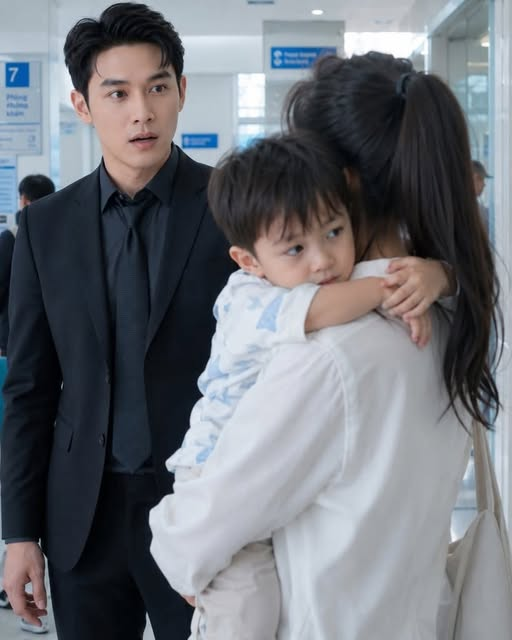
Guo Hao Vu was standing ten meters away.
For four years, I had imagined this possibility.
Yet when it happened, I felt surprisingly calm.
He looked different.
More expensive clothes.
Sharper features.
But his eyes were exactly the same.
Those eyes moved from my face to the little boy in my arms.
Then they froze.
Minh An was almost four.
Old enough for the resemblance to be impossible to ignore.
Same eyebrows.
Same nose.
Even the tiny dimple beside his mouth was identical to Hao Vu’s.
He walked toward me slowly.
“Phuong Vu?”
I adjusted my hold on my son.
“Mr. Guo.”
His face changed at the formality.
Then he looked at Minh An again.
“How old is he?”
“Almost four.”
His breathing stopped.
“Almost…”
He calculated immediately.
I saw the exact moment he understood.
“Is he mine?”
I said nothing.
“Phuong Vu.”
His voice trembled.
“Is this my son?”
Minh An woke fully and looked at him.
“Mommy, who is that?”
I touched his hair.
“Someone Mommy used to know.”
Hao Vu went pale.
Before he could speak again, another voice came from behind him.
“Hao Vu?”
Bach Vi Vi approached.
She stopped when she saw me.
Then she saw Minh An.
Her expression changed completely.
“So it’s true.”
I frowned.
“What?”
She looked at Hao Vu.
“You’ve been searching for her?”
My eyes returned to him.
Hao Vu didn’t deny it.
Vi Vi laughed bitterly.
“Three years, Phuong Vu.”
She looked at me.
“He’s been searching for you for three years.”
I felt nothing like the satisfaction I might once have imagined.
Only exhaustion.
“That’s no longer my concern.”
I started walking.
Hao Vu stepped in front of me.
“Please.”
It was the first time I had ever heard him say that word to me.
“Just tell me.”
I looked at the man who had once told me his family didn’t need the child of a country woman.
“Yes.”
His eyes reddened.
“Minh An is your biological son.”
He staggered backward half a step.
Then he reached toward the boy.
I moved away.
“No.”
His hand stopped.
“You don’t get to become his father in a hospital hallway because you finally saw his face.”
“Phuong Vu…”
“You rejected him before you knew he existed.”
His voice broke.
“I didn’t know.”
“You made sure I understood what would happen if I was pregnant.”
He remembered.
Of course he remembered.
His face became white.
“I was angry.”
“And I was your wife.”
I walked past him.
This time, he didn’t stop me.
But the next morning, he appeared outside my apartment.
I had no idea how he found the address.
He looked as though he hadn’t slept.
“I want to take responsibility.”
I almost laughed.
“Four years late?”
“I’ll compensate you.”
“There it is.”
He looked confused.
“You still think everything can be solved with money.”
“I didn’t mean—”
“I don’t need your house.”
I counted calmly.
“Your company. Your mother’s approval. Your connections. Or your money.”
I opened the door wider so he could see the modest but warm apartment behind me.
Children’s drawings covered the refrigerator.
Minh An’s toys filled one corner.
On the wall hung a photograph of my parents with their grandson.
“This is what you told me I could never build without you.”
Hao Vu stared inside.
For the first time, he understood what he had missed.
Not pregnancy.
Not childbirth.
Almost four entire years.
First steps.
First word.
First birthday.
The first day of kindergarten.
Everything.
“I want to know him.”
“That decision isn’t only yours.”
“I know.”
Surprisingly, he didn’t argue.
He lowered his head.
“I’ll do whatever the law requires.”
That was when I finally looked at him carefully.
“What happened to Bach Vi Vi?”
His silence told me enough.
Their marriage hadn’t become the perfect alliance everyone expected.
The Bach family’s investment saved his company, but it also gave them enormous influence over it.
Hao Vu had gained capital.
And lost control.
As for the marriage, Vi Vi had moved out months earlier.
Their divorce proceedings had already begun.
I didn’t ask for details.
His failed second marriage wasn’t proof that our first one should be restored.
Over the following months, everything was handled carefully.
No dramatic reconciliation.
No instant forgiveness.
No pretending the past hadn’t happened.
Hao Vu began seeing Minh An gradually and appropriately.
At first, my son called him Uncle Guo.
Hao Vu never corrected him.
That, more than his apologies, showed me he had finally learned something.
One evening, after returning Minh An home, Hao Vu stood outside my door.
“He asked me today why I wasn’t there when he was a baby.”
My hand tightened around the door.
“What did you say?”
“The truth.”
I looked at him sharply.
“An age-appropriate truth.”
He swallowed.
“I told him I made serious mistakes and wasn’t there when I should have been.”
For a moment, neither of us spoke.
Then he took an old object from his pocket.
The necklace.
The anniversary gift I had left on the dressing table four years ago.
“I kept it.”
I didn’t reach for it.
“Why?”
“Because the morning after you left, I found out you hadn’t taken anything I gave you.”
His eyes lowered.
“That was when I first realized you hadn’t married me for money.”
I almost smiled at the absurdity.
“It took you four years of marriage to learn that?”
“No.”
He looked at me.
“It took losing you.”
He held out the necklace.
I gently closed his fingers around it.
“Keep it.”
His expression fell.
“Some things belong to the life we had.”
I looked toward my apartment, where Minh An was laughing at a cartoon.
“And some things belong to the life that came afterward.”
I closed the door softly.
There was no revenge.
No dramatic reunion.
Hao Vu eventually became part of his son’s life.
But he never became my husband again.
Because forgiveness and reconciliation are not the same thing.
Four years earlier, I had walked out of his house with one suitcase and nothing in my name.
He thought I had lost everything.
In reality, that night I had carried away the only thing I truly needed.
Myself.
And months later, without knowing it, I had carried something else too.
A little boy who would one day teach both of us that family isn’t determined by who owns the house, earns the most money, or arrives too late demanding another chance.
It’s determined by who stays.
