Olivia held up the marriage certificate.
—Then tomorrow I’ll go.
Nathan’s face changed instantly.
—Olivia, enough.
She laughed.
—What? Emma offered me her place.
—There is no place to offer!
For the first time that evening, Nathan sounded genuinely angry.
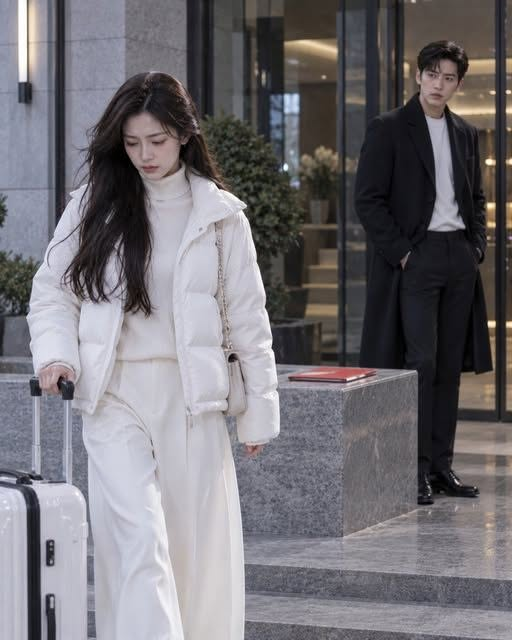
But I was already dragging my suitcase toward the elevator.
—Emma!
Nathan caught up with me.
—Where are you going?
—Away.
—Our wedding is tomorrow.
I pressed the elevator button.
—No. Your wedding was yesterday.
The doors opened.
Nathan stepped inside after me.
—Listen to me. I’ll fix this.
I looked at him.
—You cannot legally marry me tomorrow.
That finally silenced him.
For six years, I’d imagined my wedding day hundreds of times.
Never once had I imagined spending the night before it calling vendors to cancel everything.
But that was exactly what I did.
Venue.
Flowers.
Photographer.
Makeup artist.
Guests.
My parents were stunned.
Nathan’s mother cried.
His father demanded that we keep everything quiet for the family’s reputation.
I refused.
At nine that evening, I sent one message to everyone invited:
“The wedding will not take place due to circumstances that make the marriage impossible. Thank you for understanding.”
I didn’t mention Olivia.
I didn’t humiliate Nathan.
I simply stopped protecting him.
That turned out to be enough.
By midnight, everyone knew anyway.
Because Olivia posted a photograph.
Two red marriage certificates beside two glasses.
Caption:
“Some jokes become unforgettable memories.”
Nathan called me seventeen times.
I answered the eighteenth.
—Tell Olivia to delete that.
—Why are you telling me?
Silence.
Then he said:
—Because she won’t listen to me.
I almost laughed.
—And you thought she would listen to me?
—Emma, my parents are furious. The company board has heard about it. Everyone thinks—
—Nathan.
I interrupted him.
—You are Olivia’s husband.
Deal with your wife yourself.
I hung up.
The next morning, while the ballroom where I should have married Nathan stood empty, I went to breakfast with my parents.
My mother kept looking at me.
Finally she asked:
—Are you really okay?
I stirred my coffee.
—Not yet.
That was the truth.
Leaving someone didn’t erase six years overnight.
I still remembered Nathan bringing medicine when I was sick.
Waiting outside my office in the rain.
Learning to cook the noodles I liked.
There had been good years.
That was what made betrayal painful.
You weren’t mourning only what someone did.
You were mourning everything beautiful that could no longer outweigh it.
Three days later, Nathan appeared outside my parents’ house.
He looked exhausted.
—Olivia agreed to cooperate with the divorce process.
—Good.
—That’s all you’re going to say?
—What else is there?
He stepped closer.
—When it’s finalized, we’ll reschedule our wedding.
I stared at him.
He truly believed that.
—Nathan, I’m not postponing our wedding.
His expression slowly changed.
—I’m cancelling our relationship.
—Because of one drunken mistake?
—Because of six years of them.
He frowned.
So I reminded him.
The vacations Olivia joined without asking me.
The birthdays where she sat beside him because “that was always her place.”
The night she called at two in the morning and he left our anniversary dinner because she had argued with her boyfriend.
Every time I complained, Nathan gave me the same answer.
“She is practically my sister.”
I looked directly at him.
—Apparently not enough of a sister to prevent you from marrying her.
His face turned pale.
—Nothing happened between us.
—That’s not the point.
And it wasn’t.
I didn’t need to imagine physical betrayal.
What I knew was enough.
Nathan had spent years asking me to accept boundaries that would have been unacceptable if Olivia had been called what she actually was:
another woman with extraordinary access to my fiancé.
—You expected me to tolerate everything because you knew I’d stayed for six years, I said.
His eyes reddened.
—I love you.
—Then you became careless with something you thought couldn’t leave.
He had no response.
A month later, his marriage to Olivia entered the legal process required to end it.
By then, I had already moved apartments.
I returned the engagement ring through his attorney.
Olivia contacted me once.
Her arrogance was gone.
“I never wanted Nathan. We were drunk and stupid. I thought you’d forgive him like always.”
I read that sentence several times.
Like always.
Those two words told me more than the entire apology.
She had behaved without limits because Nathan had taught her that I would absorb the consequences.
I replied:
“Whether you wanted him is irrelevant. Keep me out of your marriage and your divorce.”
Then I blocked her.
Nathan continued trying for almost a year.
Flowers arrived at my office.
I returned them.
He wrote letters.
I didn’t answer.
He waited outside my building once.
I walked past him.
Eventually, he stopped.
Two years later, I saw Olivia again at a mutual friend’s engagement party.
She approached me awkwardly.
—Emma.
—Olivia.
She hesitated.
—Nathan and I don’t speak anymore.
I nodded.
It wasn’t information I needed.
—He blamed me for losing you for a long time.
I looked at her.
—That was another mistake.
She seemed surprised.
—You didn’t end my relationship.
I picked up my glass.
—Nathan did.
Across the room, someone suddenly shouted.
The bride-to-be had thrown a small practice bouquet.
It flew over several people.
And landed directly in my hands.
Everyone laughed.
For one strange second, I remembered my cancelled wedding.
The invitations.
The dress.
The man I’d thought would become my husband.
Then a woman beside me joked:
—Careful. Apparently you’re next.
I looked down at the flowers.
This time, I didn’t hand them to anyone.
I smiled.
—Maybe.
Not because I was desperate to marry.
Not because catching flowers promised anything.
But because Nathan had taught me something useful without intending to.
Six years invested in the wrong relationship were not a reason to spend a seventh.
The night before my wedding, I thought I’d discovered that my fiancé belonged to another woman.
Eventually, I understood something more important.
Nathan didn’t belong to Olivia.
And he didn’t belong to me.
He belonged to himself.
His choices were his responsibility.
And my choice was finally mine.
So I kept the bouquet.
Not as a promise that another wedding was coming.
But as proof that when the wrong one disappeared, I hadn’t lost my future.
I had gotten it back.
