Back then, I really had been like a madwoman.
But no one ever asked what had driven me to become that way.
Four years ago, Huong Noan could make Co Truong Canh abandon anything with a single phone call.
My birthday dinner.
Our anniversary.
Even the day my mother was admitted to the hospital.
Whenever I questioned him, he gave me the same answer.
“Giang Du, stop making trouble.”
So eventually I did make trouble.
I cried.
I argued.
I demanded explanations.
And every outburst became evidence that I was unreasonable, while everything that happened before it was conveniently forgotten.
After the divorce, I finally understood something.
When only one person’s anger is remembered, the person who caused it can easily pretend to be innocent.
I had no interest in explaining that history to strangers anymore.
I took Giang Tranh home.
But that evening, someone knocked on my door.
When I opened it, Co Truong Canh stood outside.
He had changed out of his suit.
In his hand was a small paper bag.
“What are you doing here?”
“I brought something for Tranh Tranh.”
I looked at the bag.
Children’s picture books.
“You should be at the hospital.”
His expression stiffened.
“My wife and the baby are being looked after.”
“Then go back.”
“Giang Du.”
His voice lowered.
“I just discovered today that I have a daughter.”
“And she discovered today that the stranger in the corridor is her father.”
That silenced him.
I didn’t want Giang Tranh confused.
She had just undergone treatment.
She needed stability, not an adult suddenly appearing because guilt had finally caught up with him.
“You can meet her,” I said eventually.
His eyes lifted.
“But slowly.”
“I agree.”
“And don’t make promises you can’t keep.”
“I won’t.”
“Don’t compensate for four missing years with expensive gifts.”
His fingers tightened around the paper bag.
“Okay.”
“And your current family must know.”
This time he hesitated.
I immediately reached for the door.
“Then there’s nothing to discuss.”
“No.”
He stopped me.
“They’ll know.”
The next weekend, he came again.
Giang Tranh sat on the carpet building a wooden castle.
Co Truong Canh stood awkwardly beside the sofa.
The man who could control an entire boardroom didn’t seem to know what to do with a three-year-old girl.
Finally, Tranh Tranh looked up.
“Mom says you’re my father.”
His throat moved.
“Yes.”
“Where were you before?”
One sentence.
Four years of absence.
Co Truong Canh looked at me.
I didn’t rescue him.
He crouched in front of her.
“I didn’t know you were here.”
Tranh Tranh thought about this seriously.
“Why?”
His face changed.
“Because your mother and I separated before you were born.”
She nodded as if evaluating a business proposal.
Then she held out one wooden block.
“Can you build?”
Co Truong Canh took it.
“I can try.”
“You put that there.”
He obeyed.
Five seconds later, the tower collapsed.
Giang Tranh stared at him.
“You’re not very good.”
For the first time, I saw Co Truong Canh laugh without arrogance.
“No.”
He rebuilt it.
That was how their relationship began.
Not with a dramatic reunion.
With wooden blocks.
Two months later, his wife asked to meet me.
Her name was Linh An.
I expected hostility.
Instead, she arrived alone and placed a folder on the table.
“I know about Giang Tranh.”
I waited.
She continued.
“Truong Canh told me everything.”
“Everything?”
Her expression became complicated.
“Everything he was willing to admit.”
That distinction mattered.
“I didn’t come to ask you to disappear,” she said.
“Good, because I wouldn’t.”
“I know.”
She looked tired.
“I came because his mother has started asking questions.”
My hand stopped.
Co Truong Canh’s mother had never liked me.
To her, I had been unsuitable from the beginning.
Wrong family.
Wrong background.
Too stubborn.
Too unwilling to lower my head.
“What questions?”
“Whether Giang Tranh should be brought into the Co family.”
I almost laughed.
“She isn’t an object to be brought anywhere.”
“I told them the same thing.”
That surprised me.
Linh An looked directly at me.
“I have a newborn son. I know exactly what they’re thinking.”
Inheritance.
Family name.
Bloodline.
The same old obsession.
“They’re already discussing what belongs to which child.”
My voice turned cold.
“Giang Tranh doesn’t need their money.”
“I believe you.”
She pushed the folder toward me.
Inside were copies of messages from the Co family group.
I read three pages.
Then stopped.
One sentence from his mother was enough.
A daughter raised outside the family cannot suddenly return and compete with our grandson.
I closed the folder.
“I don’t want anything.”
Linh An nodded.
“I know.”
“But I want Truong Canh to understand what his family is doing before someone hurts both children.”
For the first time, I saw her not as the woman who replaced me.
But as another woman standing inside the same family system I’d escaped.
That evening, I called Co Truong Canh.
“Come over.”
He arrived twenty minutes later.
I placed the messages before him.
He read them silently.
His face became colder with every page.
“I didn’t know.”
I almost laughed.
“You didn’t know many things.”
He didn’t defend himself.
The following morning, he called a family meeting.
I wasn’t there.
I didn’t need to be.
Later, Linh An told me what happened.
Co Truong Canh made one thing clear.
Neither child would be used against the other.
His son would not become a weapon against his daughter.
His daughter would not be dragged into family politics because of money.
And nobody was allowed to contact Giang Tranh without my permission.
His mother was furious.
For once, he didn’t ask a woman to endure her anger for him.
He handled it himself.
That was when I finally began to believe he might actually have changed.
Not enough to erase our past.
Enough to become a better father.
Half a year passed.
Giang Tranh recovered well.
Her follow-up appointments became less frequent.
Co Truong Canh attended when his schedule allowed.
Sometimes Linh An came too, carrying her baby.
There was no dramatic rivalry between us.
No battle over a man.
That part of my life was over.
One afternoon, while the children were together, Co Truong Canh asked me to walk outside.
We stopped beneath the hospital trees.
“I owe you an apology.”
“You’ve apologized before.”
“Not for the right thing.”
I looked at him.
He continued quietly.
“I used to tell everyone you were emotional.”
“You were.”
“I told myself you destroyed our marriage with arguments.”
He paused.
“But I never told anyone what happened before those arguments.”
I said nothing.
“I made you feel insecure.”
“I dismissed you.”
“I let other people interfere.”
“And whenever you finally exploded, I used your reaction to prove you were the problem.”
His eyes were red.
“That was unfair.”
Four years earlier, I would have cried hearing those words.
Now I simply felt tired.
“Why are you telling me this?”
“Because I heard those nurses.”
He looked toward the hospital.
“They repeated the version of our marriage that I allowed everyone to believe.”
Finally.
He understood.
“I can’t change what happened,” he said.
“No.”
“But I can stop lying about it.”
That mattered more than I expected.
Then he asked:
“If things had been different…”
“No.”
I stopped him gently.
“Don’t ask.”
He understood.
We were never going back.
Some relationships can be repaired.
Others can only be understood after they end.
Ours belonged to the second kind.
Years passed.
Giang Tranh grew stronger.
She became energetic, stubborn and frighteningly good at mathematics.
She loved her younger half-brother.
She also loved correcting her father’s grammar in text messages.
Co Truong Canh never became the center of her life.
But he became part of it.
Consistently.
Quietly.
Without demanding gratitude.
And that was enough.
One spring afternoon, I returned to the same hospital for Giang Tranh’s routine follow-up.
She came running out of the consultation room holding her report.
“Mom!”
I stood.
“What did the doctor say?”
She grinned.
“Everything looks good.”
Behind her came Co Truong Canh.
He smiled too.
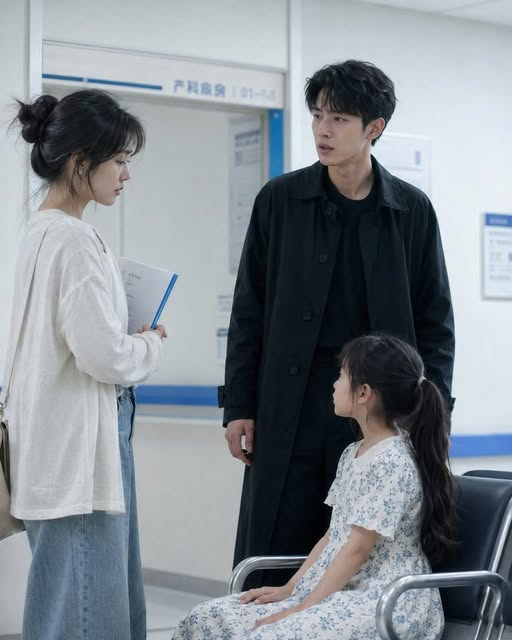
For one strange second, I remembered our first meeting in that corridor four years after the divorce.
The shock in his eyes.
The little girl in the floral dress.
The question:
“Is this our child?”
Back then, I thought fate had brought him back to reopen an old wound.
I was wrong.
Sometimes the past returns not because you’re supposed to return to it.
Sometimes it returns because there is finally something left to resolve.
Co Truong Canh walked beside his daughter toward the elevator.
At the doors, Giang Tranh turned around.
“Mom, hurry!”
“Coming.”
I followed.
Not behind my ex-husband.
Not back toward our marriage.
But beside my daughter, toward the life we’d built after it.
The rain from four years ago had stopped long before.
And this time, none of us needed an umbrella.
