I gently covered Niem An’s hand with mine.
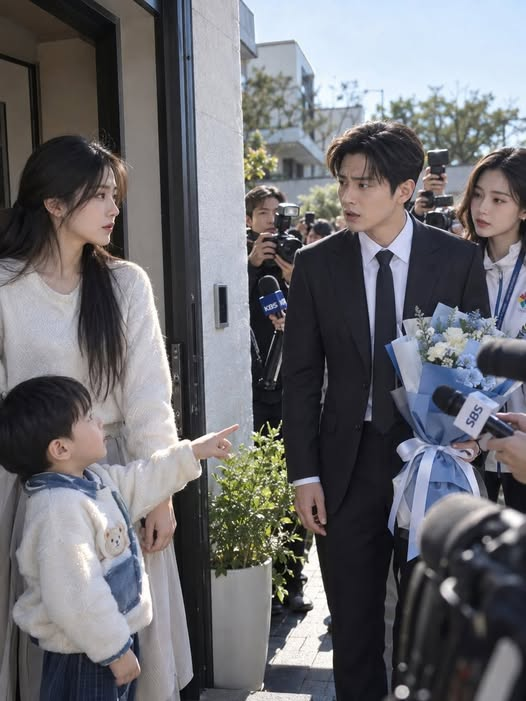
—Don’t be afraid. Mom is here.
Luc Trach Xuyen’s face stiffened.
Those words seemed to strike him harder than our son’s question.
A father should have been the person a child ran toward.
Instead, his own son needed protection from him.
One reporter immediately raised the microphone.
—Coach Luc, did you know your wife was pregnant when you left the country?
Another followed.
—Have you visited your son during these four years?
—Did you financially support him?
—Why doesn’t he recognize you?
Trach Xuyen’s triumphant return was collapsing in front of the cameras.
He looked at me sharply.
—Let’s talk inside.
—There’s nothing to discuss today.
His jaw tightened.
—This is my home.
I almost laughed.
—Was.
One word.
That was enough.
His young student, Linh Kha, stepped forward.
She was still wearing the championship jacket.
—Please don’t misunderstand Coach Luc. These four years were extremely difficult. He sacrificed almost everything for our team.
I looked at her.
—Almost everything?
She stopped.
I lowered my eyes toward Niem An.
—Some things weren’t his to sacrifice.
Trach Xuyen immediately interrupted.
—Enough.
He reached toward our son.
Niem An hid completely behind me.
—Mom, I want to go inside.
—Alright.
I began closing the door.
Trach Xuyen caught it.
—I’m his father.
I looked directly into his eyes.
—Then tell me his birthday.
Silence.
His hand slowly loosened.
—His favorite food?
Nothing.
—What is he afraid of at night?
Still nothing.
The reporters had stopped asking questions.
They didn’t need to.
Every second of silence was already an answer.
I closed the door.
That night, Trach Xuyen called thirty-seven times.
I didn’t answer.
The next morning, his triumphant homecoming dominated the news.
But nobody cared about the gold medal anymore.
Everyone wanted to know why a celebrated coach’s three-year-old son had called him “uncle.”
At noon, he returned.
Alone.
No cameras.
No student.
No championship uniform.
He stood outside wearing an ordinary black shirt.
—I want to see Niem An.
—He’s sleeping.
—I can wait.
I studied him.
Four years earlier, those words would have made me happy.
Now they almost sounded ridiculous.
—You had four years to wait.
His eyes darkened.
—I was building our future.
—No.
I shook my head.
—You were building yours.
He became silent.
Then he said:
—I sent money.
—I returned it.
—Why?
—Because what I needed was a husband, not a bank transfer.
His expression changed.
The night before he left, I’d asked him to delay his departure until after the baby’s birth.
He refused.
“This opportunity won’t wait.”
He was right.
The opportunity hadn’t waited.
But neither had our child.
Niem An had been born.
Learned to crawl.
Taken his first steps.
Said his first word.
Had fevers.
Started kindergarten.
Life had continued perfectly well without Luc Trach Xuyen.
—I thought you’d understand, he whispered.
I smiled faintly.
—You always thought that.
Understand his ambition.
Understand his silence.
Understand why training mattered more.
Understand why Linh Kha needed him beside her.
Apparently, being his wife meant understanding everything while receiving almost nothing.
Trach Xuyen lowered his voice.
—Give me a chance to be his father.
I looked at him for a long time.
—You can meet him.
Hope immediately appeared in his eyes.
I continued:
—But you don’t get to demand affection.
His expression froze.
—No forced hugs. No telling him what to call you. No reporters. No photographs for publicity.
—He’s my son.
—Exactly.
I stepped closer.
—So for once, think about what he needs instead of what you want.
He agreed.
The first visit lasted twenty minutes.
Niem An called him Uncle Luc.
Trach Xuyen flinched but said nothing.
The second time, he brought an expensive remote-controlled car.
Niem An played with the cardboard box instead.
The third time, he brought nothing.
He sat on the carpet and helped our son build a wooden train.
That was the first successful visit.
Months passed.
Something unexpected happened.
Trach Xuyen stopped demanding.
He simply appeared when he promised.
When Niem An performed at kindergarten, he sat quietly in the last row.
When the boy became sick, Trach Xuyen brought medicine and left when I said we needed rest.
One evening, Niem An suddenly asked:
—Are you really my dad?
Trach Xuyen froze.
—Yes.
—Then where were you?
The man who could answer dozens of hostile reporters without hesitation couldn’t answer a three-year-old child.
Finally, he whispered:
—Far away.
—Why?
Trach Xuyen looked at me.
I gave him nothing.
No rescue.
No excuse.
He turned back toward his son.
—Because I made a bad decision.
That was the first time he said it.
Not “training.”
Not “career.”
Not “sacrifice.”
A bad decision.
A year after his return, he asked me whether we could start again.
I shook my head.
—No.
His face went pale.
—Even after everything I’ve done?
—Everything you’ve done recently is for Niem An.
I smiled gently.
—Being a better father doesn’t automatically make you my husband again.
He lowered his head.
This time, he accepted the answer.
Years passed.
Eventually, Niem An stopped calling him Uncle Luc.
One morning, without anyone prompting him, he shouted:
—Dad!
Trach Xuyen stood completely still.
Then he turned away for several seconds before answering.
That title took him years to earn.
But the title of husband never returned.
Later, during an interview, a reporter asked Trach Xuyen about the greatest defeat of his career.
He remained silent for a long time.
Then he answered:
—I once believed opportunities couldn’t wait, but family always would.
I saw the interview only once.
Then I turned off the television.
Across the room, Niem An was packing his backpack for a weekend with his father.
He was happy.
That was enough for me.
Four years earlier, Luc Trach Xuyen had left because he believed becoming a champion would guarantee that everything he abandoned would still be waiting when he returned.
Instead, he came home with a gold medal and discovered his son didn’t recognize him.
His wife no longer waited for him.
And the lock I changed after he left never needed his key again.
Not because I hated him.
But because during those four years when he was learning how to win before the entire world—
I had learned how to build a life without him.
